On May 6, 2026, in a corporate filing that read like a footnote and landed like a tectonic shift, xAI ceased to exist as a standalone company. It was folded into SpaceX as a new division called SpaceXAI, dragging Grok, Grokipedia, the Colossus supercomputer, and the social network formerly known as Twitter along with it. The richest man in the world had quietly merged his AI lab into his rocket company, which already owned his social network, which already owned his media narrative.
Twelve days later, the implications are still being absorbed. They shouldn't be. This is the move Musk has been telegraphing for years. The companies were never really separate. They were tentacles.
The Mission Behind the Empire
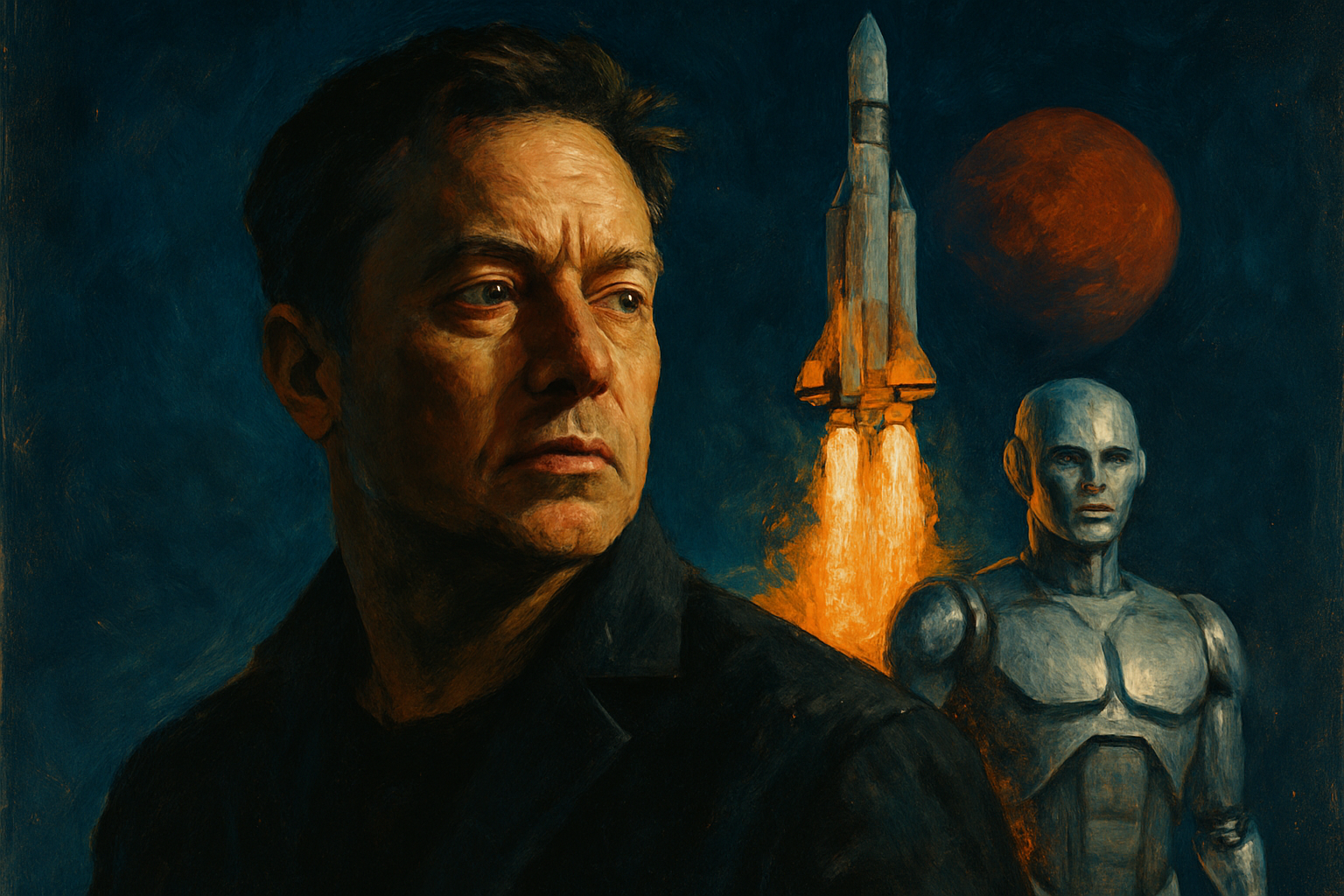
Musk does not run businesses the way other CEOs run businesses. He runs vehicles for a worldview. Pull on any thread and you find the same four obsessions stitched underneath: make humanity multi-planetary, keep AI from killing us by building it himself, decarbonize the planet so the planet survives long enough for the first two to matter, and keep the public square open enough that nobody can stop him from doing any of it.
Every company maps onto a piece of that thesis. SpaceX is the backup drive for the species. Tesla is the energy and labor layer that funds it and powers it. xAI is the cognition layer that runs on top. Neuralink is the bandwidth between human and machine. X is the loudspeaker. The connections matter more than the org charts. Tesla's battery and solar division is, in effect, SpaceX's future Martian power grid. Neuralink only becomes interesting in a world with a model like Grok on the other end of the cable.
The Companies, Today
SpaceX and Starship. As of the last test flight on October 13, 2025, Starship had flown eleven times — six successes, five failures. Block 4, when it arrives, is designed to put 200 tons in low Earth orbit, more than ten times the current operational maximum of any other vehicle. The economic engine underneath all of this is Starlink, now SpaceX's dominant revenue line and the single most important reason Musk can afford to lose rockets while learning how to land them.
Tesla. Full Self-Driving remains stuck in the gap between impressive demo and works without a human in the loop. The robotaxi pivot is the bet. Optimus, shown publicly as v.2 in November 2025, is the moonshot — Musk reiterated on the Q1 2026 earnings call that he expects it to become the largest product Tesla, or anyone, has ever sold. The humanoid robot business is no longer a side project. It is the thesis.
SpaceXAI (formerly xAI). Grok is the consumer surface. Colossus, the Memphis supercomputer cluster, is the moat. The merger consolidates compute, capital, and chips under one roof. Grokipedia, launched as a Wikipedia challenger, is the ideological front — an attempt to seize the encyclopedia layer the way X tried to seize the news layer.
Neuralink. Noland Arbaugh became the first human Neuralink recipient on January 29, 2024. By late 2025, implants had spread beyond the US, with Canada's University Health Network performing the first non-US procedures. Blindsight, the vision-restoration program, has FDA breakthrough designation. The ethical questions — about what happens when the same person owns the brain interface and the AI on the other side of it — remain very much open.
X. No longer just a social network. xMoney payments are live in early markets; the super-app ambition is explicit. The platform's job, internally, is to be the operating system for everything else Musk does — a distribution channel for Grok, a payment rail, a town square he controls.
2040: The Empire at Maximum Extension
Fifteen years out, the honest answer is: nobody knows. But the shape of the bet is clear enough to sketch the two ends of the distribution.
In the bull case, by 2040 there are humans on Mars — not a colony, but a permanent crewed outpost. Starship variants are flying weekly. Tesla has shipped Optimus units in the millions; the labor market in developed economies has been reorganized around them. Grok-7 or whatever it is called by then is at or beyond human-level on most cognitive tasks. Neuralink BCIs are mainstream for paralysis, common for blindness, and in early consumer trials for healthy adults. Musk, in this scenario, is the first individual to wield civilizational-scale leverage outside of a state.
In the bear case, Starship has slipped again, Mars is still a PowerPoint, Optimus is a niche industrial tool, Grok is a footnote in a market won by someone else, Neuralink is mired in safety litigation, X has bled users to whatever comes next, and the empire fractures because too much of it was held together by one man's reality-distortion field.
The truth will almost certainly be somewhere in between. The variance is asymmetric: Musk does not need to win every bet. He needs to win one of the biggest ones. Starship working is enough. Optimus working is enough. AGI from SpaceXAI is enough.
The Fragility Question
The merger of xAI into SpaceX is either the smartest capital allocation move of the decade or the moment the whole structure became too entangled to fail safely. The same person now controls the compute, the rockets, the cars, the robots, the brain chips, the social graph, and a non-trivial fraction of global satellite internet. No previous industrialist — not Rockefeller, not Ford, not Gates — sat on a portfolio with this kind of horizontal reach across both physical and cognitive infrastructure.
If one company falls, the others can absorb it. If Musk falls — health, focus, political exposure, regulatory backlash — every one of them wobbles at once. That is the trade he has made, and as of May 2026 he has stopped pretending otherwise.
The next fifteen years are not really about Mars, or AGI, or humanoid robots. They are about whether civilization is comfortable with a future in which one private actor holds this many of the controls. We are about to find out.