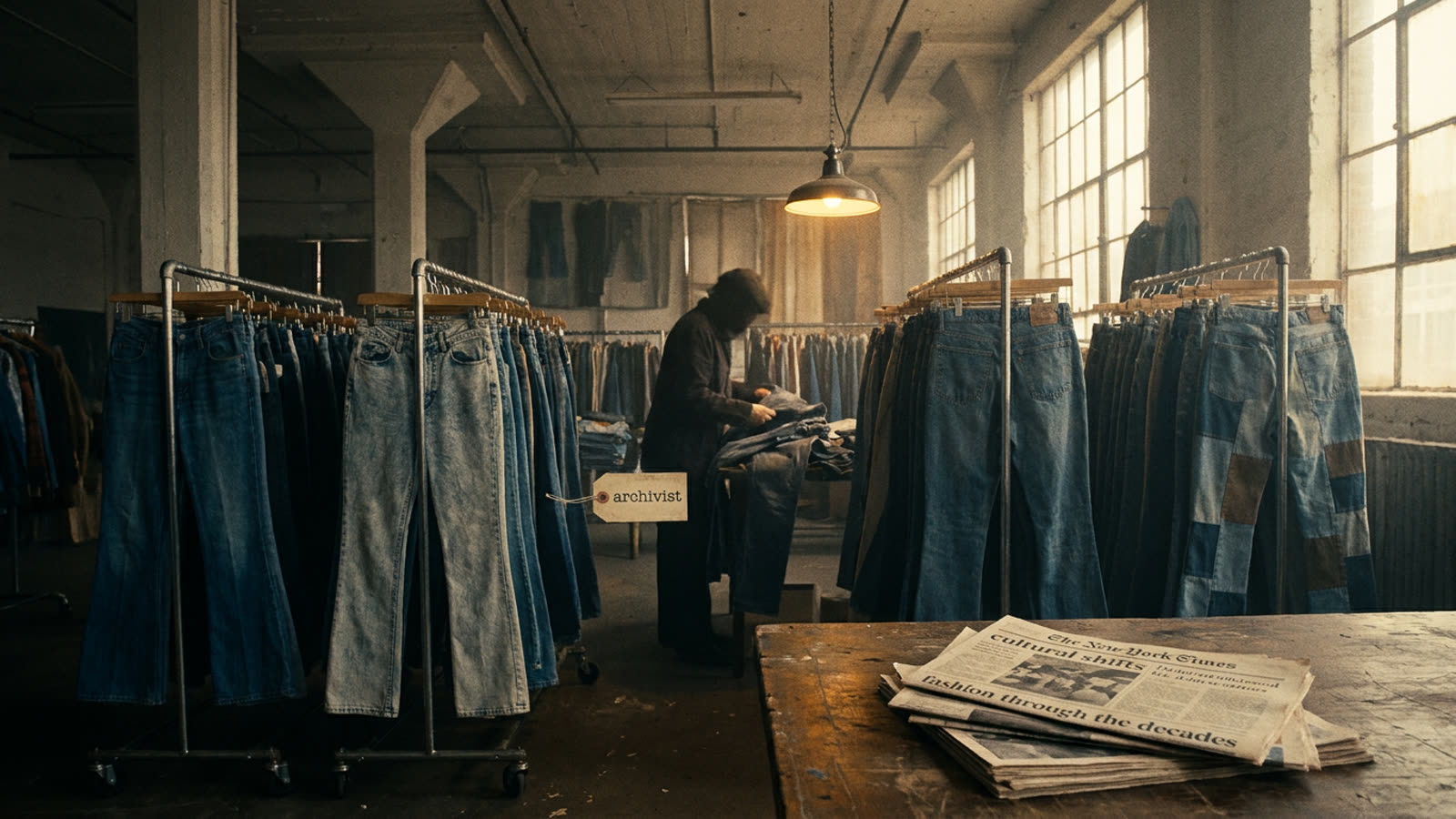
Every generation gets the jeans it deserves, which is perhaps why looking at old photographs of ourselves in denim is so reliably mortifying.
The relationship between Americans and their jeans has always been more revealing than the garments themselves. What we choose to do to a simple pair of cotton twill trousers—distress them, bedazzle them, slice them into ribbons, hoist them to our armpits or drag them below our hip bones—says more about our collective psyche than any sociological survey could capture. Denim is democracy's fabric, which means it reflects our worst impulses as faithfully as our best.
The rebel uniform becomes the establishment
When Marlon Brando rolled into collective consciousness in The Wild One, his Levi's 501s weren't a fashion choice—they were a provocation. James Dean's denim in Rebel Without a Cause carried the same charge. But rebellion has a shelf life, and by the time baby boomers were buying their children's back-to-school jeans at Sears, the garment had completed its journey from counterculture to conformity in barely two decades.
The designer denim explosion of the late 1970s and early 1980s represented something new: jeans as status symbol. Gloria Vanderbilt, Calvin Klein, and Jordache transformed workwear into aspirational luxury, complete with provocative advertising that would make contemporary brand managers reach for their smelling salts. Brooke Shields informing America that nothing came between her and her Calvins was the moment denim stopped being about authenticity and started being about desire.
The rise, fall, and inexplicable return of the low-rise
The early 2000s gave us many regrettable trends, but none quite so anatomically punishing as the ultra-low-rise jean. Paris Hilton and her cohort made visible hip bones a prerequisite for participation in public life. The style required either genetic fortune or genuine hunger, and its ubiquity created a generation of women who learned to sit down in careful stages.
That this silhouette has returned—albeit in modified form—among Gen Z proves that fashion's memory is mercifully short. The current iteration sits slightly higher, a concession to the fact that humans occasionally need to bend at the waist. But the impulse remains: denim as body modification, as discipline, as performance.
Where we are now
The current denim landscape is characterized by what might charitably be called pluralism and less charitably called chaos. Wide-leg jeans coexist with skinny jeans in a détente that would have seemed impossible during the tribal wars of the 2010s. Vintage Levi's command prices that would have baffled their original wearers. Japanese selvedge denim has created a connoisseur class that discusses warp and weft with the solemnity of wine collectors.
Our take
The democratization of denim—the fact that you can now spend either forty dollars or four hundred on a pair of blue jeans and both choices are defensible—is perhaps the only genuinely egalitarian development in fashion this century. That we continue to invest this humble fabric with so much meaning suggests we still need uniforms, even when we pretend we don't. The jeans you're wearing right now will embarrass you in fifteen years. This is not a warning; it's a promise.