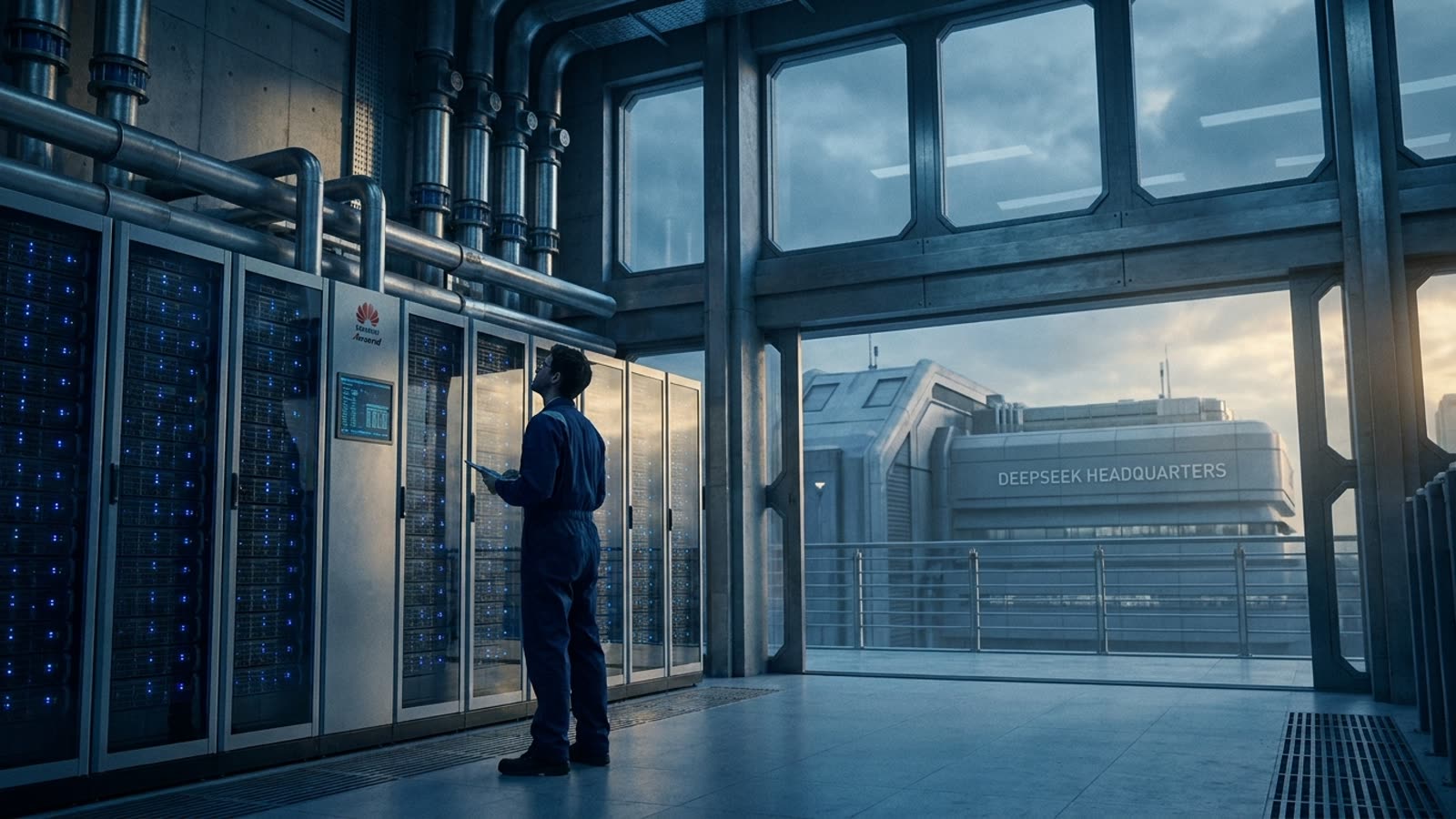
The timing was exquisite. Just as American and Chinese negotiators prepared to meet for their highest-stakes summit in years, DeepSeek—the Hangzhou startup that shocked Silicon Valley in January with its cost-efficient reasoning models—quietly confirmed it would train its next-generation system exclusively on Huawei's Ascend processors, abandoning Nvidia entirely.
This is not a symbolic gesture or a government-mandated PR exercise. It is a structural shift in how China's most capable AI lab will operate, and it carries implications that extend far beyond one company's supply chain. For three years, U.S. export controls on advanced semiconductors have rested on a single assumption: that Chinese AI development would remain bottlenecked by its inability to match Nvidia's CUDA ecosystem and cutting-edge chips. DeepSeek's announcement suggests that assumption has an expiration date.
The Huawei factor
Huawei's Ascend 910B chips have been dismissed by Western analysts as inferior substitutes—slower, less energy-efficient, and lacking the software maturity that makes Nvidia's GPUs the default choice for serious AI research. That assessment was largely correct eighteen months ago. It appears increasingly outdated now.
DeepSeek's engineers have reportedly spent the past year optimizing their training infrastructure for Ascend hardware, developing custom kernels and compiler tools that narrow the performance gap. The company claims its upcoming model will match or exceed the capabilities of its January release, which already rivaled OpenAI's o1 on key benchmarks. If true, this would represent the first frontier-class model trained without any American silicon—a milestone Beijing has pursued with the urgency of a moon landing.
What Washington loses
The Biden and Trump administrations both treated chip export controls as a trump card, a way to slow Chinese AI progress by years without firing a shot. That logic assumed Chinese alternatives would remain perpetually behind. DeepSeek's move suggests the controls may have accelerated domestic substitution rather than prevented it.
This does not mean Huawei has caught Nvidia—it almost certainly hasn't in raw performance. But AI development is not purely a hardware race. DeepSeek demonstrated in January that algorithmic efficiency can compensate for computational constraints. A lab that trains effectively on slightly inferior chips may still produce models that compete with those built on the best hardware available. The export controls remain painful for China, but they are no longer the chokepoint they were designed to be.
Our take
There is a certain irony in watching America's most potent economic weapon become a catalyst for the self-sufficiency it was meant to prevent. DeepSeek's Huawei pivot will not make China an AI superpower overnight, but it does mark the end of a comfortable assumption in Washington: that technological containment could be maintained indefinitely through supply chain control. The chip war is entering a new phase, one where both sides have functioning ammunition. The summit negotiations just got more interesting.