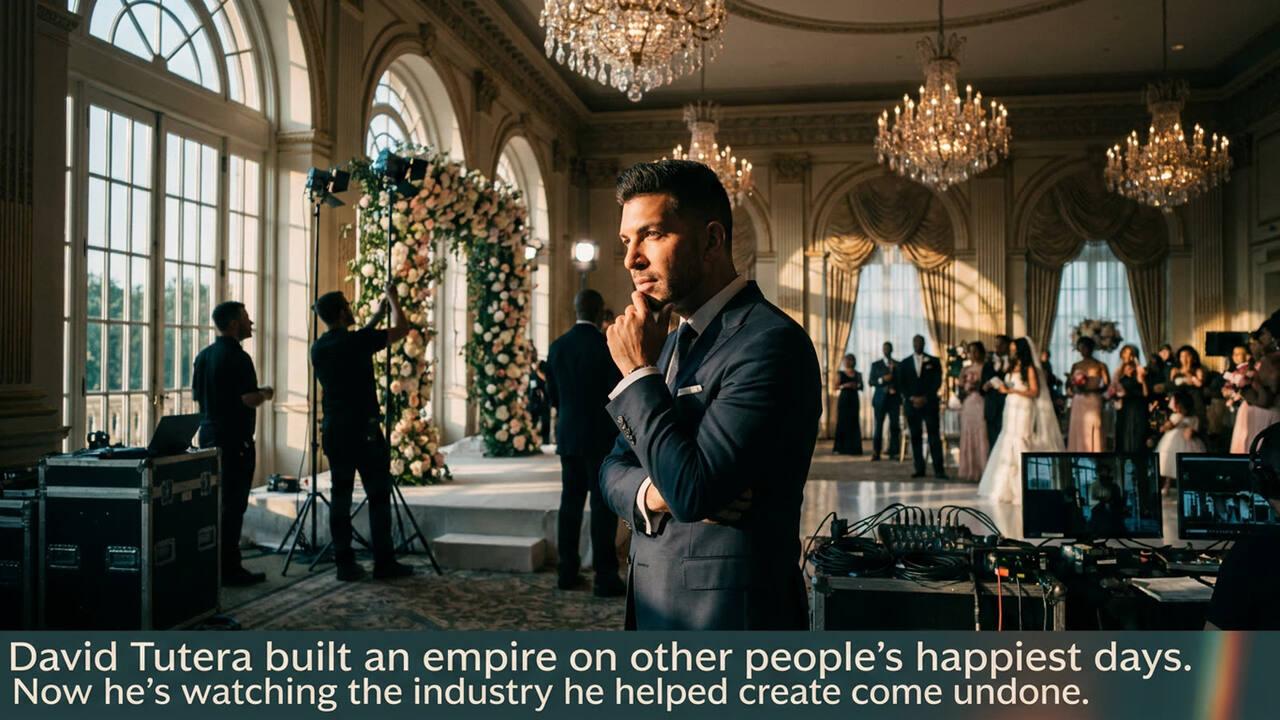
The man who once orchestrated Jennifer Lopez's engagement party and transformed celebrity weddings into prime-time entertainment is having a moment of reckoning with an industry he helped inflate beyond recognition.
David Tutera, the wedding planner whose name became synonymous with lavish ceremonies through his long-running WE tv series "My Fair Wedding," has spent three decades convincing couples that their special day should be, above all, spectacular. He built a media empire on the premise that weddings are not merely ceremonies but productions—complete with dramatic reveals, celebrity-adjacent aesthetics, and budgets that would make a Hollywood producer wince. The formula worked brilliantly for years. Now it's colliding with a generation that increasingly views the traditional wedding industrial complex with something between skepticism and outright hostility.
The spectacle economy meets its limits
Tutera's career arc mirrors the wedding industry's own trajectory from intimate family affair to Instagram-ready content opportunity. His television work, which ran for nearly a decade, didn't just document weddings—it established a visual vocabulary for what celebrations should look like. The cascading floral arrangements, the choreographed first dances, the transformation narratives where brides emerged from planning disasters into their "dream day." It was aspirational television that doubled as advertising for an entire sector.
But the economics have shifted beneath the industry's feet. The average American wedding now costs north of $30,000, a figure that has roughly tripled in inflation-adjusted terms since the 1980s. Younger couples, many of whom watched their parents' generation pour small fortunes into single-day events, are increasingly opting out entirely or scaling back dramatically. Elopements and micro-weddings have surged. The courthouse ceremony, once considered a concession, has become a statement.
The content paradox
Here's the peculiar bind facing celebrity wedding planners in 2026: social media has simultaneously democratized wedding aesthetics and devalued the expertise required to achieve them. Pinterest boards and TikTok tutorials have made the Tutera look achievable—or at least approximable—without the Tutera price tag. Couples can source their own vendors, design their own mood boards, and coordinate their own timelines using tools that didn't exist when "My Fair Wedding" premiered.
Yet the same platforms that undercut traditional planners have also created new demand for weddings as content. The pressure to produce shareable moments has never been higher, even as the willingness to pay for professional orchestration has declined. It's a tension that defines the current moment: everyone wants the photo, fewer want the planner.
Our take
Tutera deserves credit for recognizing, early, that weddings are fundamentally theatrical. The problem is that he helped build a machine that now requires constant feeding—bigger budgets, more elaborate setups, ever-escalating expectations—at precisely the moment when economic reality and generational values are pushing in the opposite direction. The wedding industry isn't dying, but its gilded age may be. The planners who thrive next will be the ones who figure out how to deliver spectacle at a price point that doesn't require a second mortgage.