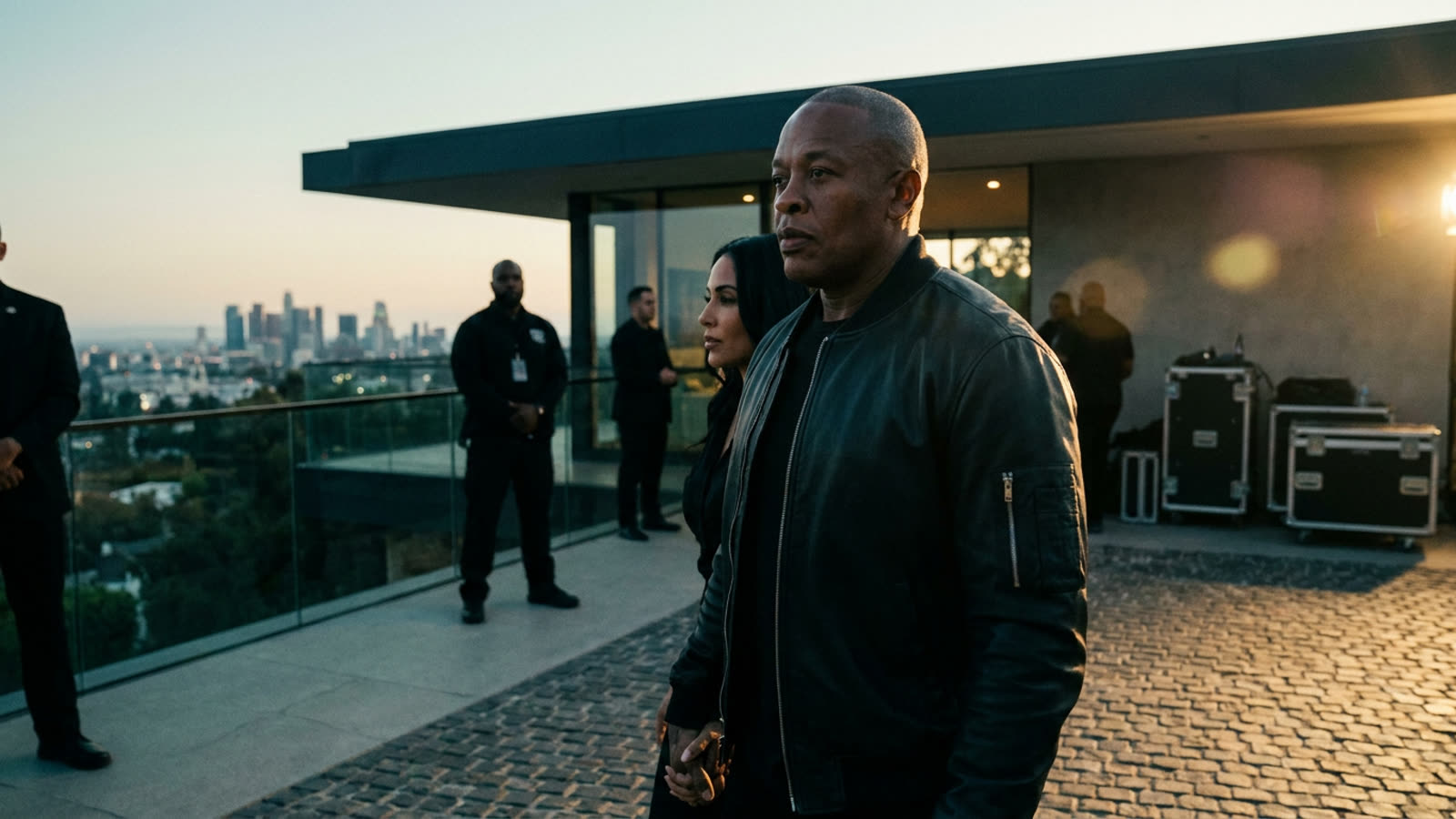
Dr. Dre, the man who built Beats by Dre into a $3 billion Apple acquisition and produced some of the most consequential hip-hop albums ever recorded, has spent the years since his divorce from Nicole Young in something resembling monastic seclusion—at least by Los Angeles standards. That era appears to be ending. The 61-year-old was photographed this week holding hands with Michelle Saniei, a relatively low-profile figure compared to the producer's usual orbit of platinum artists and tech executives.
The images mark Dre's first public romantic appearance since his marriage to Young dissolved in a spectacularly acrimonious split that saw allegations of abuse, demands for spousal support exceeding $2 million per month, and the kind of forensic examination of prenuptial agreements that keeps Beverly Hills family lawyers in vacation homes.
The post-divorce recalibration
Dre's withdrawal from public life following the divorce was notable for someone whose career has been defined by strategic visibility—the Beats headphones draped around every athlete's neck, the Super Bowl halftime show, the HBO documentary that carefully managed his legacy. Friends suggested he was exhausted by the legal warfare and the tabloid scrutiny of his personal history. The divorce settlement, finalized in late 2023, reportedly saw Young receive approximately $100 million, a figure that sounds enormous until you remember Dre's net worth hovers near $500 million.
Saniei, who has been linked to wellness and lifestyle ventures in Southern California, represents a departure from the high-wattage relationships that defined Dre's earlier years. She is not a recording artist, not a model with a reality show, not someone whose Instagram following constitutes a media company. For a man who has spent four decades in an industry that treats romantic partners as brand extensions, the choice reads as deliberate.
What privacy means for a mogul
The hand-holding photographs are almost quaint in their domesticity—two people walking, fingers interlaced, no entourage visible. For Dre, who once embodied West Coast hip-hop's most aggressive postures, the image suggests a man who has decided that the performance of masculinity that made him famous is no longer worth the effort. He has nothing left to prove commercially; the Beats sale and Apple's ongoing royalty arrangements mean he could never work again and still leave generational wealth.
The question is whether this relationship will remain shielded from the scrutiny that consumed his marriage. Young's divorce filings painted a portrait of a man whose public image as a savvy businessman obscured a volatile private life. Dre denied the most serious allegations, but the proceedings left a residue that no amount of carefully produced documentary footage could fully clean.
Our take
There is something almost poignant about watching Dr. Dre—the architect of gangsta rap's commercial peak, the mentor who launched Eminem and shaped Kendrick Lamar—reduced to tabloid photographs of a man holding his girlfriend's hand. But reduced is the wrong word. At 61, with his legacy secure and his fortune intact, Dre appears to be choosing the thing that eluded him during his most successful years: an ordinary private life. Whether Michelle Saniei becomes a permanent fixture or a transitional figure, the image itself tells us something. The man who once rapped about chronic and Compton now just wants to walk down the street without a narrative attached. Good luck with that.