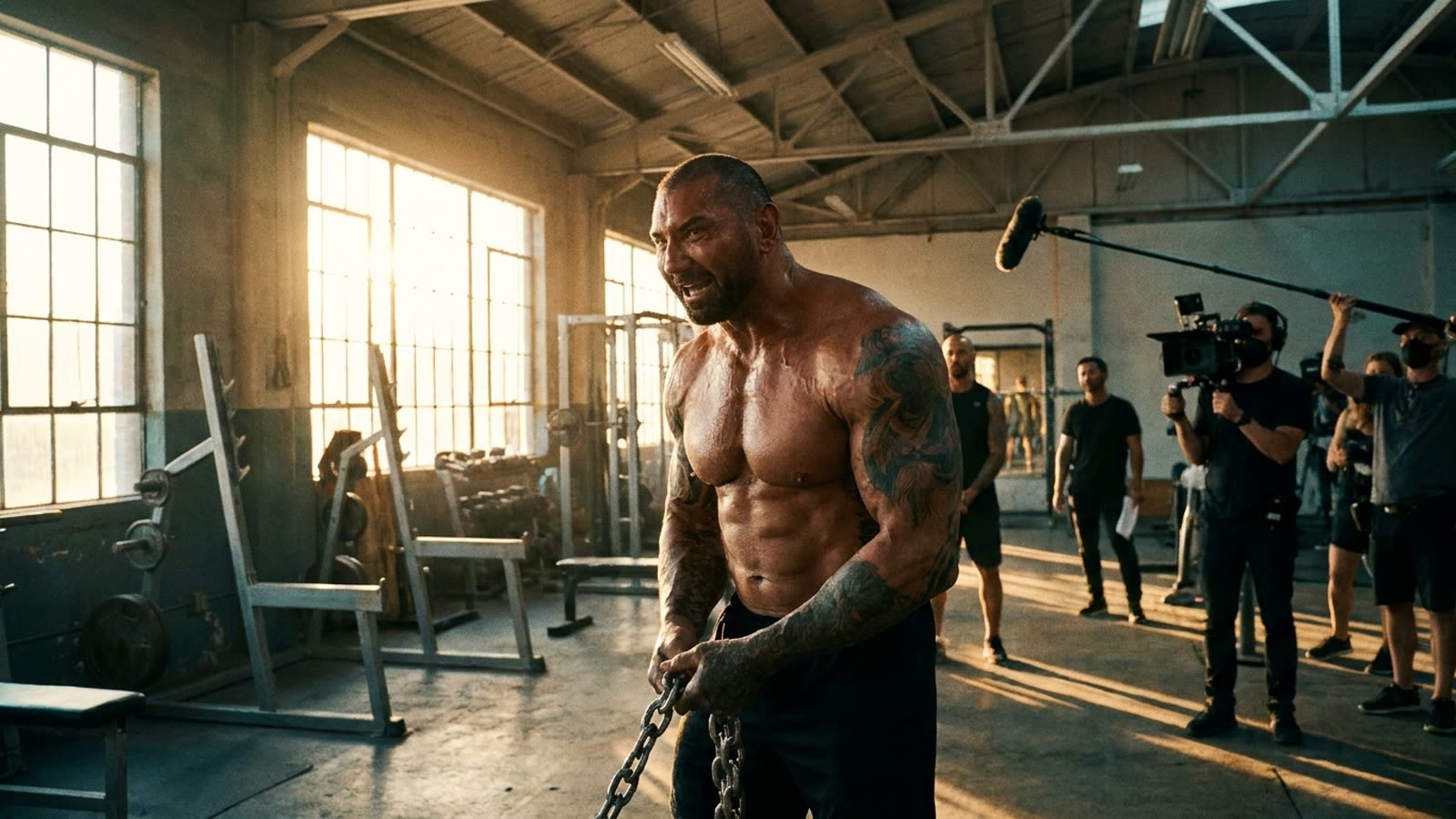
Dave Bautista has never been one to half-commit. The former WWE champion turned surprisingly nuanced character actor has spent months adding 20 pounds of muscle to his already formidable frame, all in service of playing Kratos, the rage-fueled Spartan god-slayer at the center of Sony's upcoming God of War television series. The transformation, which Bautista revealed over the weekend, represents something beyond vanity metrics or Instagram fodder — it's a statement about what prestige gaming adaptations now demand from their leads.
The casting makes almost too much sense. Bautista, 57, has spent the past decade defying expectations, pivoting from Drax the Destroyer's comic relief in the Guardians of the Galaxy franchise to genuinely affecting dramatic work in Blade Runner 2049 and Knock at the Cabin. He's proven he can do more than throw punches. But Kratos requires him to do both: the character is defined equally by his capacity for ultraviolence and his tortured relationship with his son Atreus, the emotional core of the 2018 game reboot that revitalized the franchise.
The body as text
In an era when digital de-aging and CGI enhancement can smooth over physical limitations, Bautista's decision to undergo genuine physical transformation reads as a deliberate artistic choice. Kratos is not merely large; he is mythologically proportioned, a man whose body tells the story of decades of divine warfare. The character's ashen skin, marked by the red tattoo commemorating his murdered family, sits atop musculature that suggests supernatural origin. For Bautista to approximate this through actual training rather than digital augmentation suggests the production is betting on practical authenticity — the same approach that elevated HBO's The Last of Us from competent adaptation to cultural phenomenon.
The 20-pound gain also speaks to Bautista's understanding of his own brand. He has been vocal about wanting roles that challenge rather than coast on his physicality, but he clearly recognizes that Kratos demands both. This isn't a character who can be played slight and compensated with camera angles.
The adaptation arms race
God of War arrives amid an unprecedented boom in gaming adaptations, with studios finally cracking the code that eluded Hollywood for decades. The Last of Us demonstrated that fidelity to source material, combined with genuine cinematic craft, could produce prestige television. Fallout proved that tonal translation mattered as much as narrative accuracy. Now God of War must navigate even trickier terrain: adapting a franchise built on spectacle and violence into something that justifies its existence beyond fan service.
The series, developed by Amazon MGM Studios, faces the challenge of translating gameplay's visceral satisfaction into passive viewing. Kratos's appeal in the games derives partly from player agency — the catharsis of controlling his destruction. Television must find equivalent emotional hooks, which likely explains the emphasis on the father-son dynamic that defined the Norse-era games.
Our take
Bautista at 57, gaining 20 pounds of muscle to play a video-game character, could easily read as desperate or delusional. Instead, it reads as the work of an actor who understands exactly what this role requires and refuses to cheat his way there. Whether God of War succeeds will depend on factors far beyond his physique — writing, direction, the impossible task of making mythological carnage feel emotionally earned. But Bautista has done his part. He's showing up as Kratos in body, not just in contract. In an industry increasingly comfortable with digital shortcuts, that commitment means something.