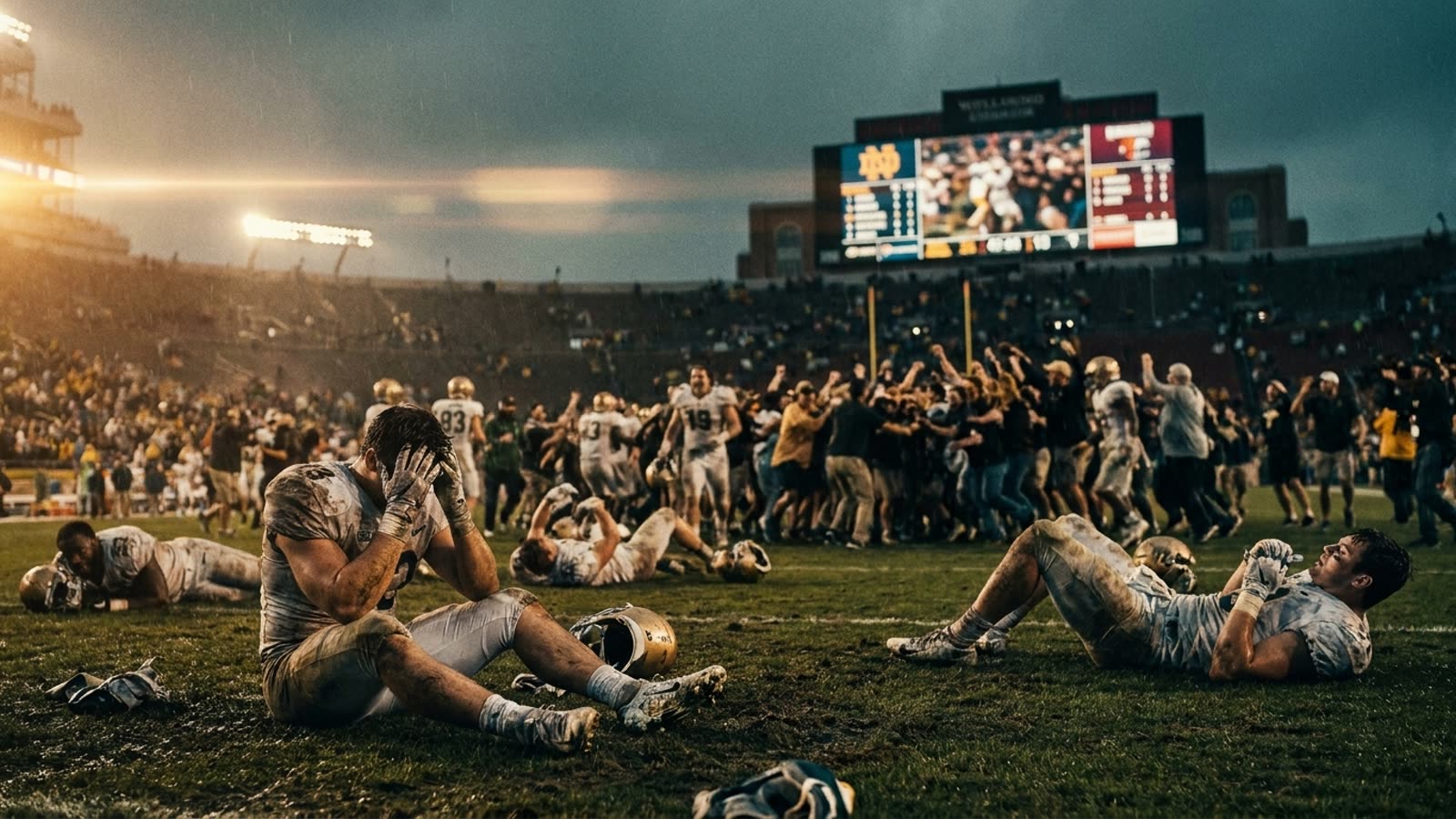
The College Football Playoff selection committee convenes in a few weeks to impose order on a sport that spent Saturday reminding everyone it does not want to be ordered. Five teams ranked in the top seven lost on the same day — a statistical improbability that nonetheless felt inevitable to anyone who has watched this season's parity quietly build toward detonation.
The wreckage is comprehensive. Texas fell at home to Tulane's Jon Sumrall, who celebrated by donning a cowboy hat while striding through the corridors of Darrell K Royal-Texas Memorial Stadium like a man who had just robbed a bank in broad daylight and intended to enjoy the afternoon. The image will define the weekend, but the results define something larger: a sport in which the gap between the haves and have-mores has narrowed to the point of irrelevance on any given Saturday.
The committee's nightmare
The twelve-team playoff was supposed to provide clarity. Instead, it has raised the stakes of every regular-season upset while simultaneously making the path to qualification murkier. When five top-seven teams lose in a single week, the cascading effects on strength of schedule, conference championship implications, and at-large bids become a computational nightmare that no eye test can resolve.
The committee will retreat to its spreadsheets and its solemn deliberations, but the sport itself is making an argument that transcends metrics: perhaps the rankings were always a polite fiction, a way to organize television schedules and generate debate rather than a genuine reflection of relative quality.
Why parity is winning
The transfer portal and NIL have redistributed talent in ways that are only now becoming visible on the field. Programs that once served as developmental leagues for the elite now retain their best players or poach them from traditional powers. Coaching staffs have professionalized to the point where scheme can neutralize recruiting advantages. The result is a sport where any team with a pulse and a plan can beat anyone on the right Saturday.
This is not the NFL's version of parity, which is engineered through salary caps and draft orders. This is organic chaos, the product of a system that tried to professionalize without regulating and is now discovering that markets, left to their own devices, tend toward equilibrium.
Our take
The handwringing about college football's unpredictability misses the point. The sport was never meant to be a tidy hierarchy; it was meant to be a collection of regional obsessions that occasionally collide in spectacular fashion. Saturday delivered exactly that. The cowboy hat was earned. The rankings were always suggestions. And the playoff committee's job just got a lot harder — which is to say, a lot more interesting.