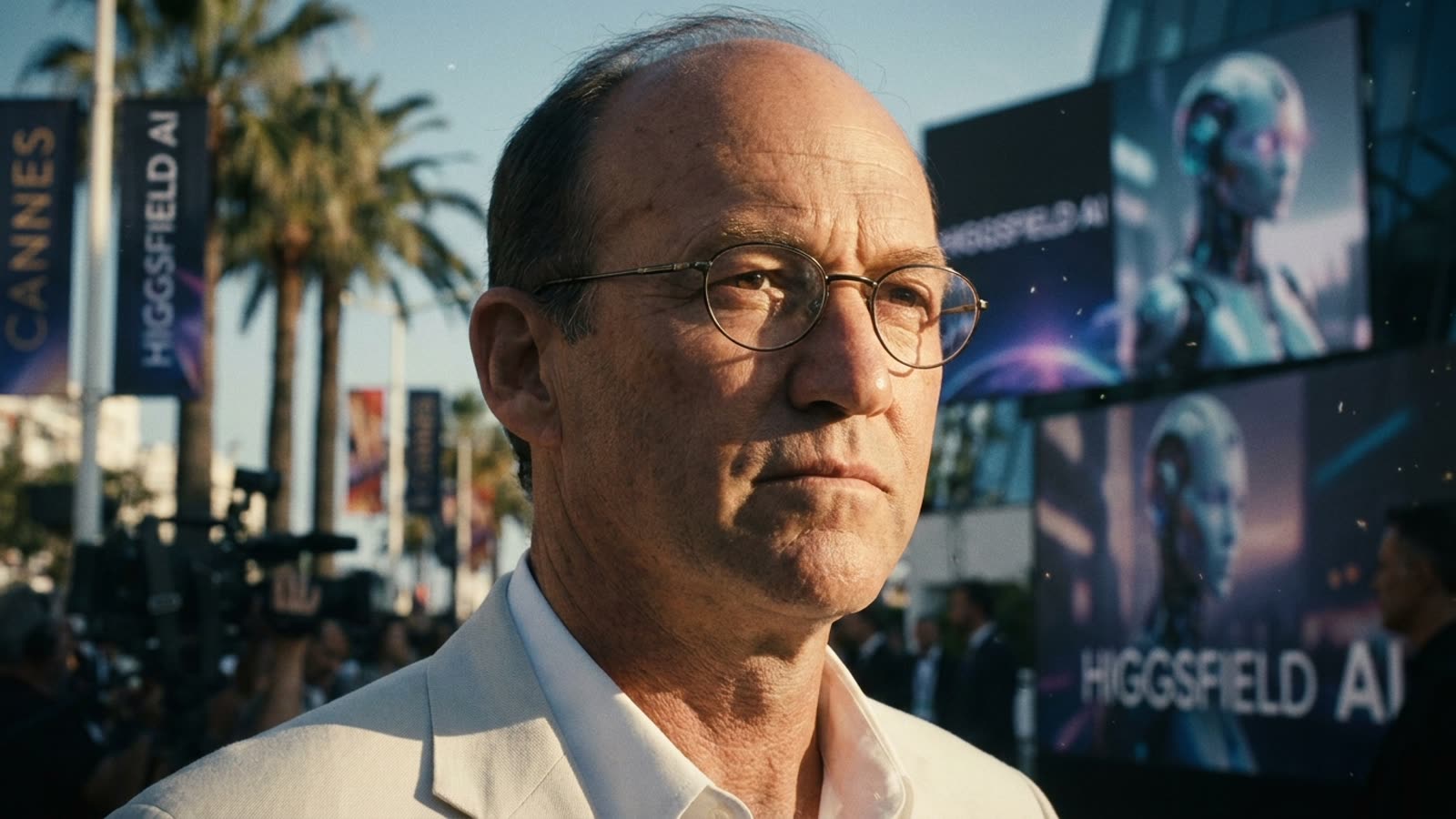
The reveal dropped quietly at the Cannes Film Market on Saturday: two original science-fiction features, Hyperia and b, will be produced using generative AI across their entire pipeline — pre-production, principal photography, post. The man steering the ship is Chuck Russell, the director who gave us Jim Carrey's rubber-faced breakout in The Mask and Arnold Schwarzenegger erasing witnesses in Eraser. His new company, Neumorphic AI, has partnered with Higgsfield, a generative-video startup that has been quietly building tools for AI-native cinematography.
This is not another press release about AI "assisting" editors or generating storyboards. Russell and Higgsfield are betting that the entire production apparatus — from script visualization to final color grade — can run through models trained on cinematic grammar. If they pull it off, the economics of mid-budget genre filmmaking change overnight.
Why Russell, why now
Russell's filmography is instructive. He has always worked in the space between studio tentpoles and indie experiments: high-concept premises executed on disciplined budgets. The Mask cost $23 million in 1994 and grossed nearly $352 million worldwide. That ratio — spectacle per dollar — is exactly what AI production tools promise to optimize. Russell told buyers at Cannes that Neumorphic's approach lets him "shoot" scenes that would otherwise require months of VFX iteration, collapsing timelines from years to months.
Higgsfield, for its part, has been positioning itself as the Runway rival focused specifically on narrative coherence — maintaining consistent characters, lighting, and spatial logic across shots. The partnership suggests Russell sees their tech as mature enough for feature-length continuity, not just viral clips.
The guild question
Hollywood's labor agreements remain in flux after the 2023 strikes, and AI's role in production is still being litigated contract by contract. Russell's announcement will inevitably draw scrutiny from SAG-AFTRA and the DGA, both of which have been negotiating guardrails around synthetic performances and AI-assisted direction. Whether Hyperia and b use human actors, digital doubles, or something in between was not disclosed — a conspicuous omission that suggests the legal architecture is still being built.
Our take
Chuck Russell is not a visionary auteur; he is a craftsman who knows how to land a genre picture on budget. That is precisely why this announcement matters more than if, say, a first-time director had made it. When a veteran with studio relationships and a track record bets his next projects on AI-native production, it signals that the technology has crossed from experiment to infrastructure. The films may or may not be good. The precedent is already set.