Every sport has a canonical image. Baseball has Willie Mays racing toward the warning track. Basketball has Jordan hanging in the air against the Lakers. Football — the global kind — has Carlos Alberto Torres receiving a square pass from Pelé and driving the ball into the net with such violence that the goalkeeper never moved. The goal itself took perhaps two seconds. The build-up that preceded it, a nine-pass sequence involving every outfield player, took roughly a minute. Together they constitute the most influential sixty seconds in the history of the game.
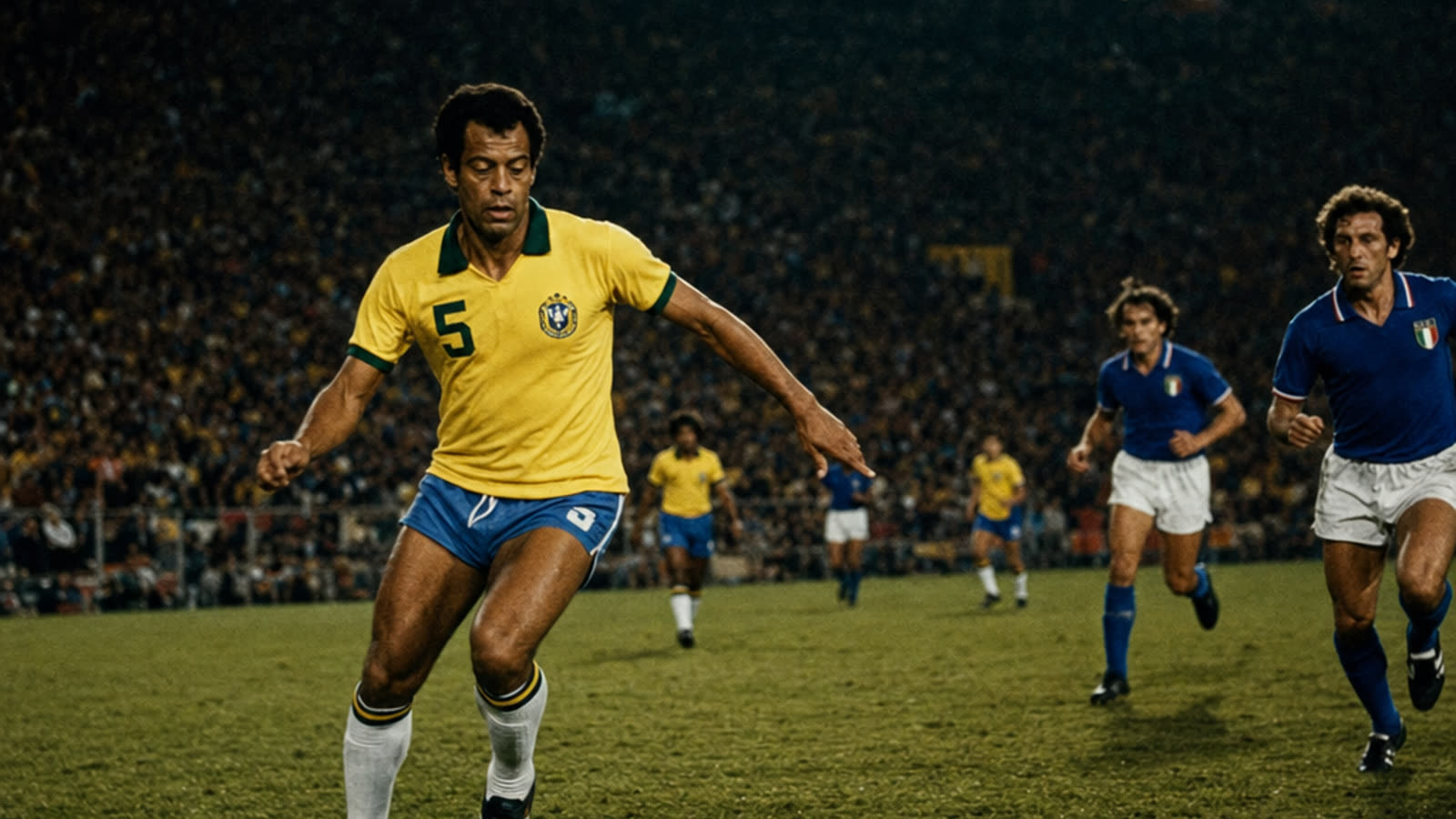
The 1970 World Cup final in Mexico City's Estadio Azteca was already decided by the time the sequence began. Brazil led Italy 3–1 with minutes remaining. What followed was therefore unnecessary in the strictest competitive sense, which is precisely why it mattered. Freed from anxiety, the Seleção played as if composing a sonnet in real time: Clodoaldo dribbling past four Italians in his own half, Rivelino laying off to Jairzinho, the ball moving left to right across the pitch with metronomic inevitability until Pelé, stationed at the edge of the box, paused — actually paused — before rolling a pass into Carlos Alberto's path.
The geometry of joy
Tactical analysts have dissected the goal endlessly. The width of Brazil's formation stretched Italy's defense to breaking point. The one-touch passing eliminated the possibility of a press. But the technical explanations miss the point. What made the goal immortal was its mood: serene, unhurried, almost leisurely, yet culminating in a shot of startling ferocity. Carlos Alberto struck the ball so cleanly that Italian goalkeeper Enrico Albertosi appeared frozen in a still photograph. The contrast between the calm of the approach and the violence of the finish remains the goal's essential tension.
Brazil's 1970 side is routinely called the greatest team ever assembled, a claim that is difficult to refute and pointless to debate. Pelé, Jairzinho, Tostão, Rivelino, Gérson — the names read like a roll call of demigods. Yet the team's legacy rests disproportionately on a single goal in a match already won. This is not a contradiction. The goal distilled the team's philosophy into a reproducible image, a GIF avant la lettre that could be transmitted across generations without losing resolution.
Why it endures
The 1970 final was the first World Cup final broadcast live in color to a global audience. The timing was not incidental. Carlos Alberto's goal became football's moon landing — a shared visual memory for hundreds of millions of people who had never seen the sport rendered in such vivid, sun-drenched hues. The yellow shirts against the Azteca's green pitch, the blue sky, the brown leather ball: the palette itself entered the sport's collective unconscious.
Subsequent decades have produced goals of greater individual brilliance — Maradona's slalom against England, Bergkamp's pirouette against Argentina — but none with the same totalizing quality. Carlos Alberto's goal was not about Carlos Alberto. It was about a team, a nation, and an idea of football that privileged beauty alongside victory. Every tiki-taka sequence, every Pep Guardiola positional drill, every youth-academy emphasis on ball retention traces a line back to that minute in Mexico City.
Our take
Football has spent the intervening decades trying to recapture something it glimpsed in 1970. The sport has grown faster, more athletic, more tactically sophisticated, yet the Carlos Alberto goal remains the benchmark against which all collective brilliance is measured. It is the game's founding myth, not because it was the first great goal but because it was the first one everyone saw together, in color, at the same moment. That simultaneity created a shared aesthetic standard. We are still living inside it.