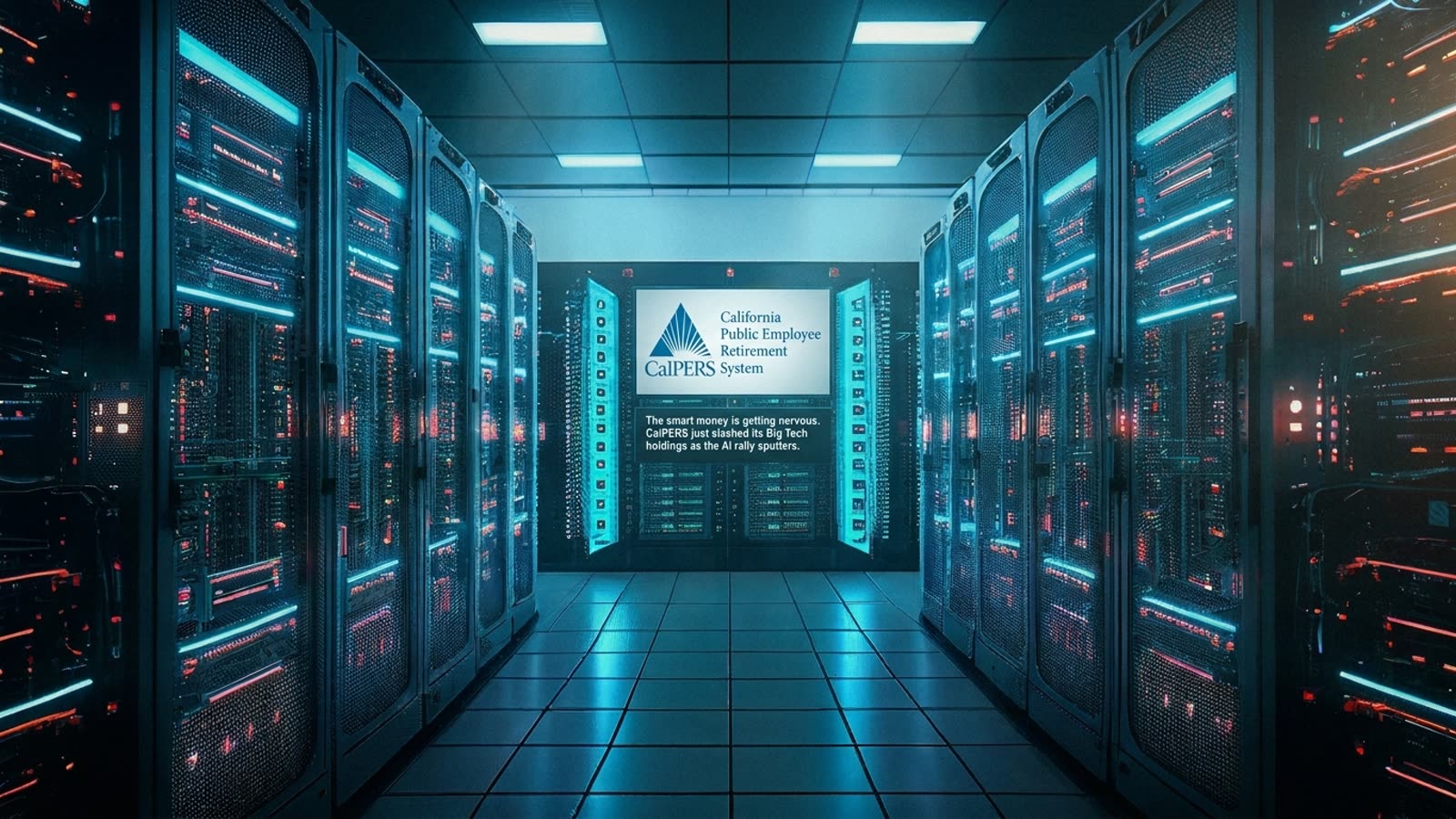
The California Public Employees' Retirement System, which manages roughly half a trillion dollars for two million state workers and retirees, has been trimming its positions in the technology giants that defined the market's AI mania. The move marks a significant inflection point: when the nation's largest public pension fund starts hedging against the very stocks that powered its recent gains, the message to smaller investors is unmistakable.
CalPERS had ridden the Magnificent Seven — Apple, Microsoft, Alphabet, Amazon, Nvidia, Meta, and Tesla — to enviable returns as each company positioned itself as an AI infrastructure play. But the fund's investment committee has grown increasingly uncomfortable with the gap between what these companies are spending on AI and what they're earning from it. The billions flowing into data centers, custom chips, and research talent have yet to produce commensurate revenue streams, and CalPERS appears unwilling to wait indefinitely for the payoff.
The valuation problem
The concern isn't that AI is fake — it's that the market priced in a decade of dominance before the technology proved it could reliably generate returns. Nvidia's forward price-to-earnings ratio, even after recent corrections, remains elevated by historical standards. Microsoft and Google have both acknowledged that their AI infrastructure spending will continue to outpace AI revenue growth for the foreseeable future. For a pension fund with obligations stretching decades into the future, that's a troubling asymmetry.
CalPERS isn't alone in its skepticism. Several sovereign wealth funds and large endowments have similarly rebalanced away from concentrated tech exposure in recent months, though few have been as explicit about their reasoning. The fund's chief investment officer has noted that diversification remains the bedrock of prudent pension management — a polite way of saying that betting retirees' futures on AI hype is not the job.
What this means for the broader market
When passive flows dominated the post-pandemic rally, the Magnificent Seven became self-reinforcing: their size meant index funds had to buy them, which made them larger, which meant more buying. CalPERS' retreat, multiplied across dozens of similarly cautious institutions, could reverse that dynamic. If active managers conclude that AI spending has become a drag rather than a catalyst, the same feedback loop that inflated these stocks could deflate them.
The tech-heavy Nasdaq's recent 2.6 percent single-day drop suggests the market is already recalibrating. Investors are no longer asking whether AI will transform the economy; they're asking whether it will transform earnings before patience runs out.
Our take
CalPERS isn't predicting an AI winter — it's acknowledging that winters are possible and that pension funds shouldn't be the last ones holding the umbrella. The fund's caution is a reminder that the AI trade was always a bet on execution, not just ambition. When the most conservative money in the room starts edging toward the exit, it's worth asking whether the party has peaked.