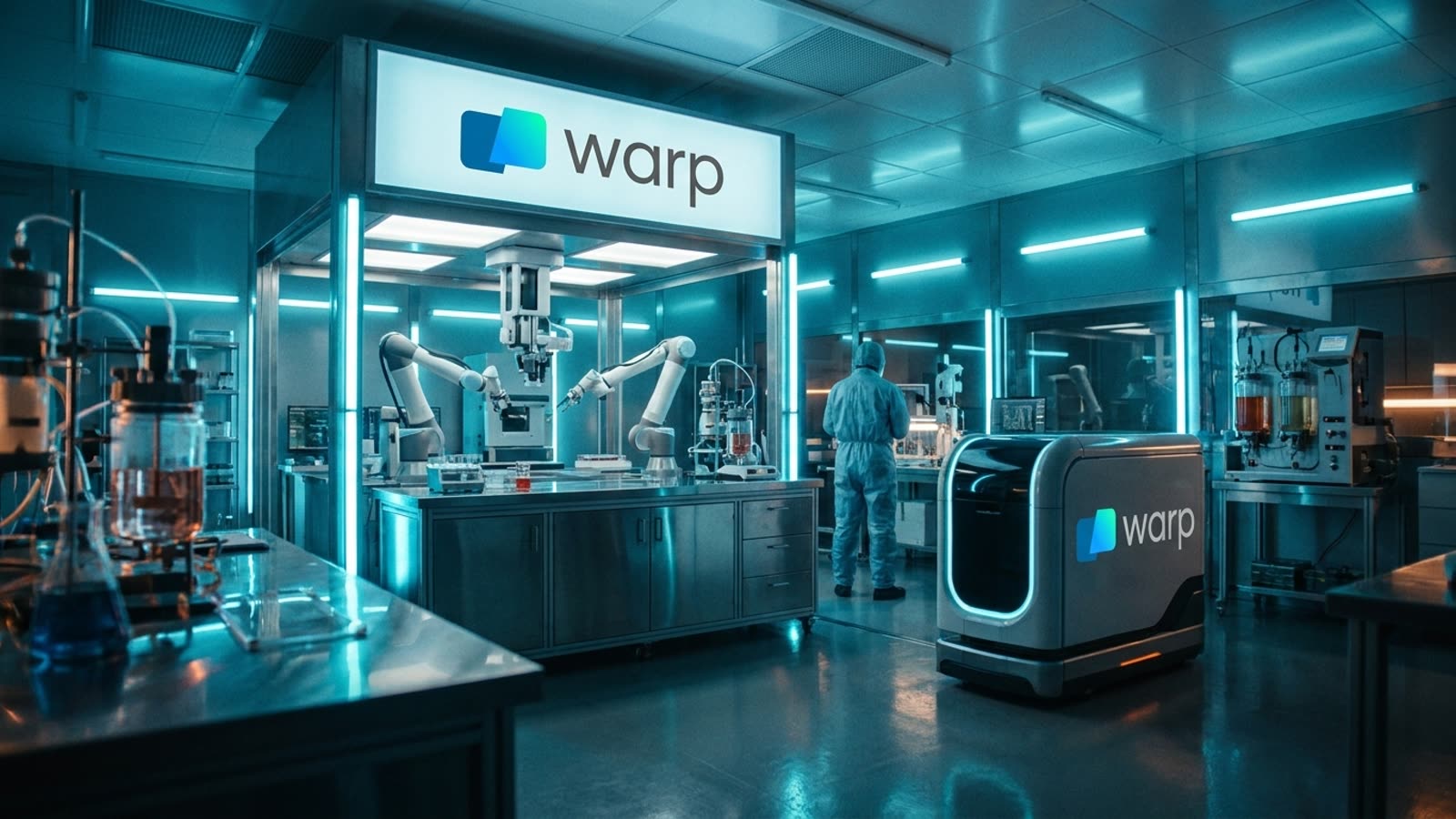
The bottleneck in biomedical research has never really been ideas — it has been the excruciatingly slow process of testing them. Pipettes, petri dishes, and postdocs working through the night represent a pace of experimentation that artificial intelligence, for all its recent triumphs in protein folding and molecular simulation, cannot accelerate from behind a screen. Warp Science, the new venture from a former OpenAI science lead, is built on a simple premise: if you want AI to transform biology, you need to give it hands.
The thesis
Warp Science emerged from stealth on Thursday with a $215 million Series A led by Lightspeed Venture Partners, an eye-popping sum for a company that has yet to publish peer-reviewed results. The startup's founder previously helped build some of OpenAI's most consequential research infrastructure before departing earlier this year. His argument is that the field has over-indexed on computational biology while neglecting the physical layer — the actual experiments that validate or falsify hypotheses. Warp's solution is a fleet of robotic systems designed to conduct wet-lab experiments autonomously, guided by AI models that can design, execute, and iterate on protocols without human intervention.
Why now
The timing is not accidental. Large language models have proven capable of parsing scientific literature, suggesting experimental designs, and even writing code to control laboratory instruments. What they cannot do is open a freezer, calibrate a centrifuge, or notice that a cell culture looks slightly off. Warp's bet is that general-purpose robotics has finally matured enough to close that gap. The company claims its systems can run certain assays at ten times the speed of a human technician, with error rates low enough to satisfy pharmaceutical-grade quality standards. If true, this would represent a step-change in the economics of early-stage drug discovery, where most candidates fail and the cost of each failure compounds.
The skeptic's case
Biology is famously unforgiving to automation. Unlike semiconductor fabrication, where conditions can be controlled to nanometer tolerances, wet labs are messy, variable, and full of edge cases that confound even experienced researchers. Previous attempts to build "lights-out" laboratories have stumbled on precisely this complexity. Warp's investors are betting that modern AI can handle the variability, but the company will need to demonstrate reproducibility across a wide range of experimental contexts before Big Pharma writes checks. The $215 million war chest buys time, but not indefinitely.
Our take
The most interesting thing about Warp Science is not the robots — it is the implicit critique of the AI-in-biology hype cycle. For years, we have been told that computational breakthroughs would revolutionize medicine. They have not, at least not at the pace promised, because biology is not a software problem. Warp's founder seems to understand this, which is why he left the most celebrated AI lab on earth to build machines that get their hands dirty. Whether he succeeds will depend on execution, not vision. But the framing is refreshingly honest: the hard part of science is still the science.