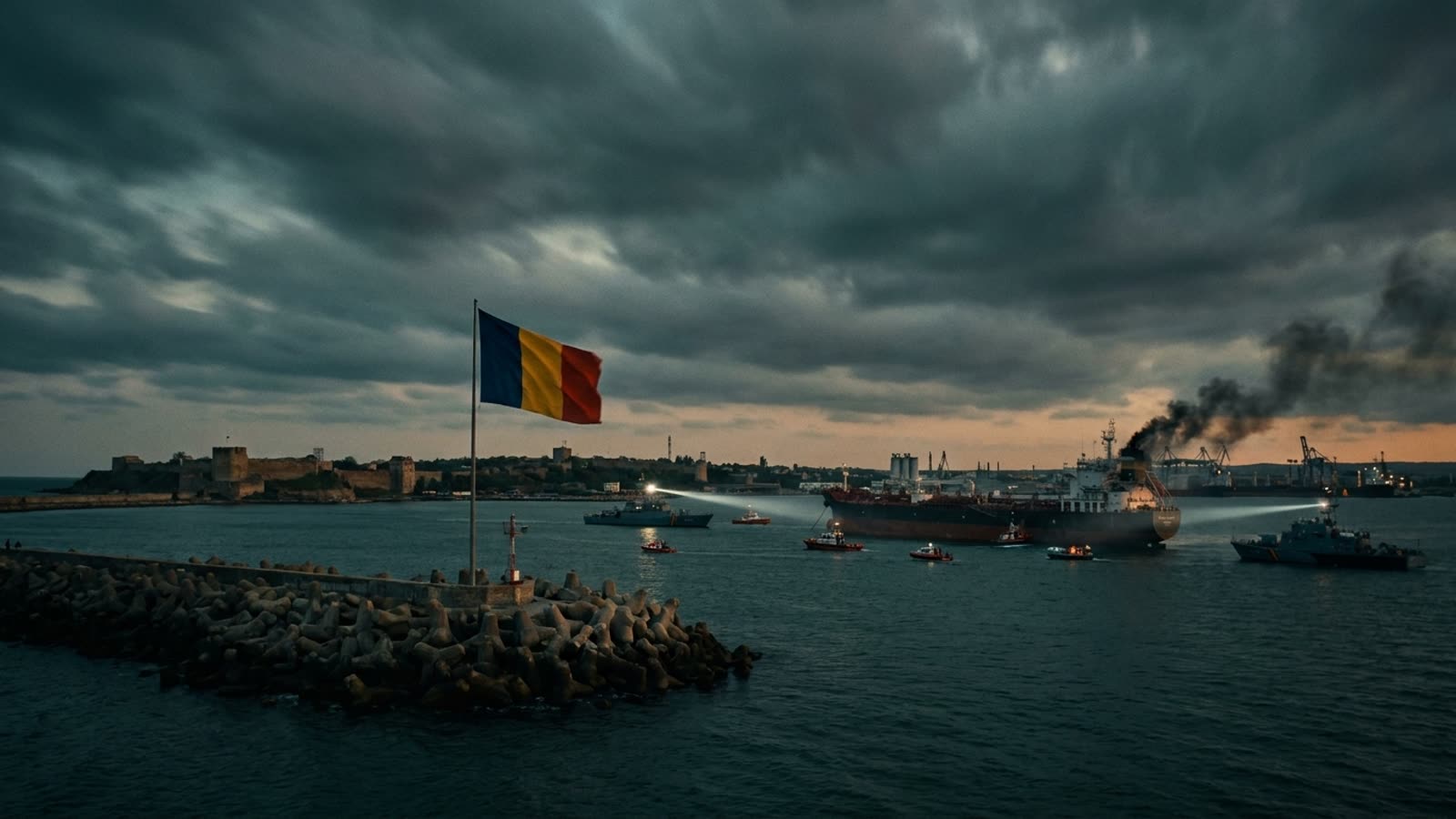
The Black Sea has been a contested gray zone since 2022, but Thursday's drone strikes on two civilian tankers near Romania's coast represent something qualitatively different: an attack on commercial shipping in waters that brush against NATO territory, with Bucharest's president calling it "unacceptable" and alliance sources confirming the drones originated from Russia.
Seven sailors are missing. The tankers were set ablaze. And Europe now faces a question it has studiously avoided for years: what happens when Moscow's war on Ukraine bleeds into attacks on neutral commerce within sight of an EU member state?
The geography of provocation
Romania's Black Sea coastline is not Ukrainian territory, and the tankers struck were not military vessels. This matters enormously. Russia has spent four years calibrating its aggression to stay just below the threshold that would trigger Article 5 or unified Western retaliation. Striking civilian ships this close to NATO waters—close enough that Romanian authorities are leading the response—tests whether that threshold has any meaning at all.
The Kremlin's calculus appears straightforward: if the West tolerated attacks on Ukrainian grain ships, perhaps it will tolerate attacks on tankers transiting nearby international waters. Each unanswered escalation establishes a new baseline.
NATO's awkward position
The alliance confirmed Russian origin of the drones but stopped short of characterizing the strikes as an attack on NATO interests. This diplomatic caution is understandable—no one wants a direct confrontation—but it creates a credibility problem. Romania is a full NATO member. Its president has publicly condemned the strikes. If commercial vessels can be attacked with impunity in waters this close to allied territory, the security guarantees that underpin Black Sea commerce begin to look theoretical.
Bucharest will likely push for enhanced naval patrols and possibly escort arrangements for civilian shipping. Whether other alliance members have the appetite for such commitments—which would put NATO vessels in proximity to Russian drones—remains to be seen.
The Iran-Saudi parallel
The same day, Yemen's Iran-backed Houthis struck the presidential palace in Aden, killing two. The symmetry is instructive: in both the Black Sea and the Red Sea, authoritarian powers and their proxies are demonstrating that commercial chokepoints can be weaponized with minimal consequence. The Strait of Hormuz saw tanker attacks last week. Global shipping is being squeezed from multiple directions simultaneously, and the international order's response has been largely rhetorical.
Our take
Romania's president is right that attacking commercial ships "has to stop," but stating the obvious is not a strategy. NATO faces a choice: either it treats the Black Sea as a zone where member-state-adjacent shipping enjoys some protection, or it concedes that Russia can interdict commerce at will. The missing sailors deserve an answer, and so does every shipping company calculating whether the Black Sea route is worth the risk. Ambiguity is not neutrality—it is an invitation to further escalation.