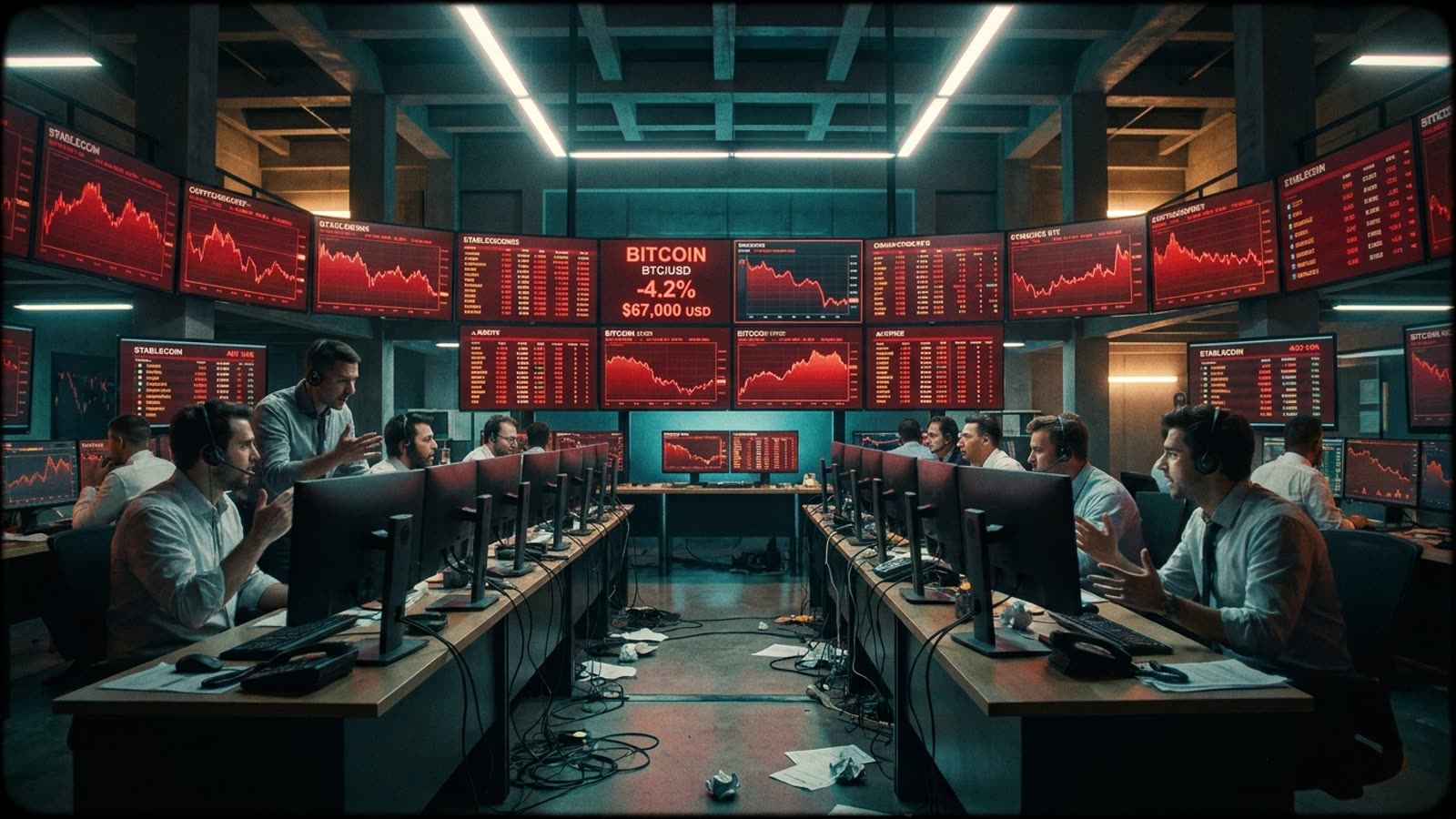
The narrative around Bitcoin corrections used to be simple: price drops, retail panics, capital flees to fiat. But the current slide toward $67,000 is producing a different pattern. Rather than cashing out to traditional bank accounts, a meaningful portion of crypto capital is rotating into stablecoins—digital dollars that keep funds on-chain while avoiding volatility. It's a sign that crypto markets have developed their own internal flight-to-safety reflex, one that keeps liquidity circulating within the ecosystem even during drawdowns.
This isn't merely traders waiting for a dip to buy. Stablecoin market caps have swelled even as Bitcoin has retreated, suggesting that holders are actively choosing digital dollars over actual dollars. The infrastructure now exists—yield-bearing stablecoin products, instant redemption mechanisms, and institutional-grade custody—to make parking in USDC or USDT feel less like a compromise and more like a strategic allocation.
The AI stock vacuum
Bitcoin's summer malaise isn't happening in isolation. Capital is chasing the AI trade with abandon, and crypto is losing the attention war. Nvidia's continued ascent, the proliferation of AI infrastructure plays, and the promise of near-term corporate earnings from the sector have created a gravitational pull that Bitcoin—with its uncertain regulatory status and lack of cash flows—cannot match. K33 Research has warned of a "choppy summer" as this rotation plays out, and the stablecoin surge suggests traders agree: better to wait in digital dollars than compete with Jensen Huang for investor attention.
Institutional plumbing matters
The stablecoin shift also reflects how much the crypto financial stack has matured. Products that let institutional investors swap between stablecoins and yield-generating instruments around the clock have proliferated. The friction of moving between crypto and traditional finance—once a significant barrier—has diminished. For a fund manager, keeping dry powder in a stablecoin that earns yield while remaining instantly deployable into Bitcoin or Ethereum is now operationally trivial. That changes the calculus during corrections: why exit entirely when you can stay liquid, earn a few basis points, and re-enter without the delays of wire transfers?
Our take
The stablecoin surge during Bitcoin's slide is the clearest evidence yet that crypto has built its own internal capital markets. When traders flee to digital dollars rather than actual dollars, they're making a statement about where they see the future of finance—and it's not in legacy banking rails. Bitcoin may be having a difficult summer, but the ecosystem it spawned is proving remarkably sticky. The question is no longer whether crypto can survive corrections, but whether it can eventually recapture the capital currently mesmerized by AI. That's a higher-class problem than the industry faced even two years ago.