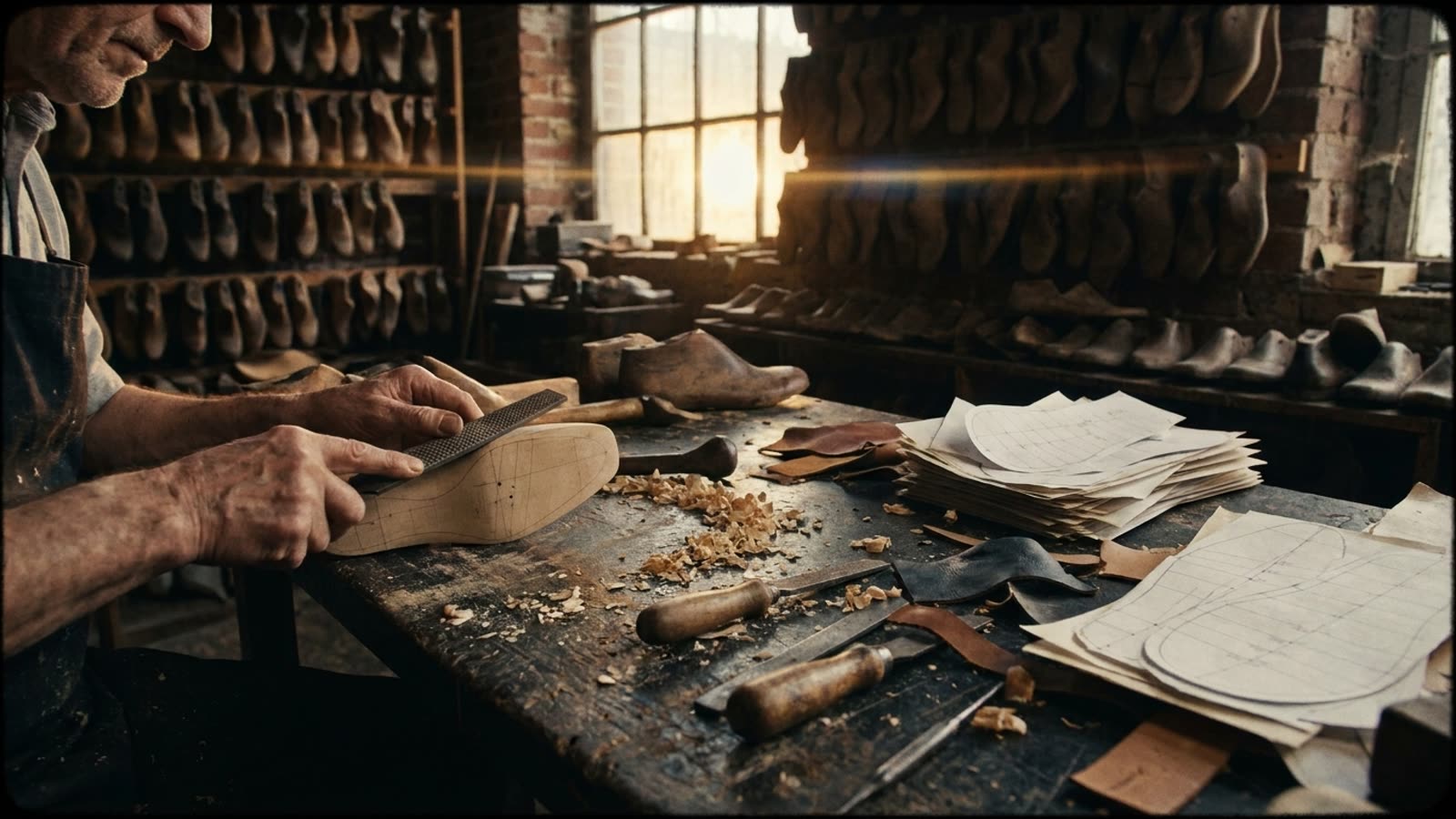
A bespoke shoe begins not with leather but with wood. Before a single stitch is sewn, a craftsman must carve a last—a three-dimensional replica of the client's foot that will serve as the skeleton around which the shoe takes shape. Get the last wrong and nothing else matters: the finest calfskin in the world cannot compensate for a form that pinches the metatarsal or gaps at the heel. Yet the artisans who perform this foundational work are vanishing, and the houses that depend on them have been remarkably slow to reckon with the crisis.
The problem is generational arithmetic. In Northampton, England's historic shoemaking heartland, the handful of remaining last-makers learned their trade in the postwar decades when apprenticeships were common and factory work was respectable. Most are now in their seventies or eighties. The situation in continental Europe is scarcely better; workshops in Vienna, Milan, and Paris report similar demographics. A craft that once employed thousands across the industrialized world now numbers its true practitioners in the dozens.
Why machines cannot simply take over
CNC routers can rough out a last from a digital scan, and several firms now offer this service to mid-tier shoemakers. But bespoke work demands something subtler. A skilled last-maker interprets not just the static dimensions of a foot but its dynamic behavior—how it spreads under weight, where the tendons pull, which pressure points will cause pain after eight hours of wear. This knowledge is accumulated over decades and transmitted through proximity, not manuals. The machines, for all their precision, produce competent approximations; the masters produce comfort.
The economics compound the difficulty. A hand-carved last for a single client might take forty hours and sell for a few hundred pounds—a pittance relative to the labor involved, though the finished shoes built upon it can fetch several thousand. Last-makers have historically subsidized the glamour of the shoemaking houses, absorbing the unglamorous early work so that the cordwainers can claim the glory. Unsurprisingly, young people with artistic inclinations and manual dexterity have preferred to become the shoemakers themselves, or to abandon the trade entirely for better-compensated fields.
The houses' uneasy silence
Luxury brands are notoriously protective of their supply chains, and few wish to advertise that their bespoke programs depend on octogenarians working in unheated workshops. Some have begun stockpiling lasts for existing clients, a kind of wooden insurance policy against the inevitable. Others have quietly shifted toward made-to-measure rather than true bespoke, using standardized lasts with minor adjustments—a compromise that preserves margins while diluting the promise.
A handful of initiatives aim to reverse the decline. The Cordwainers' Company in London has funded sporadic training programs; a workshop in Florence affiliated with a heritage house has taken on apprentices. But these efforts remain modest, and the pipeline from novice to master spans a decade or more. The window for transmission is closing.
Our take
The disappearance of last-makers is a quiet scandal of the luxury industry—a sector that trades on heritage while neglecting the human infrastructure that makes heritage possible. Clients paying five figures for bespoke footwear deserve to know that the craft's foundation is crumbling. And the houses, for all their talk of timelessness, might consider that some investments cannot be deferred. Wood rots slowly, but skill can vanish in a generation.