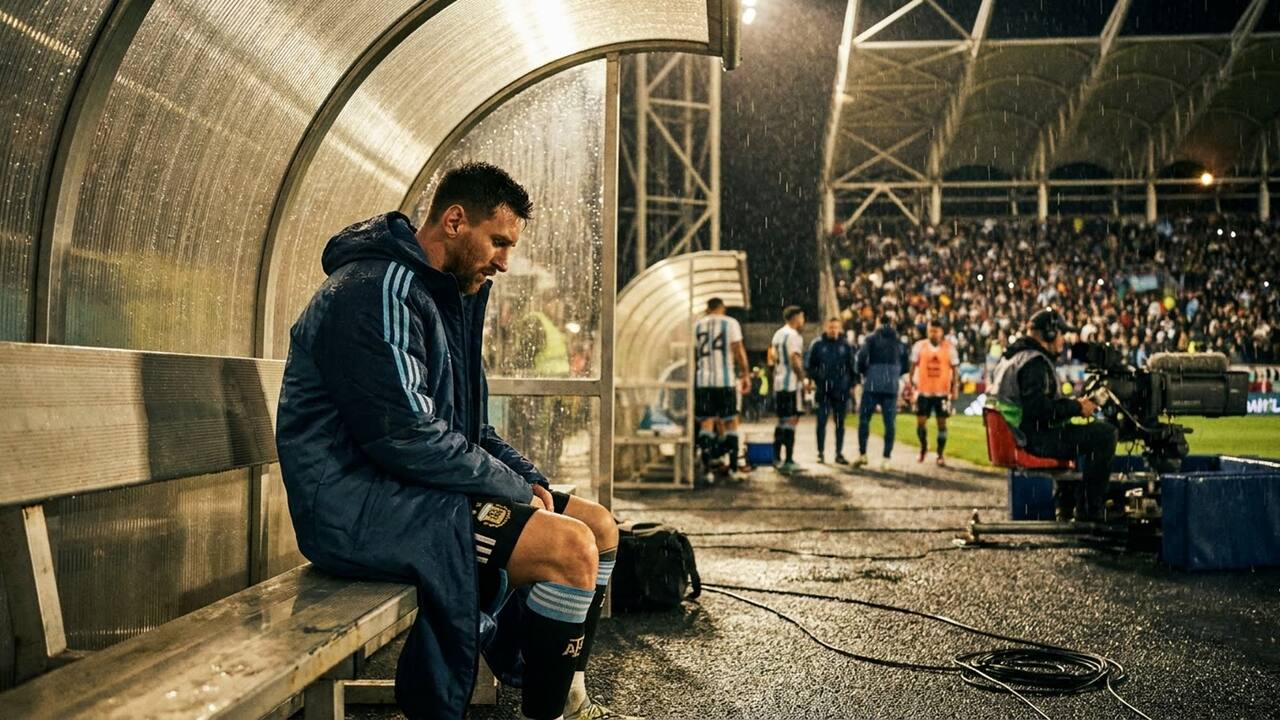
The most telling image from Argentina's final group-stage match wasn't on the pitch — it was in the dugout, where Lionel Messi sat in a pristine tracksuit, watching his teammates navigate a meaningless fixture without him.
Lionel Scaloni's decision to rest his captain, with Argentina already through to the round of 32, represents the cold calculus that now governs elite tournament football. The expanded 48-team World Cup means seven matches to lift the trophy instead of the traditional six. For a 38-year-old whose legs have carried him through two decades of the highest-level football, every 90 minutes matters.
The arithmetic of rest
Argentina secured their knockout berth with a match to spare, a luxury that few teams manage in a tournament where the margin for error has paradoxically shrunk even as the field has expanded. Scaloni, who guided Argentina to the 2022 title in Qatar, has become perhaps the most pragmatic manager in international football — a man who understands that sentiment cannot override physiology.
Messi's workload management has been a recurring theme since his move to Inter Miami. The player who once seemed incapable of sitting out any match has accepted, however reluctantly, that preservation is now part of performance. His club has rested him strategically throughout MLS seasons; his country now does the same on the world's biggest stage.
What the dead rubber revealed
Without Messi, Argentina still looked formidable — a testament to the depth Scaloni has built around his aging core. Julián Álvarez and Lautaro Martínez carried the attacking burden, while Enzo Fernández continued to demonstrate why he remains one of the world's most complete midfielders. The supporting cast has matured since Qatar, no longer merely a frame for Messi's brilliance but a functioning unit capable of independent thought.
This matters enormously for the knockout rounds. Argentina's path to the final will require winning four consecutive elimination matches, potentially against the likes of Germany, England, or Brazil. Scaloni cannot afford to arrive at those fixtures with his best player already running on fumes.
The Ronaldo contrast
Meanwhile, Cristiano Ronaldo continues to play every minute Portugal can give him, debuting new golden boots and chasing records that grow increasingly abstract. The contrast between the two rivals' twilight approaches could not be starker: Messi conserving for moments that matter, Ronaldo accumulating for history's ledger. Neither is wrong, exactly, but only one strategy seems calibrated for tournament success.
Our take
Scaloni's rest gambit is the most mature decision in this World Cup so far. The expanded format punishes sentimentality and rewards managers who treat tournaments like campaigns rather than single battles. Argentina learned in 2022 that peaking at the right moment matters more than dominating every group-stage fixture. Messi sitting in a tracksuit isn't a sign of decline — it's a sign that Argentina actually intends to win this thing.