Tim Cook has spent years insulating Apple from the messiness of geopolitics, cultivating relationships in Beijing while whispering reassurances in Washington. That balancing act just got considerably harder.
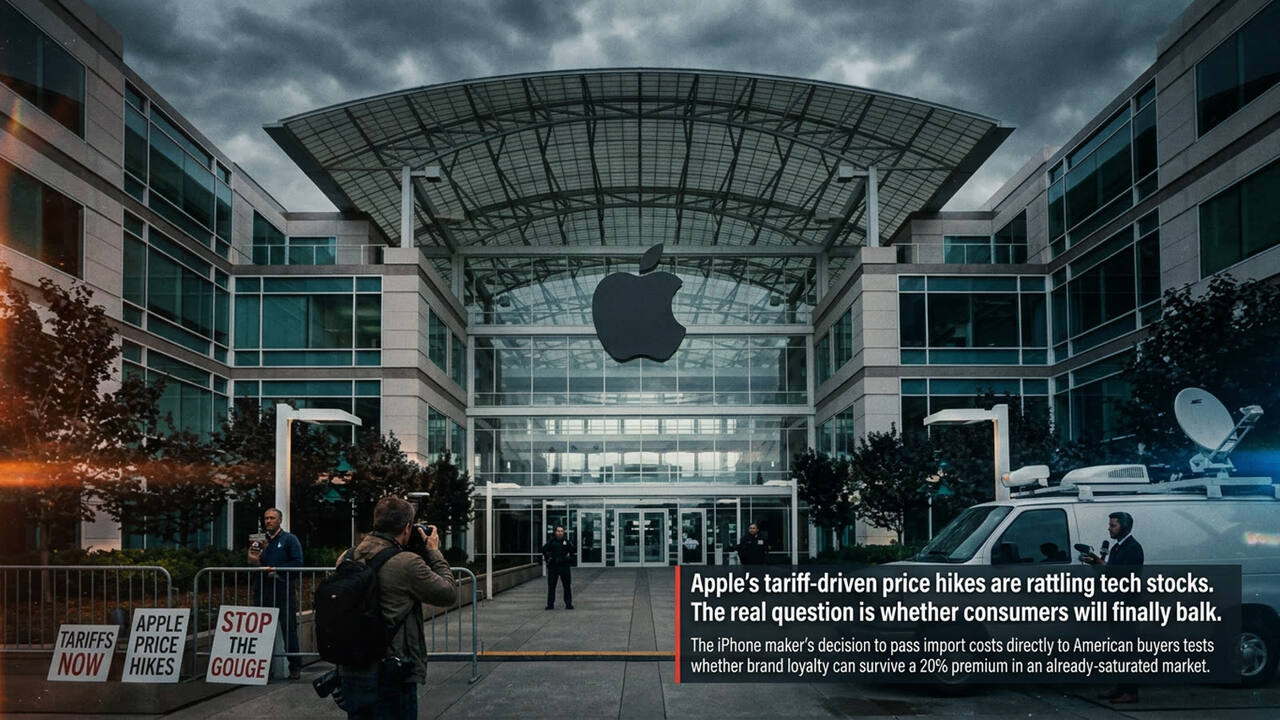
Apple's announcement that it will raise prices across its product lineup to offset tariff costs sent tech stocks sliding on Thursday, with the Nasdaq shedding 1.3% in morning trading. The move marks a strategic pivot for a company that has historically absorbed cost pressures rather than test consumer price sensitivity. This time, Cupertino is betting that customers who paid $1,199 for an iPhone Pro Max will stomach $1,400.
The tariff arithmetic
The numbers are brutally simple. With tariffs on Chinese-assembled electronics now hovering around 25%, Apple faces roughly $15-20 billion in additional annual costs if it maintains current production geography. The company has accelerated manufacturing in India and Vietnam, but those facilities cannot yet match Chinese scale or quality control. Cook's team apparently concluded that margin compression was the greater threat than demand destruction.
Market reaction suggests investors are not convinced. Apple shares fell more than 3% by midday, dragging the broader tech sector with it. The concern is not merely about one quarter's earnings—it is about the precedent. If Apple, with its legendarily loyal customer base, cannot absorb tariff costs, what hope do less beloved brands have?
Consumer psychology at the breaking point
Apple's pricing power has always rested on a peculiar alchemy: the sense that its products exist in a category apart from mere electronics. That perception has justified premium after premium, upgrade after upgrade. But there are limits.
Smartphone replacement cycles have already stretched beyond four years for the average American consumer. The incremental improvements between iPhone generations have become imperceptible to all but the most devoted enthusiasts. A 20% price increase arrives at precisely the moment when the case for upgrading was already weakening.
Retail analysts note that Apple's most price-sensitive customers—those buying base-model iPhones or older iPads—are exactly the segment most likely to defect to Android or simply delay purchases indefinitely. The luxury tier may hold, but volume could suffer.
Oil's quiet slide
Meanwhile, oil prices resumed their decline after a brief spike following yesterday's ship attack in the Red Sea, settling below $72 per barrel. The market's sanguine response suggests traders believe supply disruptions will remain contained—or that demand concerns outweigh geopolitical risk. For consumers, cheaper gasoline offers some offset to pricier gadgets, though the psychological impact of a more expensive iPhone likely outweighs savings at the pump.
Our take
Apple's decision to pass tariff costs to consumers is less a show of strength than an admission of strategic exhaustion. The company that once seemed to operate above the fray of trade wars and supply chain chaos has run out of clever workarounds. Cook is gambling that brand loyalty is infinite, that customers will grumble but ultimately pay. He may be right—Apple has defied pricing gravity before. But every premium product eventually discovers the ceiling. The next two quarters will reveal whether the iPhone has finally found its.