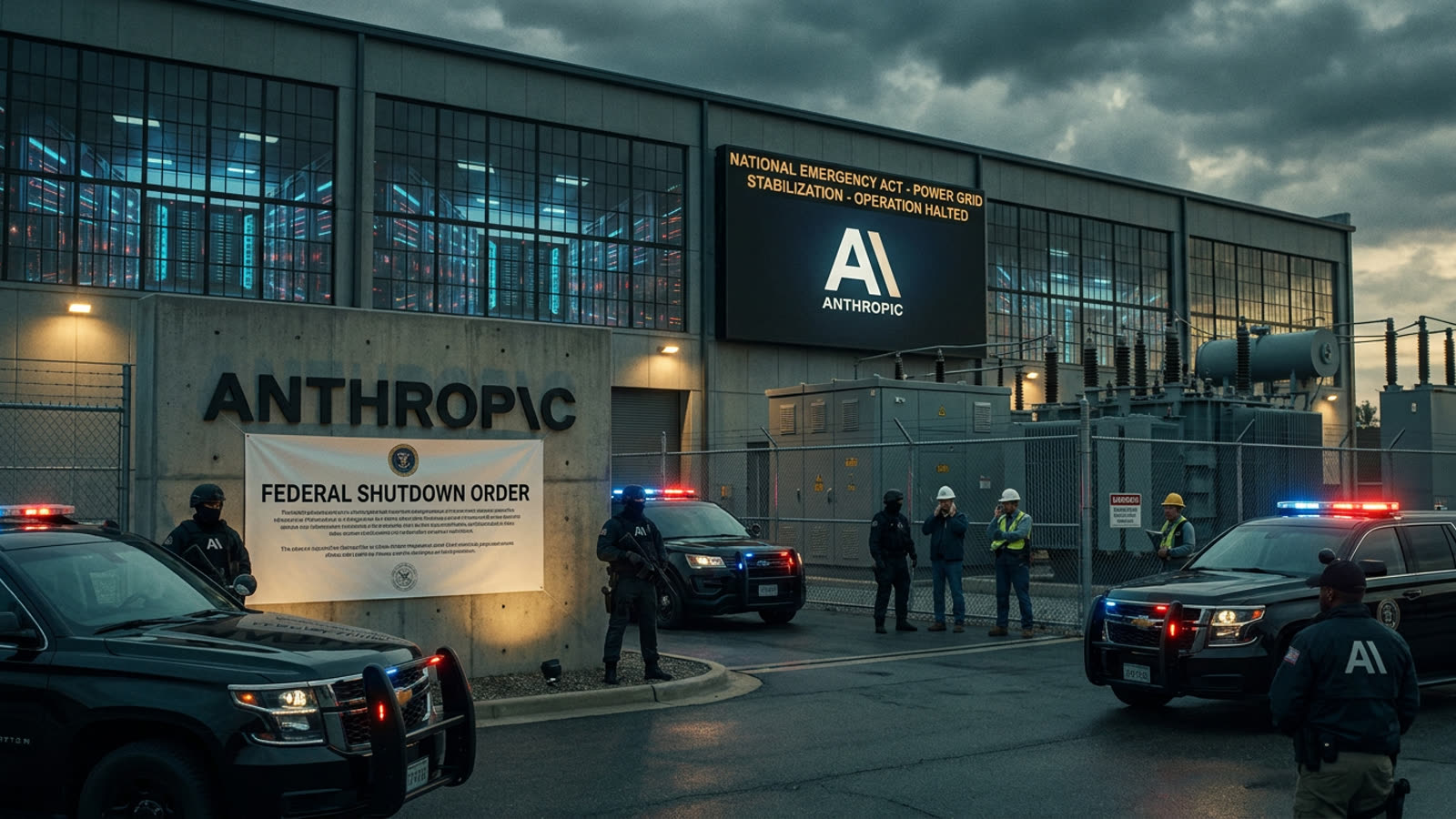
The federal government's decision to suspend Anthropic's flagship AI system marks the first time Washington has forcibly shut down a frontier model not for safety concerns about the technology itself, but because the infrastructure required to run it threatened to destabilize regional power grids.
The order, issued by the Department of Energy in coordination with FERC, came after Anthropic's newest Claude variant began drawing power loads that exceeded contractual limits at multiple data center facilities. The company had been racing to deploy a model requiring computational resources that pushed against the physical limits of American electrical infrastructure.
The gigawatt problem
Anthropic's search for 1 gigawatt of dedicated capacity—enough to power roughly 750,000 homes—illuminates the absurd energy economics of frontier AI. The company's pre-IPO shares dropped sharply on the news, but the real story isn't about one firm's stock price. It's about whether the United States can physically support the AI industry it has spent billions subsidizing.
Data centers already consume approximately 4% of U.S. electricity. The major AI labs are collectively seeking power allocations that would require the equivalent of several new nuclear plants coming online within years, not the decades such projects typically require. Grid operators in Virginia, Texas, and the Pacific Northwest have all reported that AI-related power requests now exceed available capacity.
Regulatory improvisation
The shutdown order exists in a legal gray zone. No federal statute explicitly grants the government authority to suspend AI operations for power consumption reasons. The DOE invoked emergency grid-reliability provisions designed for natural disasters and equipment failures, not for telling a $60 billion company that its software uses too much electricity.
This improvisation signals that American AI governance remains dangerously ad hoc. Congress has held dozens of hearings on algorithmic bias and existential risk, yet the most immediate constraint on AI development turns out to be something far more mundane: whether the lights stay on.
The pre-IPO fallout
Anthropic had been positioning for a public offering that would value the company among the most valuable startups in history. That timeline now faces serious uncertainty. Investors who purchased pre-IPO shares through secondary markets watched their positions decline as news spread, a reminder that betting on AI companies means betting on their ability to secure physical resources, not just intellectual ones.
The company's rivals face similar constraints but have been more conservative in deployment timelines. OpenAI and Google DeepMind have both announced partnerships with nuclear energy providers, effectively acknowledging that AI's future depends on solving a 20th-century problem: generating enough electricity.
Our take
The Anthropic shutdown is less a setback for one company than a preview of AI's infrastructure winter. America has chosen to lead in artificial intelligence without first ensuring it can power that ambition. The result is a government forced to ration computational resources like a developing nation managing rolling blackouts. The irony is sharp: the world's most advanced AI systems may ultimately be constrained not by alignment problems or regulatory caution, but by the humble copper wire and the spinning turbine.