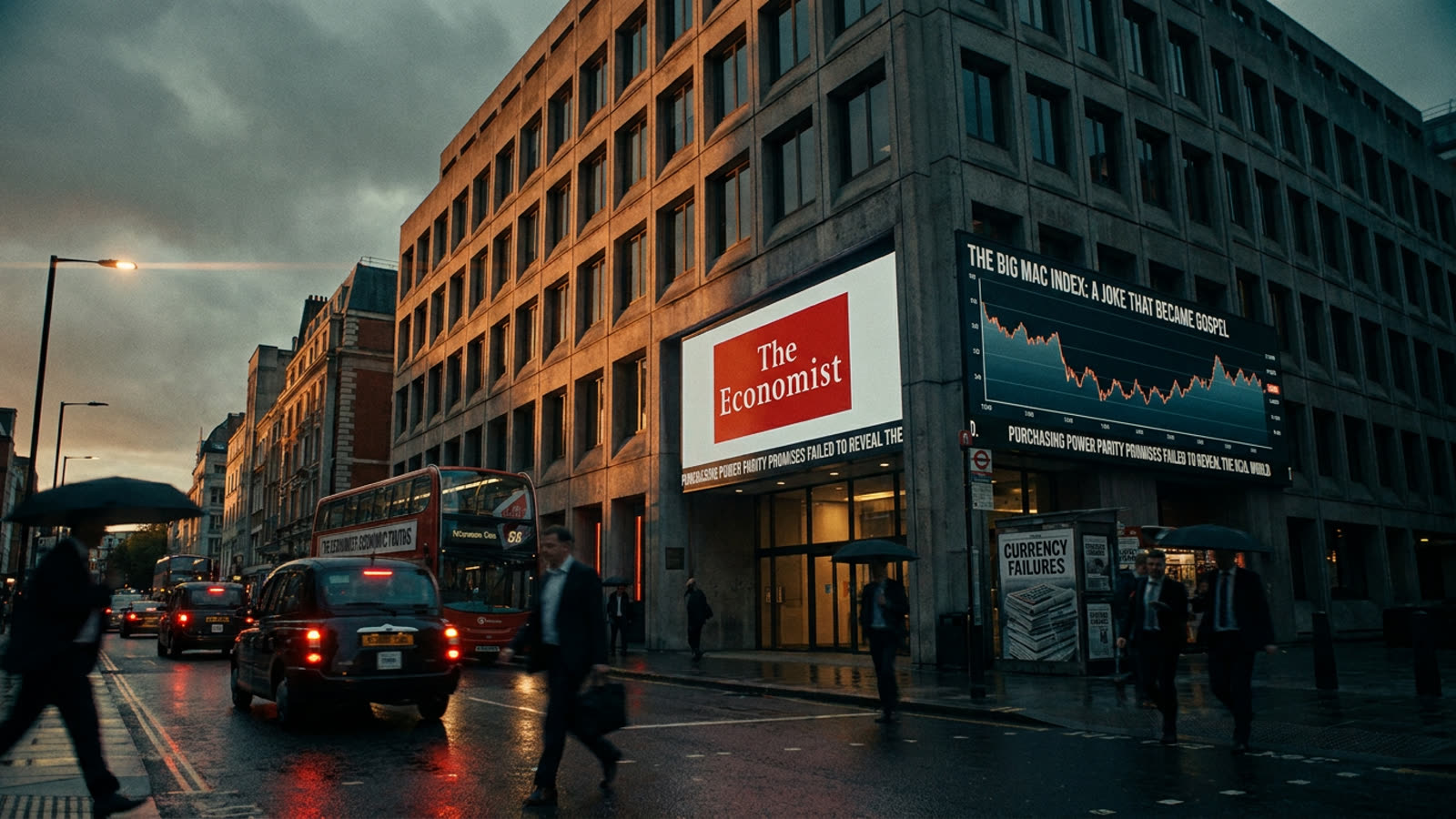
In 1986, The Economist invented a currency-valuation tool as a tongue-in-cheek thought experiment. Nearly four decades later, finance ministers cite it in speeches, hedge funds reference it in pitch decks, and economics textbooks present it with a straight face. The Big Mac Index — which compares the price of McDonald's signature burger across countries to estimate whether exchange rates are at their "correct" level — has become the world's most famous application of purchasing power parity. That it started as a joke tells you everything about the theory's awkward relationship with reality.
Purchasing power parity, or PPP, rests on a seductive premise: identical goods should cost the same everywhere once you account for exchange rates. If a basket of groceries costs $100 in New York and €90 in Paris, the "fair" dollar-euro rate should be roughly 1.11. When actual exchange rates diverge from this implied rate, currencies are deemed over- or undervalued, destined to correct over time. The logic feels airtight. The evidence is anything but.
Why the theory keeps failing
PPP's foundational assumption — that arbitrage will equalize prices across borders — ignores almost everything that makes real economies messy. Shipping costs, tariffs, taxes, local wages, real estate prices, and regulatory regimes all drive persistent price differences that have nothing to do with currency misalignment. A Big Mac in Zurich costs more than one in Manila not because the Swiss franc is overvalued, but because Swiss rent, Swiss labor, and Swiss beef all cost more. The burger is identical; the inputs are not.
Empirical studies have repeatedly shown that exchange rates can deviate from PPP-implied levels for years, sometimes decades. The Japanese yen spent most of the 1990s and 2000s at levels PPP models deemed wildly undervalued, yet the correction never came in the way the theory predicted. Traders who bet on mean reversion learned expensive lessons about how long markets can stay "irrational."
The index's quiet utility
None of this means PPP is useless. For comparing living standards across countries — asking whether a middle-class salary in São Paulo buys more comfort than one in Stockholm — PPP-adjusted figures are indispensable. The World Bank and IMF rely on PPP calculations to measure poverty and economic output in ways that raw exchange rates would distort beyond recognition. China's economy looks very different depending on whether you measure it in market dollars or PPP dollars, and both figures reveal something true.
The Big Mac Index itself has evolved. The Economist now publishes an "adjusted" version that accounts for GDP per capita, tacitly acknowledging that comparing burger prices between Switzerland and Vietnam without context is absurd. The adjustment makes the index more accurate and considerably less fun.
Our take
PPP endures because it answers a question everyone wants answered: what is a currency really worth? That the answer is perpetually wrong in the short term and only vaguely right in the long term has not dimmed its appeal. Economists keep refining the models; markets keep ignoring them. The Big Mac Index remains the perfect emblem of this tension — a gag that became a benchmark precisely because no one has invented a better one. Sometimes the most honest thing a theory can do is admit it started as a joke.