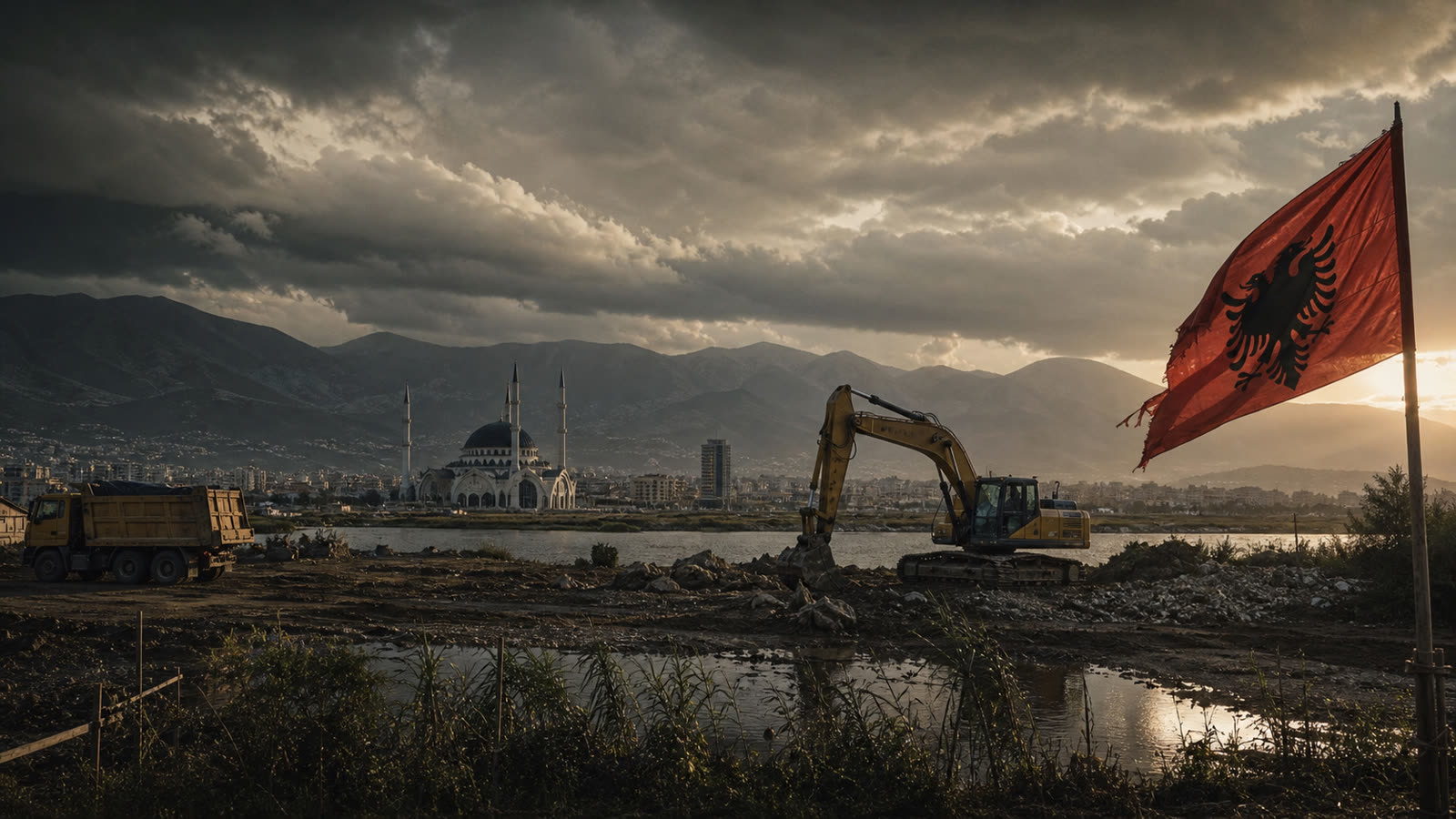
Albania's government is gambling that the Trump name is worth more than EU accession rules, and possibly more than the country's own coastline.
The Vjosa-Narta Protected Landscape, a 230-square-kilometer wetland on Albania's southern Adriatic coast, was until recently one of the last undeveloped stretches of Mediterranean shoreline. It is home to endangered Dalmatian pelicans, serves as a critical stopover for migratory birds, and sits atop one of Europe's last wild river deltas. It was also, until a quiet regulatory change earlier this year, off-limits to large-scale construction. Now a Trump-branded luxury resort is slated to rise there, and the Albanian government appears to be rewriting the rules in real time to make it happen.
The regulatory sleight of hand
Dutch MEP Bas Eickhout has accused Tirana of deploying "sneaky" practices to circumvent environmental impact assessments that would normally apply under EU candidate-country obligations. Albania, which opened formal accession negotiations in 2022, is bound by the EU's environmental acquis—the body of law that governs everything from habitat protection to water quality. Yet the government has reportedly reclassified portions of the protected area and fast-tracked permitting in ways that sidestep standard review periods. Protests against the development have turned violent, with local activists clashing with police near the construction perimeter.
The Trump Organization has not commented on the controversy, but the project's local partners have defended it as a job-creating boon for a region with double-digit unemployment. The resort is expected to include a golf course, marina, and several hundred hotel rooms—amenities that require precisely the kind of land transformation the protected designation was meant to prevent.
Why this matters beyond Albania
The Vjosa-Narta case is not merely a local zoning dispute. It is a stress test for the EU's leverage over candidate countries at a moment when that leverage is already fraying. Hungary and Serbia have shown that membership aspirations do not guarantee compliance with Brussels' preferences; Albania may be learning the same lesson. If Tirana can secure a high-profile American investment by bending environmental rules, other Balkan governments will take note.
There is also the awkward question of what the Trump brand now represents. In the United States, the president's approval rating has sunk to new lows, with a Washington Post-ABC poll this week showing 66 percent of Americans believe he is using the presidency for personal enrichment. A resort bearing his name, built on contested land with contested permits, is unlikely to improve that perception—though it may not need to. The Trump Organization's international business has long operated on the theory that controversy is a feature, not a bug.
Our take
Albania is not the first country to sacrifice a wetland for a golf course, and it will not be the last. But the brazenness here is instructive. Tirana is betting that the EU, distracted by Ukraine and its own internal fractures, will not make an example of a small Balkan state over a few pelicans. That bet may prove correct. The more interesting question is whether Albania's political class has calculated the long-term cost of signaling that its laws are negotiable for the right investor. Environmental protections, once hollowed out, rarely recover. Neither, sometimes, does a country's credibility.