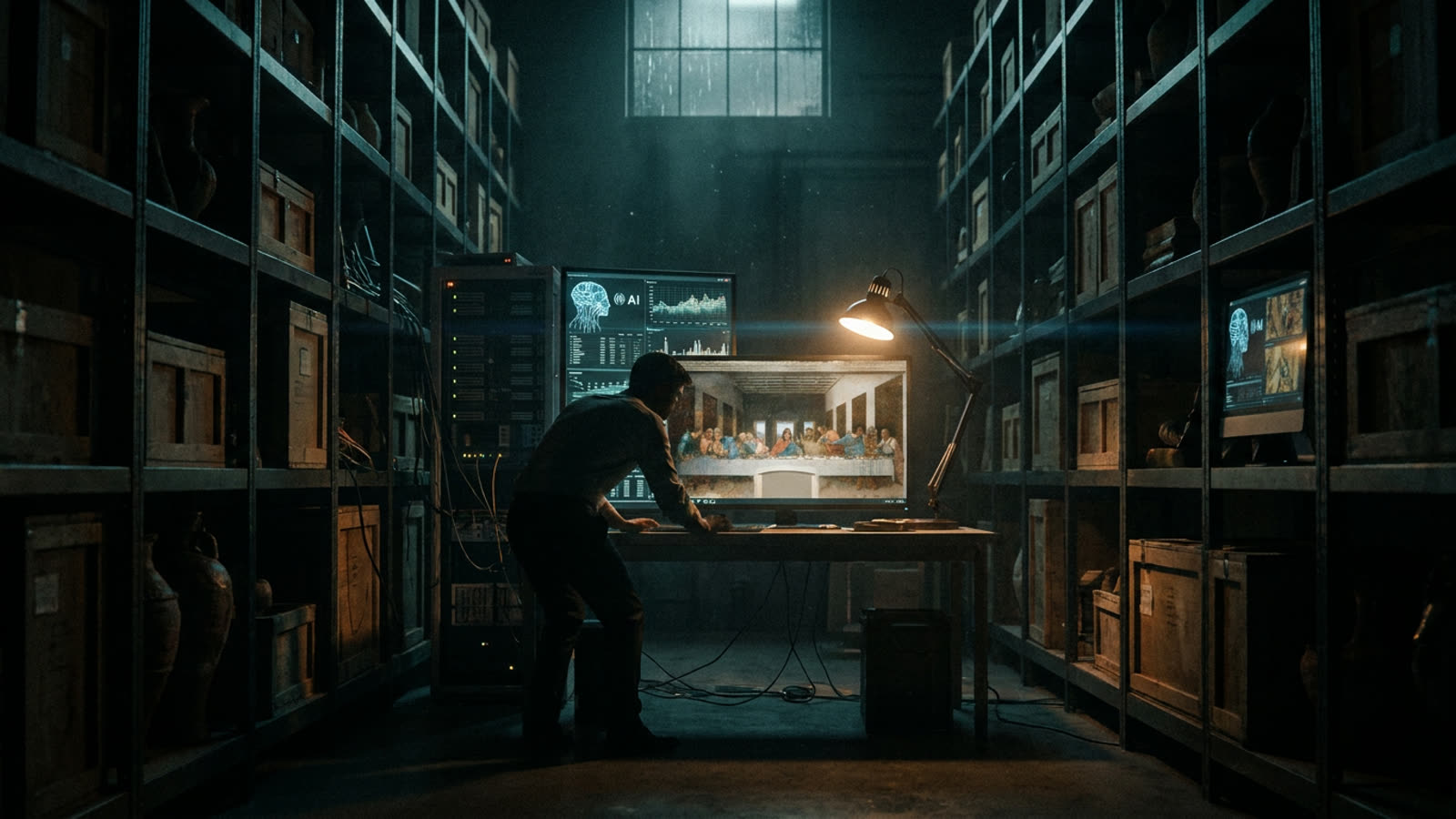
The average major museum displays perhaps five percent of its collection at any given time. The rest — millions of objects ranging from Roman coins to Victorian mourning jewelry to fragments of cuneiform tablets — sits in climate-controlled storage, cataloged in systems that often date to the punch-card era. This invisible archive represents humanity's material memory, and artificial intelligence is fundamentally changing how institutions manage it.
The transformation is unglamorous but profound. Where a human cataloger might spend fifteen minutes describing a single ceramic shard — noting its provenance, condition, stylistic period, and relationship to similar objects — machine learning systems can now process thousands of images per hour, flagging anomalies, suggesting classifications, and identifying connections that would take researchers years to discover manually.
The backlog problem
Museums have always faced an impossible arithmetic. Collections grow faster than budgets for cataloging staff. The British Museum holds roughly eight million objects; the Smithsonian's various institutions collectively possess over 155 million. Many items acquired decades ago remain only partially documented, their stories locked away in handwritten notes or the memories of retired curators.
AI offers a path through this backlog. Computer vision systems trained on existing catalogs can examine photographs of uncatalogued objects and propose likely dates, origins, and material compositions. Natural language processing can extract structured data from handwritten accession records, digitizing institutional knowledge that would otherwise fade. The goal is not to replace curatorial expertise but to multiply it — to let specialists focus on interpretation while algorithms handle the initial sorting.
Conservation's new eyes
Beyond cataloging, AI is proving valuable for preservation. Machine learning models can analyze high-resolution images of paintings to detect early signs of deterioration invisible to the human eye: microscopic flaking, subtle color shifts that indicate chemical degradation, or structural weaknesses in canvas. Some institutions now conduct regular AI-assisted condition surveys, catching problems before they become crises.
The technology also enables new forms of research. By training models on authenticated works, scholars can more systematically analyze questions of attribution and workshop practice. When a model identifies that a particular brushstroke pattern appears in only three of a painter's known works, it raises questions worth investigating — not as definitive judgment, but as a starting point for human inquiry.
The limits of automation
Museum professionals remain appropriately cautious. AI systems inherit the biases of their training data; a model trained primarily on Western European collections may misclassify objects from other traditions. The contextual knowledge that makes curatorial work meaningful — understanding why a particular textile matters to a specific community, or how an object's meaning has shifted over centuries — remains stubbornly human.
There are also institutional concerns. Smaller museums with limited technical infrastructure struggle to implement these tools. The field risks a widening gap between well-resourced institutions that can deploy AI effectively and those that cannot. And there are unresolved questions about what happens when AI-generated catalog entries contain errors that propagate through interconnected databases.
Our take
The museum sector's quiet adoption of AI represents something increasingly rare in technology coverage: a story about genuine, incremental utility rather than revolutionary disruption. These tools are not replacing curators any more than searchable databases replaced librarians. They are expanding what is possible, making the vast invisible collections of human material culture slightly more accessible, slightly better preserved, slightly more connected. In a field defined by patience and the long view, that modest progress matters more than any chatbot's party tricks.