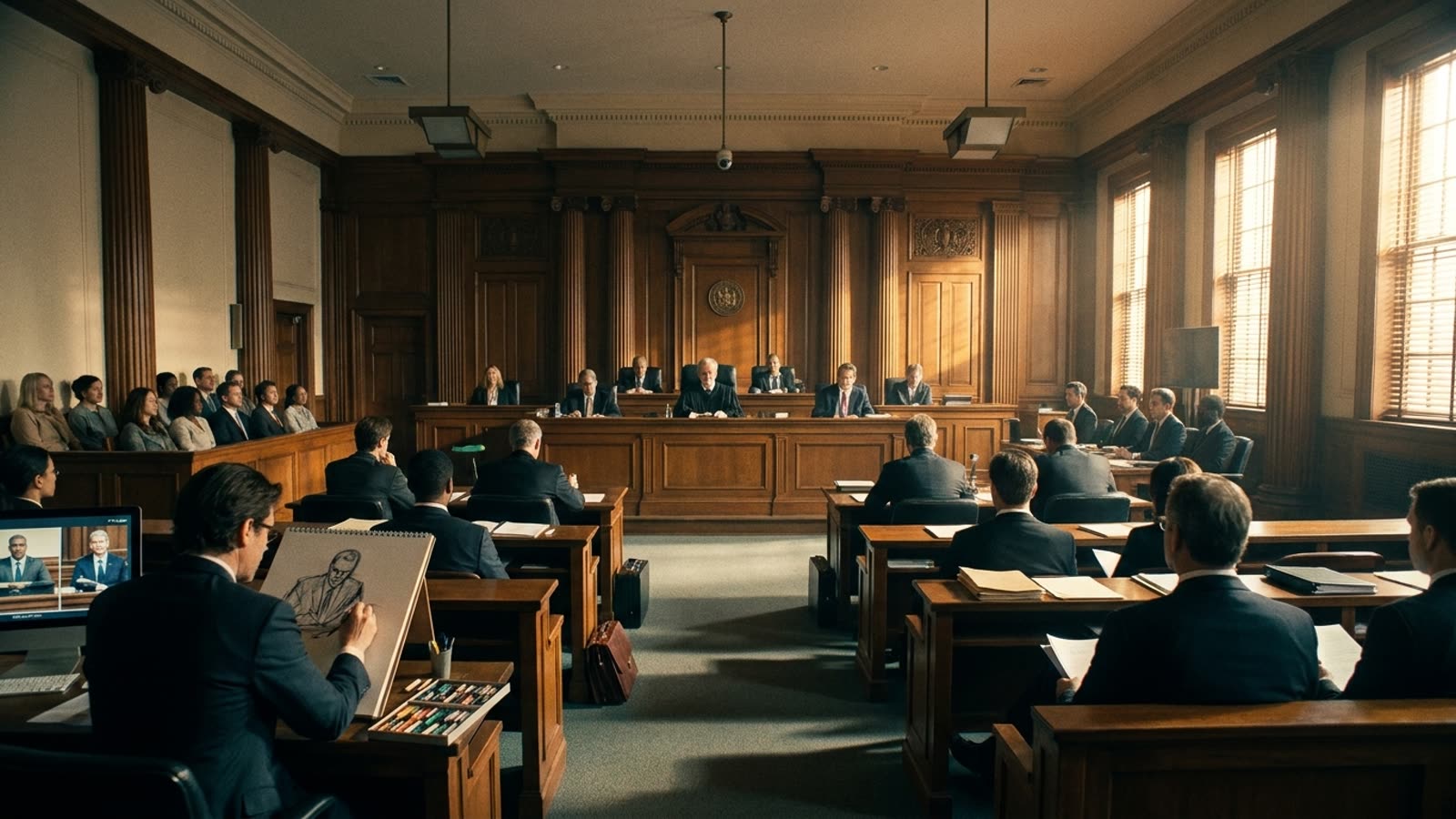
For more than a century, courtroom sketch artists have occupied one of journalism's most peculiar niches: human cameras permitted where mechanical ones are banned. They sit in federal courtrooms across America, pastels in hand, translating the theater of justice into images that land on the evening news within hours. It is a profession that technology should have killed decades ago. Instead, the age of generative AI is giving it an unexpected second act.
The paradox is straightforward. The same tools that can conjure photorealistic images of anything—including convincing depictions of defendants who never existed in trials that never happened—have made the authenticated human witness more valuable, not less. When anyone with a laptop can fabricate a courtroom scene, the artist who was physically present becomes a guarantor of truth rather than merely its illustrator.
The authentication problem
News organizations have grappled with AI-generated imagery since text-to-image models went mainstream. Fake photographs of public figures in compromising situations circulate constantly; synthetic video is not far behind. Courtroom proceedings present a particular vulnerability because cameras are prohibited in most federal trials, leaving a visual vacuum that fabricators can exploit.
The traditional sketch artist fills that vacuum with something AI cannot replicate: verified presence. When a news outlet publishes a sketch by an artist credentialed to sit in the courtroom, it is publishing testimony. The artist saw the defendant's posture, caught the prosecutor's gesture, noticed which juror was dozing. These details are not retrievable from training data. They are observations made under oath, essentially, by someone whose professional reputation depends on accuracy.
A craft preserved by accident
The survival of courtroom sketching into the twenty-first century was already improbable. The profession exists because of a 1946 federal rule banning cameras from trial proceedings—a prohibition that most legal scholars expected to erode as video technology became less intrusive. Instead, high-profile trials from the Nuremberg successor proceedings to various organized crime cases kept reinforcing judicial skepticism about cameras. The sketch artist remained the only visual journalist allowed inside.
What no one anticipated was that the very technology threatening to make all images suspect would validate the handmade artifact. A pastel drawing on textured paper, signed by a known artist with a documented chain of custody, carries a provenance that a JPEG cannot. It is not that the sketch is more accurate than a photograph would be—it is that its authenticity is legible in ways a digital file's is not.
The economics of scarcity
There are perhaps two dozen working courtroom sketch artists in the United States who cover federal proceedings regularly. The number has held roughly steady for years, neither growing nor shrinking dramatically. Demand spikes during major trials—a former president's criminal case, a celebrity's fraud prosecution—then subsides. The artists are mostly freelancers, paid per assignment, their income unpredictable.
Yet several have reported that news organizations are now more explicit about why they want human sketches rather than AI-assisted reconstructions. The request is not merely aesthetic; it is evidentiary. Editors want to tell audiences that what they are seeing was drawn by someone who was there. In an information environment saturated with synthetic imagery, that guarantee has become a selling point.
Our take
The courtroom sketch artist is a relic that refuses to become obsolete, and their persistence says something uncomfortable about where we have landed. We built tools capable of generating any image imaginable, and in doing so, we made the handmade image newly precious. The sketch artist's value is no longer artistic—it is testimonial. They are not illustrators anymore; they are witnesses who happen to draw. That is a strange thing for a profession to become, but it may be exactly what the age of synthetic everything requires.