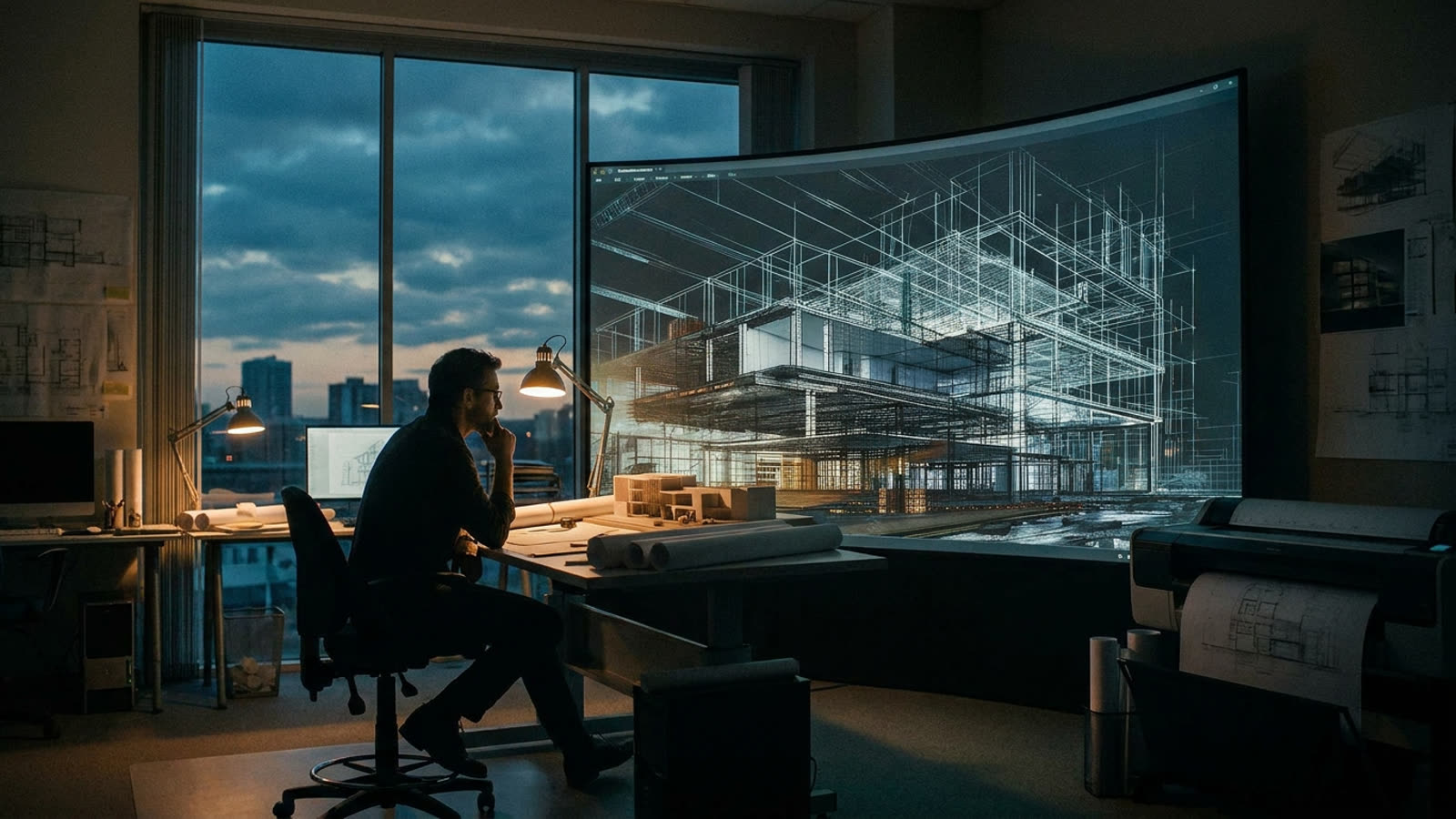
Walk into a mid-sized architecture firm today and you will find something that would have seemed improbable a decade ago: junior associates spending less time hunched over code compliance spreadsheets and more time in actual design conversations. The shift is subtle, largely invisible to clients, and rarely discussed in the breathless coverage of artificial intelligence — but it represents one of the more profound transformations happening in a white-collar profession right now.
Architecture has always been a field that romanticizes the creative act while burying practitioners in administrative drudgery. A licensed architect in the United States might spend a quarter of their working hours on tasks that have nothing to do with design: verifying setback requirements, cross-referencing fire egress codes, ensuring ADA compliance across hundreds of door specifications. This is the work that generative AI tools are now quietly consuming.
The compliance layer
Building codes are dense, jurisdictionally fragmented, and constantly updated. A project in Chicago operates under different rules than one in Phoenix, and both differ from anything in the European Union. Traditionally, firms employed specialists or devoted significant associate time to parsing these requirements and flagging conflicts early in the design process.
AI systems trained on municipal codes and historical permit data can now perform this triage in minutes rather than days. They do not replace the judgment call — a human still decides whether to redesign a stairwell or seek a variance — but they surface the relevant constraints before expensive mistakes get baked into construction documents. Several major firms have reported that code review cycles that once took weeks now conclude in a fraction of that time.
Generative sketching and its limits
The more visible application involves design generation itself. Feed a prompt describing site conditions, program requirements, and aesthetic preferences, and current tools can produce dozens of massing studies, facade variations, and spatial arrangements. This sounds like it should terrify architects, but the profession's reaction has been more nuanced.
The outputs are useful as starting points — provocations that accelerate the early ideation phase. They are not, however, architecture. They lack the embedded knowledge of how materials age, how light moves through a space across seasons, how a building relates to its neighbors and street life. They optimize for parameters that can be quantified while remaining blind to the ineffable qualities that distinguish a competent building from a meaningful one.
What this means in practice is that architects are becoming editors and curators of machine-generated possibilities rather than authors of every line. The skill set is shifting toward rapid evaluation, toward knowing which generated option contains the seed of something worth developing and which is a dead end dressed in plausible geometry.
The billable hour problem
Architecture firms have traditionally billed by the hour or as a percentage of construction cost. When AI compresses a forty-hour task into four hours, the economic model strains. Some firms are experimenting with value-based pricing — charging for outcomes rather than time — but the transition is awkward. Clients accustomed to seeing detailed hour logs want to understand what they are paying for when the answer is increasingly "judgment" rather than labor.
Younger architects face a particular bind. The tedious early-career work that AI now handles was also the training ground where they learned how buildings actually get built. If you never spend months buried in door schedules, do you develop the intuition to know when a door schedule is wrong? The profession has not yet answered this question, though some firms are deliberately rotating associates through AI-assisted and traditional workflows to preserve tacit knowledge transfer.
Our take
Architecture may be the ideal case study for how AI reshapes knowledge work without eliminating it. The profession's core value proposition — synthesizing technical constraints, human needs, cultural context, and aesthetic vision into built form — remains stubbornly resistant to automation. What is being automated is the friction around that core, the administrative overhead that has long made architecture a less creative job than its reputation suggests. If firms and clients can navigate the economic disruption, architects might find themselves doing more of what drew them to the field in the first place. That would be a rare case of technology fulfilling its promise rather than subverting it.