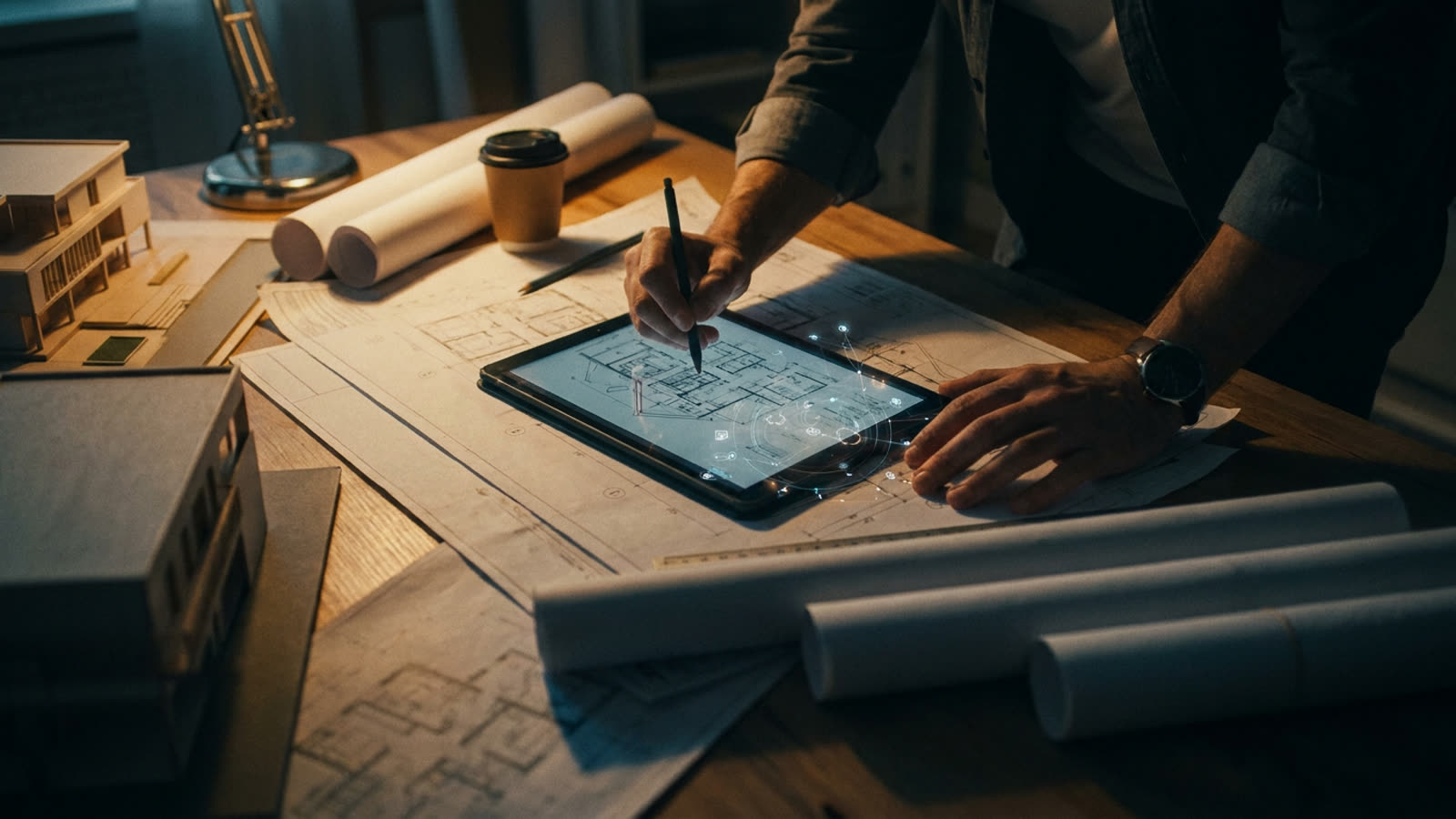
Architecture has always been a discipline caught between art and engineering, between the singular vision of a creator and the collective labor of making buildings stand up. Now a third tension has emerged: between human intuition and machine optimization. The quiet integration of AI tools into architectural practice over the past several years has not produced the dramatic displacement that headlines predicted. Instead, it has triggered something more interesting—a slow-motion redefinition of what architects actually do.
The change began with the tedious work. Generative design tools now produce thousands of floor plan variations in the time a junior architect once spent sketching a handful. Energy modeling that required specialist consultants can run in real-time as designers adjust window placements. Zoning compliance checks that consumed days happen in seconds. These efficiencies sound like simple productivity gains, but their cumulative effect reshapes the profession's entire apprenticeship model.
The vanishing grunt work problem
For generations, young architects learned their craft through repetition—drafting the same details, calculating the same loads, producing the same permit drawings. This grunt work was tedious, but it was also pedagogical. You understood buildings by drawing them badly a hundred times before drawing them well. AI tools have begun to hollow out this middle ground. The work that remains for humans clusters at two extremes: the conceptual and the relational.
At the conceptual end, architects increasingly function as curators of machine-generated possibilities, selecting from AI proposals rather than generating from scratch. At the relational end, they spend more time in client meetings, community consultations, and contractor negotiations—work that requires reading rooms, not rendering them. The architects thriving in this environment tend to be those comfortable with ambiguity and persuasion, skills that architecture schools have historically undertaught.
The new gatekeepers
Perhaps more consequential than what AI does is who controls it. The major generative design platforms are built by a handful of software companies, each encoding particular assumptions about what makes a building good. These tools optimize for measurable outcomes—energy efficiency, structural economy, code compliance—because those are the parameters they can quantify. Qualities that resist measurement, like the feeling of a space or its relationship to cultural memory, get quietly deprioritized.
This creates a subtle homogenization pressure. When every firm uses similar tools trained on similar datasets, their outputs converge toward similar solutions. The most distinctive architecture has always emerged from constraints creatively misread, from rules bent in ways that reveal new possibilities. AI tools, by their nature, enforce the rules they were trained on. The profession's challenge is preserving space for productive rule-breaking.
Our take
The architects who will matter in the coming decades are not those who resist AI nor those who surrender to it, but those who understand it well enough to know when to override it. The pencil learned to think, but thinking is not the same as knowing what is worth building. That judgment—informed by history, culture, and the irreducible strangeness of human desire—remains stubbornly analog. The profession's future depends on remembering that efficiency is a means, never an end, and that the best buildings have always been arguments about how we should live, not optimizations of how we already do.