For seventy years, weather forecasting has worked the same way. Supercomputers divide the atmosphere into a three-dimensional grid, then solve the Navier-Stokes equations—the fundamental physics of fluid dynamics—at each point, stepping forward in time to predict what happens next. The approach is called numerical weather prediction, and it has been one of computing's greatest triumphs. A five-day forecast today is as accurate as a one-day forecast was in the 1980s.
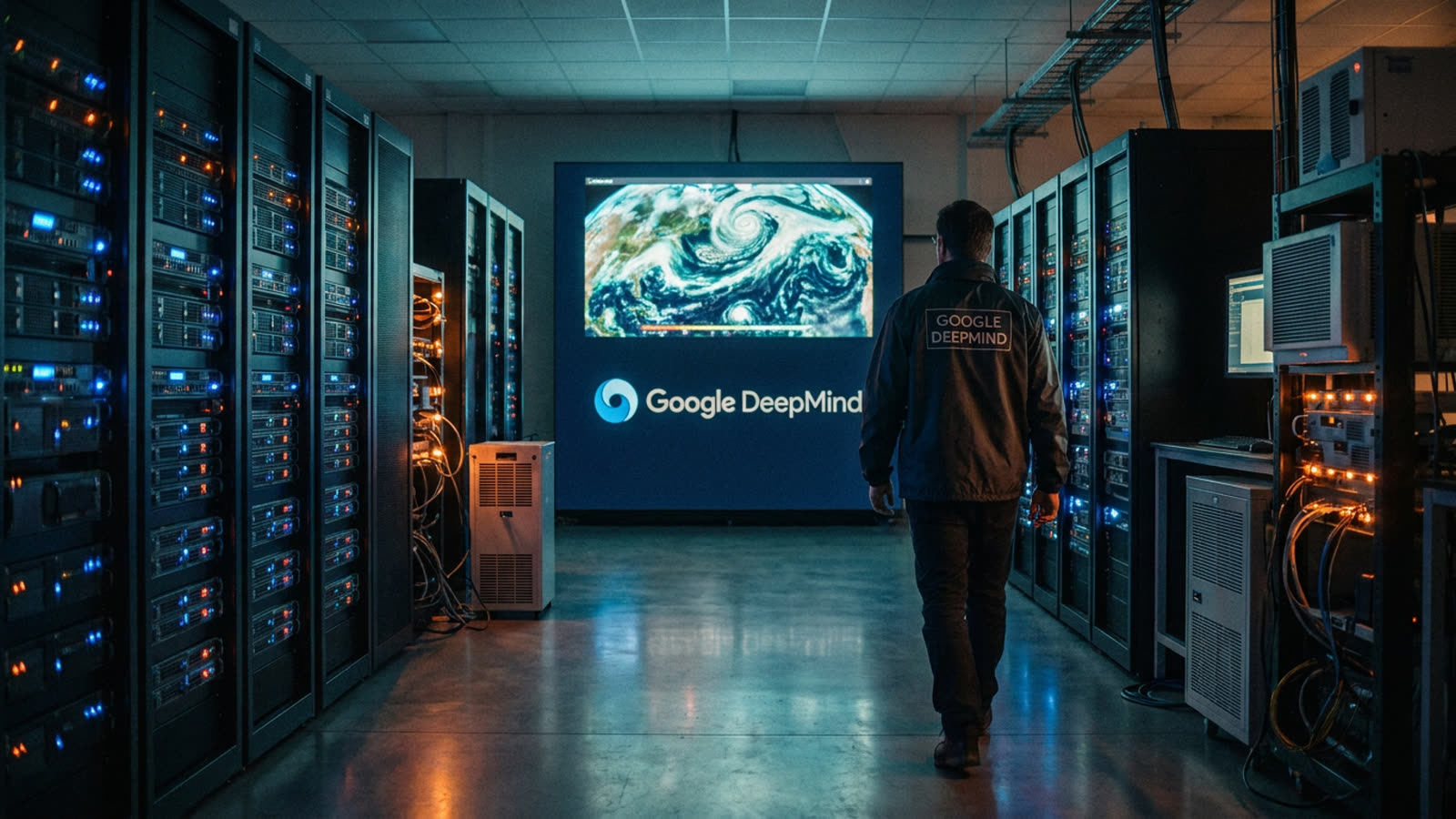
But something strange happened in 2023. Google DeepMind released a model called GraphCast that could produce ten-day forecasts in under a minute on a single machine—forecasts that, on most metrics, beat the European Centre for Medium-Range Weather Forecasts, the gold standard of global prediction. The model had never been taught the Navier-Stokes equations. It had simply learned patterns from four decades of historical weather data.
The physics-free approach
Traditional forecasting is computationally brutal. The ECMWF runs its models on one of Europe's largest supercomputers, consuming enough electricity to power a small town. Each forecast requires solving billions of equations across millions of grid points. The physics is explicit: pressure gradients drive winds, temperature differences create convection, moisture condenses into clouds according to well-understood thermodynamics.
AI weather models take a radically different approach. They treat forecasting as pattern recognition. Given the current state of the atmosphere, what state typically follows? The models—GraphCast, Huawei's Pangu-Weather, Nvidia's FourCastNet—are trained on reanalysis datasets that combine decades of observations with model outputs to create a consistent picture of past weather. They learn statistical relationships that implicitly encode physical laws without ever being told what those laws are.
The results have stunned meteorologists. These models match or exceed traditional forecasts on standard metrics while running thousands of times faster and using a fraction of the energy. They're particularly strong at predicting large-scale patterns like the track of tropical cyclones.
What AI gets wrong
The revolution has limits. AI models struggle with extreme events—the very phenomena that matter most for public safety. They tend to produce slightly blurry forecasts, averaging out the sharpest features. A hurricane's eye appears fuzzier; a squall line loses its edge. This happens because the models optimize for average accuracy, and predicting the mean outcome is safer than predicting rare extremes.
There's also the problem of physical consistency. A traditional model conserves mass and energy because the equations demand it. An AI model might subtly violate these constraints in ways that compound over longer forecasts. And when conditions fall outside the training data—a warming climate producing unprecedented heat waves—the models have no physical intuition to fall back on.
The major forecasting centers have responded cautiously. The ECMWF now runs AI models alongside its traditional system, treating them as complementary rather than replacement tools. The U.S. National Weather Service has been slower to integrate machine learning, partly due to institutional caution and partly because American forecasters place heavy emphasis on severe weather—tornadoes, derechos, flash floods—where AI's weaknesses are most apparent.
Our take
The weather forecasting revolution is a preview of something larger: the strange discovery that brute-force pattern recognition can sometimes outperform explicit understanding. Meteorologists spent decades encoding atmospheric physics into equations; AI learned equivalent predictive power from data alone. This doesn't mean physics is obsolete—the best forecasts will likely combine both approaches—but it does suggest that human-interpretable theory may not always be the fastest path to practical capability. That's an unsettling thought for scientists who believe understanding should precede prediction. The atmosphere, it turns out, doesn't care whether we understand it.