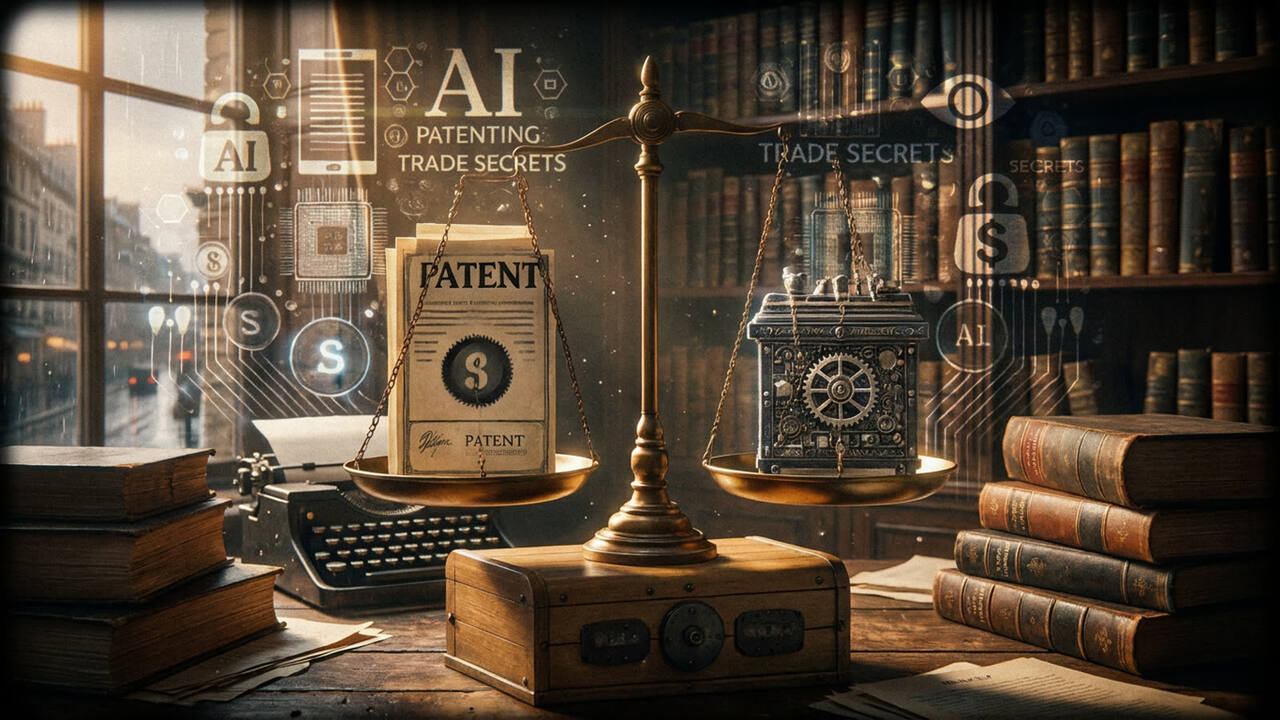
Patent law has always been a peculiar corner of the legal profession, a place where engineers become lawyers and lawyers pretend to be engineers. Now a third species has arrived: the large language model, and it is making itself comfortable in ways that reveal uncomfortable truths about creativity, authorship, and the future of innovation itself.
The transformation is not hypothetical. Across major intellectual-property firms, attorneys now routinely feed invention disclosures into AI systems that generate draft patent claims, identify relevant prior art across millions of documents, and flag potential invalidity arguments before a human examiner ever sees the application. What once took a junior associate three days now takes forty minutes. The economics are irresistible; the implications are not.
The prior-art revolution
Searching for prior art—the existing knowledge that determines whether an invention is truly novel—used to be part craft, part drudgery. Experienced patent searchers developed intuitions about where to look, which databases to query, which foreign-language sources might contain a killer reference. AI has collapsed this process. Modern systems can ingest a patent application and, within seconds, surface semantically similar disclosures from obscure journals, lapsed patents, and technical manuals that no human would have found in a reasonable timeframe.
This is, on its face, a good thing. Better prior-art searches should mean fewer bad patents, less litigation over rights that should never have been granted. But the same tools are available to applicants, who can now optimize their claims to thread the needle of existing art with surgical precision. The arms race has merely shifted to a higher plane.
The authorship problem
More troubling is the question of who actually writes the patent. When an AI system drafts claims based on an engineer's rough description, and a human attorney edits those claims, the resulting document is a collaboration between three parties—only two of whom can sign anything. Patent offices worldwide have begun grappling with AI-generated inventions, but the more immediate issue is AI-generated applications for human inventions. The prose, the structure, the strategic choices about what to claim broadly and what to claim narrowly: these are increasingly machine outputs refined by human judgment.
The legal fiction holds, for now. An attorney attests to the application's accuracy; an inventor swears to having invented. But the intellectual labor has been redistributed in ways the system was never designed to accommodate.
Our take
Patent law exists to encourage innovation by granting temporary monopolies to those who disclose their inventions to the public. The bargain assumes a human inventor, a human drafter, and a human examiner engaged in a good-faith negotiation over the boundaries of protection. AI does not break this system—it reveals how fragile the assumptions always were. The profession is adapting faster than the doctrine, and that gap will produce consequences we have not yet imagined.