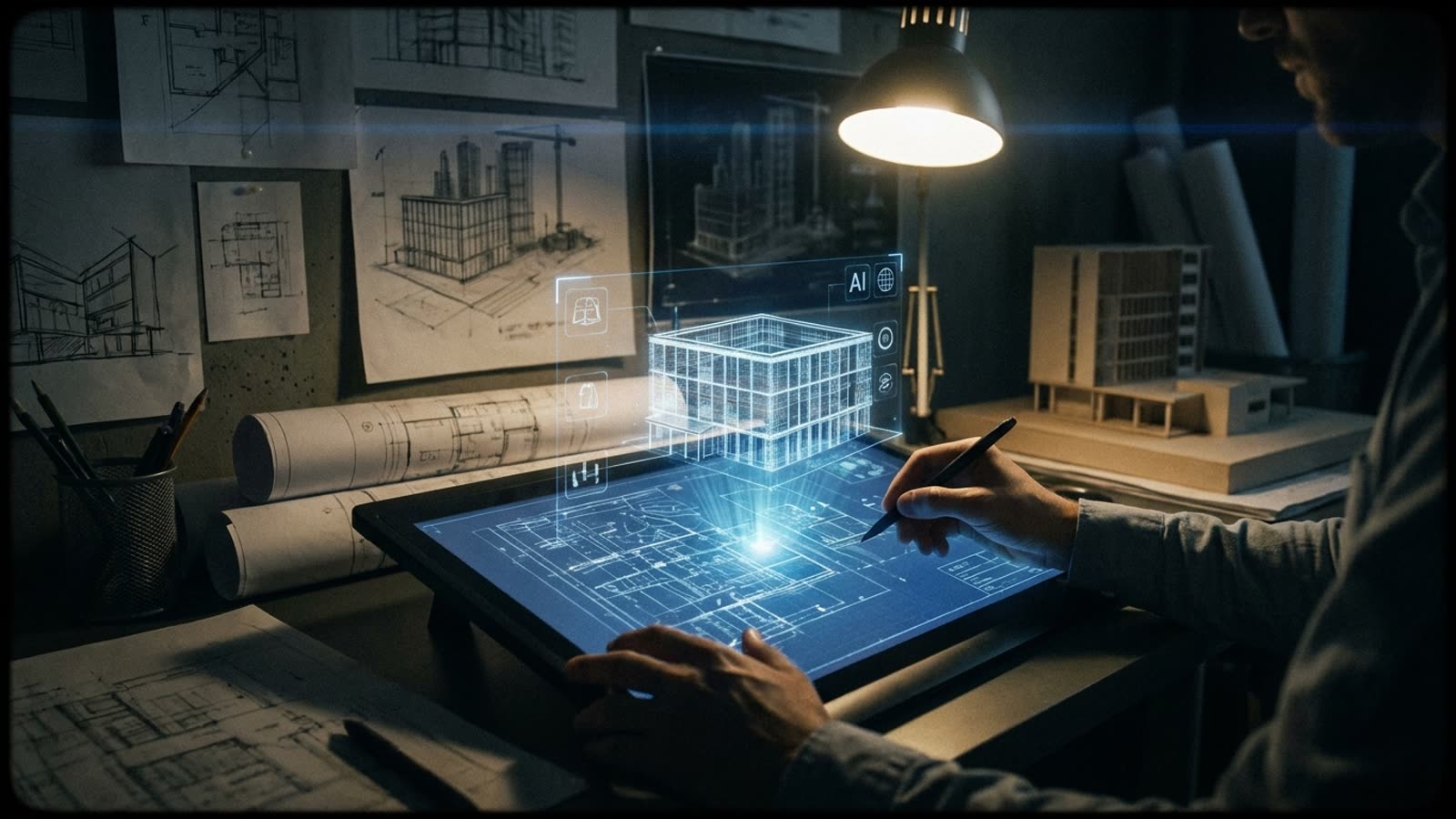
The rendering looked plausible enough—a mid-rise residential tower with an articulated façade, balconies staggered to maximize light, a ground-floor retail arcade that opened onto a pedestrian plaza. It had been generated in under ninety seconds by a large language model fine-tuned on architectural datasets. The senior partner at a London firm, reviewing it during a client pitch, found himself in an unfamiliar position: defending his profession's relevance against a tool that could produce variations faster than his associates could sharpen a pencil.
Architecture has always absorbed new technologies—CAD replaced the drafting table, BIM replaced CAD as the coordination backbone—but generative AI represents something qualitatively different. It does not merely accelerate existing workflows; it compresses the conceptual phase, the period when architects historically extracted the most value and exercised the most judgment. The question now preoccupying firms from Tokyo to Toronto is not whether AI will change the profession but how much of the profession's traditional territory it will annex.
From sketch to schematic in seconds
The early design phase has long been architecture's most labor-intensive intellectual exercise. Translating a client's brief into spatial possibilities required experienced designers to synthesize site constraints, zoning codes, programmatic requirements, and aesthetic ambitions. Today, tools trained on millions of floor plans, building sections, and municipal regulations can generate dozens of compliant massing studies before the first coffee break. Firms report using these outputs not as finished designs but as conversation starters—a library of options that would have taken weeks to produce manually.
This acceleration has economic consequences. Conceptual design fees, traditionally justified by the scarcity of creative synthesis, face downward pressure when the synthesis can be partially automated. Some firms have responded by repositioning themselves as curators and refiners of machine-generated possibilities, emphasizing the judgment required to select, modify, and defend a design rather than the labor of producing it. Others worry that clients will eventually wonder why they need the curator at all.
The liability question no one has answered
When a building fails—when a roof leaks, a stairwell violates egress codes, a structural member proves undersized—someone is responsible. Professional liability insurance, licensure boards, and tort law have spent a century assigning that responsibility to the architect of record. But what happens when the initial concept emerged from a generative model trained on data whose provenance is unclear, refined by a junior designer who treated the output as a starting point, and stamped by a principal who never saw the intermediate steps?
No jurisdiction has yet produced case law addressing AI-assisted design liability in a building failure. Insurers are watching nervously. Some underwriters have begun inserting exclusion clauses for designs substantially generated by artificial intelligence, forcing firms to document their human oversight or risk coverage gaps. The profession's regulatory bodies, meanwhile, are debating whether to require disclosure of AI involvement in permit submissions—a move that would formalize a distinction between human-authored and machine-assisted work that the technology itself is rapidly blurring.
What remains irreducibly human
For all its generative power, current AI struggles with tasks that architects perform almost unconsciously. It cannot walk a site and sense how afternoon light falls through a stand of trees. It cannot read a client's hesitation and understand that the stated brief conceals an unstated anxiety. It cannot navigate the political theater of a zoning board hearing, where the outcome depends less on code compliance than on community sentiment and aldermanic favor. Architecture, it turns out, is as much a social practice as a technical one, and the social dimensions resist automation.
Firms that have integrated AI most successfully tend to treat it as infrastructure rather than intelligence—a utility that handles the computable so that humans can focus on the relational. The danger, as one partner at a Copenhagen practice observed, is that younger architects raised on these tools may never develop the spatial intuition that the tools themselves were trained to approximate. The profession could hollow itself out, producing a generation fluent in prompt engineering but illiterate in the deeper grammar of built form.
Our take
Architecture will survive this transition, but it will emerge a different profession—smaller at the entry level, more concentrated at the top, and defined less by the production of drawings than by the exercise of judgment under uncertainty. The firms that thrive will be those that understand what AI cannot do and price their services accordingly. The ones that compete with the machine on speed and volume will lose. The real question is whether the buildings themselves will be better or worse—and that, for now, remains a matter for the humans to decide.