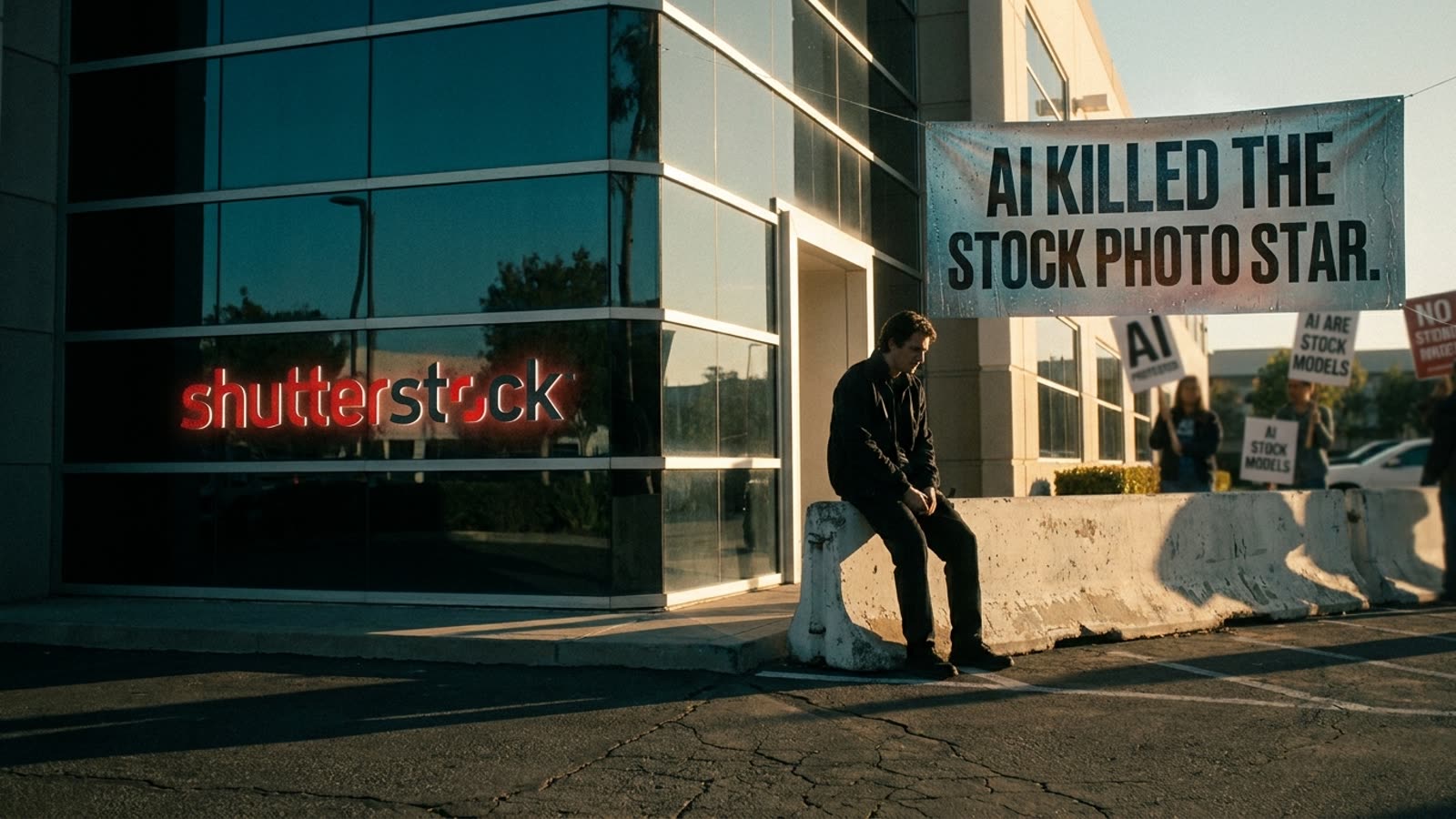
For decades, a peculiar economy thrived in the margins of commercial photography. Ordinary people with photogenic faces and an ability to look natural while pretending to enjoy a spreadsheet could earn thousands annually by posing for stock images—the visual wallpaper of corporate websites, insurance brochures, and airport advertisements. That economy is now collapsing in slow motion, and the people who built careers on looking generically professional are confronting an uncomfortable truth: AI doesn't need lunch breaks, doesn't age, and never asks for residuals.
The stock photography business was always built on a strange premise—that companies would pay for images of fake employees doing fake work to represent their real businesses. Getty Images, Shutterstock, and Adobe Stock dominated this market by maintaining vast libraries of pre-shot content, paying photographers and models a cut each time someone licensed an image. A single photograph of a woman laughing alone with salad could generate income for years.
The economics of being a face
Stock modeling was never glamorous, but it was remarkably stable. Models typically earned between $100 and $500 per shoot, plus residuals that could trickle in for years. The most successful stock faces—those blessed with the right combination of approachability and ambiguity—could appear on thousands of websites simultaneously, their features familiar to millions who would never know their names. Some models reported earning five figures annually from residuals alone, passive income from a few days of work pretending to be a nurse, a financial advisor, or a concerned parent reviewing insurance options.
Generative AI has made this business model largely obsolete. Image generators can now produce photorealistic humans in any scenario, wearing any expression, holding any prop. The output is owned outright by whoever typed the prompt. No model release required. No residual payments. No awkward negotiations about whether the image can be used for pharmaceutical advertisements.
What the platforms are doing
The major stock agencies have responded with a mixture of adaptation and denial. Several now sell AI-generated images alongside traditional photography, effectively competing with their own contributors. Others have attempted to position human-shot content as premium—authentic, ethically sourced, legally uncomplicated. The pitch is essentially that real humans photograph better than fake ones, which may be true but matters less when the buyer just needs a generic hero image for a landing page that will be redesigned in six months anyway.
Some photographers and models have pivoted to creating training data for the very systems replacing them, a transaction that feels less like adaptation than assisted obsolescence. Others have moved toward content that AI still struggles to produce convincingly—images requiring genuine emotion, cultural specificity, or the kind of spontaneous imperfection that makes a photograph feel alive rather than generated.
The broader pattern
Stock photography is neither the first nor the most important profession to be disrupted by automation, but it offers an unusually clean case study in how AI reshapes creative labor. The work being displaced isn't artistically ambitious—no one mourns the loss of another image of diverse coworkers high-fiving—but it was real income for real people who developed real skills. The models learned to convey warmth without specificity, professionalism without personality. The photographers mastered lighting setups that made conference rooms look aspirational. These were crafts, even if modest ones.
Our take
The death of stock modeling matters less for what it destroys than for what it previews. Every profession that involves producing adequate-but-not-exceptional work at scale is now in the same position those models occupied: waiting to see whether the machines get good enough fast enough to make human involvement economically irrational. The stock models at least saw it coming. Most workers in the path of generative AI will not have that luxury.