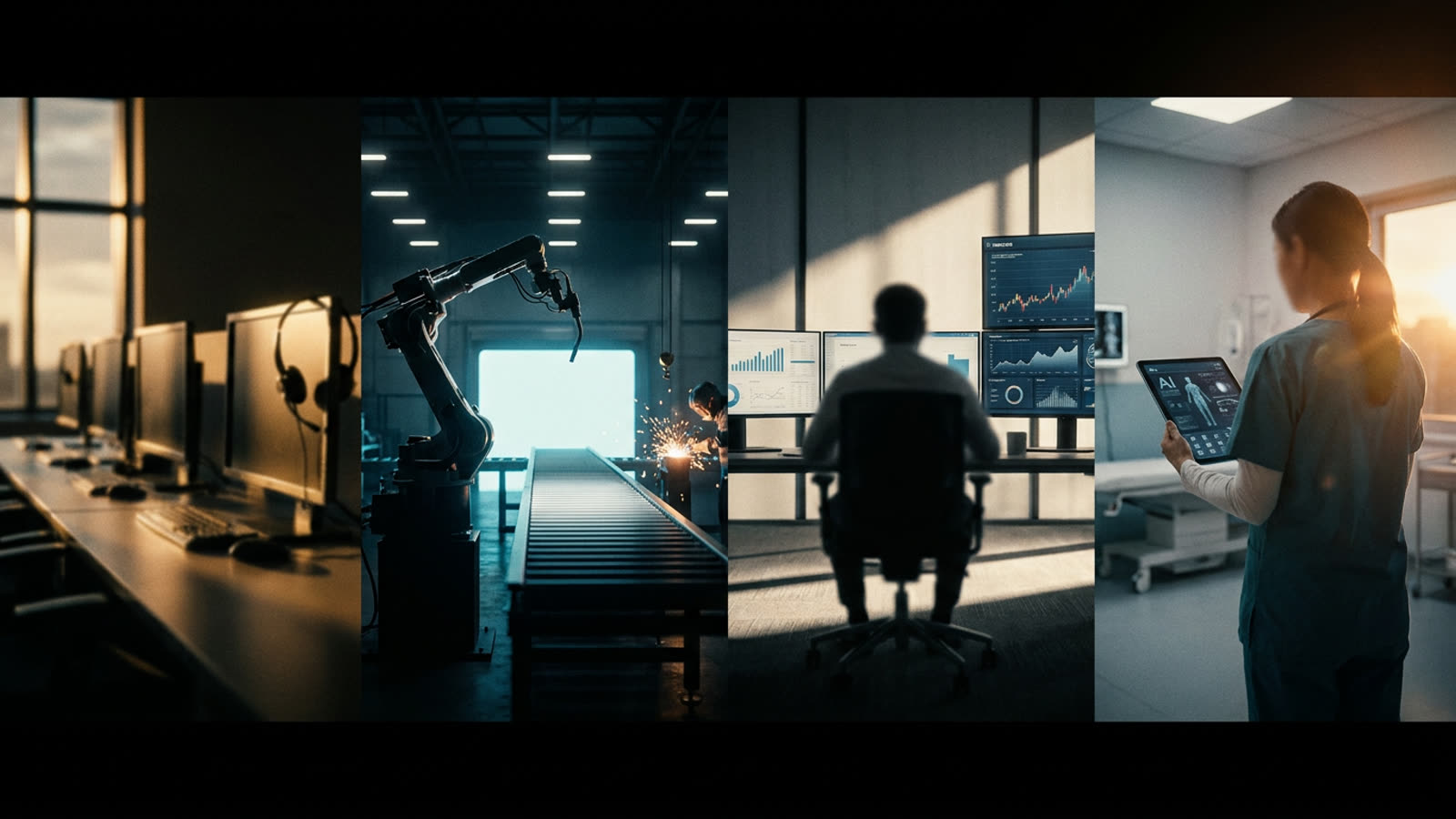
The era of soothing corporate bromides about AI and employment is quietly ending. Where tech executives once insisted that artificial intelligence would merely augment human workers—creating more jobs than it destroyed, enhancing productivity without displacement—the messaging has grown noticeably more candid. The question is no longer whether AI will transform the labor market, but how profound that transformation will be and who will bear its costs.
This shift reflects a maturing understanding within the industry itself. Early-stage AI optimism, which treated every technological disruption as an unambiguous net positive, has given way to a more sober assessment. The companies building these systems understand their capabilities better than anyone, and their increasing willingness to discuss workforce displacement signals that internal projections have become difficult to ignore.
The productivity paradox returns
Economists have long puzzled over why technological advances don't always translate into broad-based prosperity. The current AI moment threatens to make this paradox more acute. Large language models and their successors can now perform tasks that were, until recently, considered safely in the human domain: legal research, code generation, customer service, content creation, even preliminary medical diagnosis.
The traditional response—that workers will simply move to higher-value tasks—assumes a pace of adaptation that may not match the speed of technological change. Retraining programs take years; AI capabilities improve in months. The mismatch creates a temporal gap that policy has yet to address seriously.
Corporate candor, political silence
What's striking about the current moment is the asymmetry between corporate acknowledgment and political response. Tech leaders are increasingly explicit about the scale of coming changes, yet legislative bodies in most major economies have produced little beyond exploratory committees and aspirational frameworks. The European Union's AI Act focuses primarily on safety and rights, not labor market adaptation. The United States has offered even less.
This gap isn't accidental. Addressing AI-driven displacement requires confronting uncomfortable questions about wealth distribution, educational reform, and the social contract itself—questions that resist easy partisan framing and offer few quick political wins.
Our take
The honesty is welcome, even if it arrives without solutions attached. For years, the AI industry sold a vision of frictionless progress where everyone benefits and no one loses. That narrative was always implausible, and its quiet abandonment marks a necessary step toward serious policy discussion. The harder work—building institutions that can distribute AI's gains more broadly and cushion its disruptions—remains almost entirely undone. Acknowledging the problem is not the same as solving it, but it's a prerequisite. The clock, meanwhile, keeps ticking.