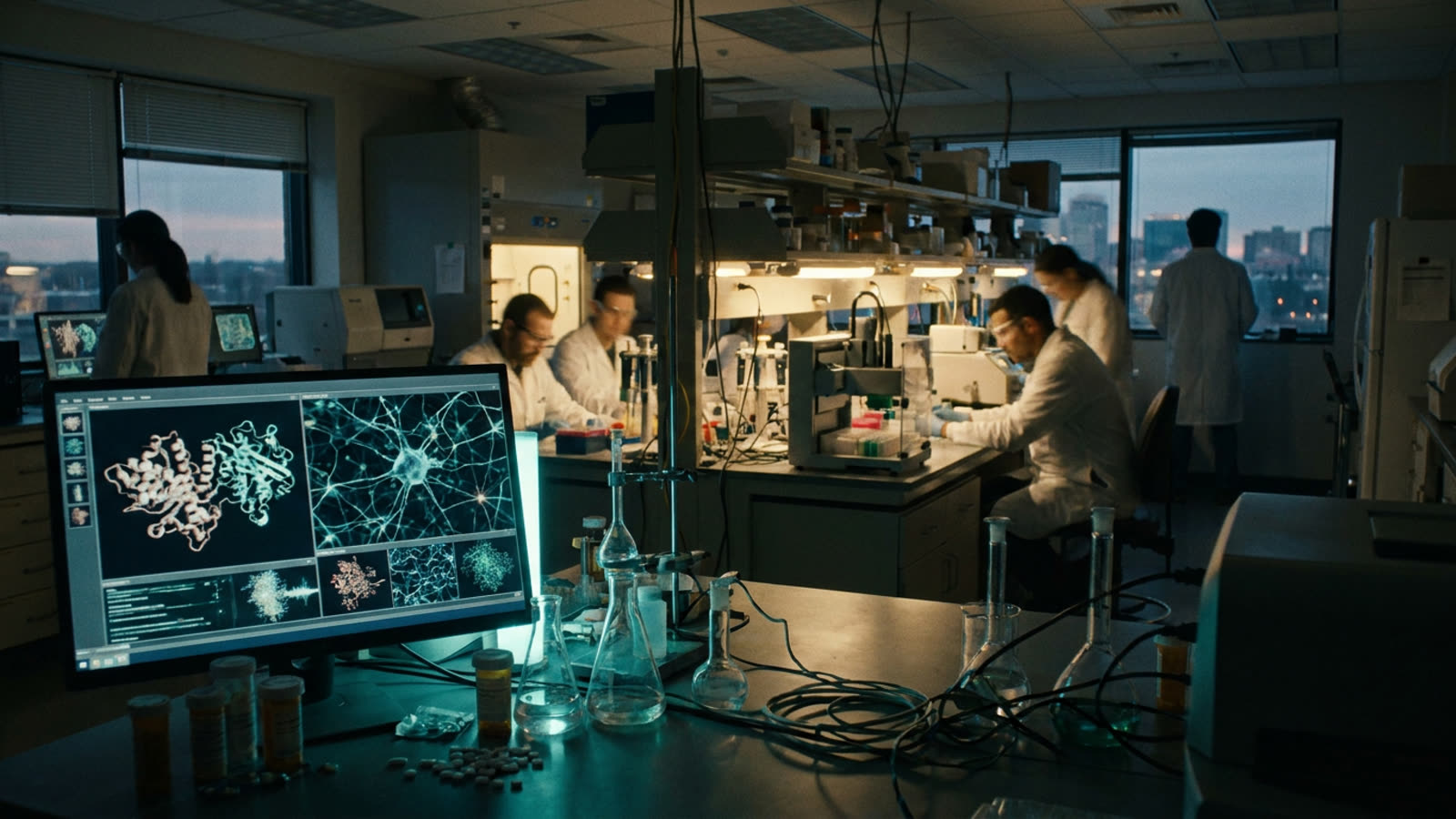
For most of the past half-century, pharmaceutical research has operated under a grim arithmetic: of every ten thousand compounds that enter preclinical testing, roughly one will reach patients. The average cost to bring a single drug to market now exceeds two billion dollars, and the timeline stretches beyond a decade. This brutal attrition rate has shaped everything from how pharma companies allocate capital to why certain diseases—rare ones, unprofitable ones—remain therapeutic orphans. Artificial intelligence is now attacking this arithmetic at its foundations, and the implications extend far beyond faster pipelines.
The target-finding revolution
Traditional drug discovery begins with identifying a biological target—a protein, enzyme, or receptor implicated in disease. This step alone can consume years of painstaking laboratory work, sifting through genomic data, protein interactions, and disease pathways. Machine learning models trained on vast biological datasets can now surface candidate targets in weeks rather than years, cross-referencing patterns across thousands of diseases and millions of molecular interactions that no human team could process. The shift is not merely one of speed; it is one of scope. AI systems can identify targets that human researchers, constrained by disciplinary boundaries and cognitive limits, would never have considered.
Molecules designed, not discovered
Once a target is identified, the search for a molecule that can modulate it has historically resembled an expensive lottery. Chemists synthesize and test thousands of compounds, most of which fail. Generative AI models are inverting this process, designing novel molecular structures optimized for specific properties—binding affinity, solubility, toxicity profiles—before a single compound is synthesized. Several biotechnology firms have advanced AI-designed molecules into human clinical trials, a milestone that would have seemed implausible a decade ago. The compounds are not merely faster to develop; they are, in some cases, structurally unlike anything in existing chemical libraries, suggesting that machine learning may access regions of molecular space that human intuition cannot reach.
The human bottleneck persists
Yet the revolution remains incomplete, and the constraints are instructive. AI excels at pattern recognition and optimization within defined parameters, but drug development is not a closed system. Clinical trials depend on recruiting patients, navigating regulatory frameworks, and managing the irreducible unpredictability of human biology. A molecule that looks perfect in silico may fail catastrophically in a living organism for reasons no model anticipated. The most sophisticated AI cannot yet predict how a compound will behave across the full diversity of human genetics, comorbidities, and concurrent medications. Pharma executives who expected AI to halve development timelines are discovering that the technology compresses certain phases dramatically while leaving others stubbornly unchanged.
Our take
The honest assessment is that AI is transforming drug discovery, but not yet revolutionizing medicine. The technology is shifting risk earlier in the pipeline, allowing companies to fail faster and cheaper—a genuine improvement, but not the breakthrough that headlines sometimes suggest. The diseases that remain untreated are often untreated not because we lack candidate molecules, but because the biology is poorly understood, the patient populations are small, or the economics are unfavorable. AI can accelerate the search for needles; it cannot yet manufacture haystacks. The real test will come over the next decade, as AI-designed drugs move through late-stage trials and either validate the hype or reveal its limits. For now, the lab bench is indeed learning to think—but it is learning, like all students, that thinking is only the beginning of the work.