In 1997, when IBM's Deep Blue defeated Garry Kasparov, obituaries for human chess were written with unseemly haste. The game's highest expression had been automated; what remained for flesh-and-blood players was surely a long, dignified decline into irrelevance. Nearly thirty years later, the opposite has occurred. More people play chess than at any point in history, prize funds have swelled, and the elite grandmasters are stronger than Kasparov ever was — precisely because they grew up training with the machines that were supposed to replace them.
This is not a heartwarming story about human resilience. It is a case study in professional metamorphosis, and it offers the most instructive template we have for understanding how AI reshapes expertise across fields.
The centaur era and its collapse
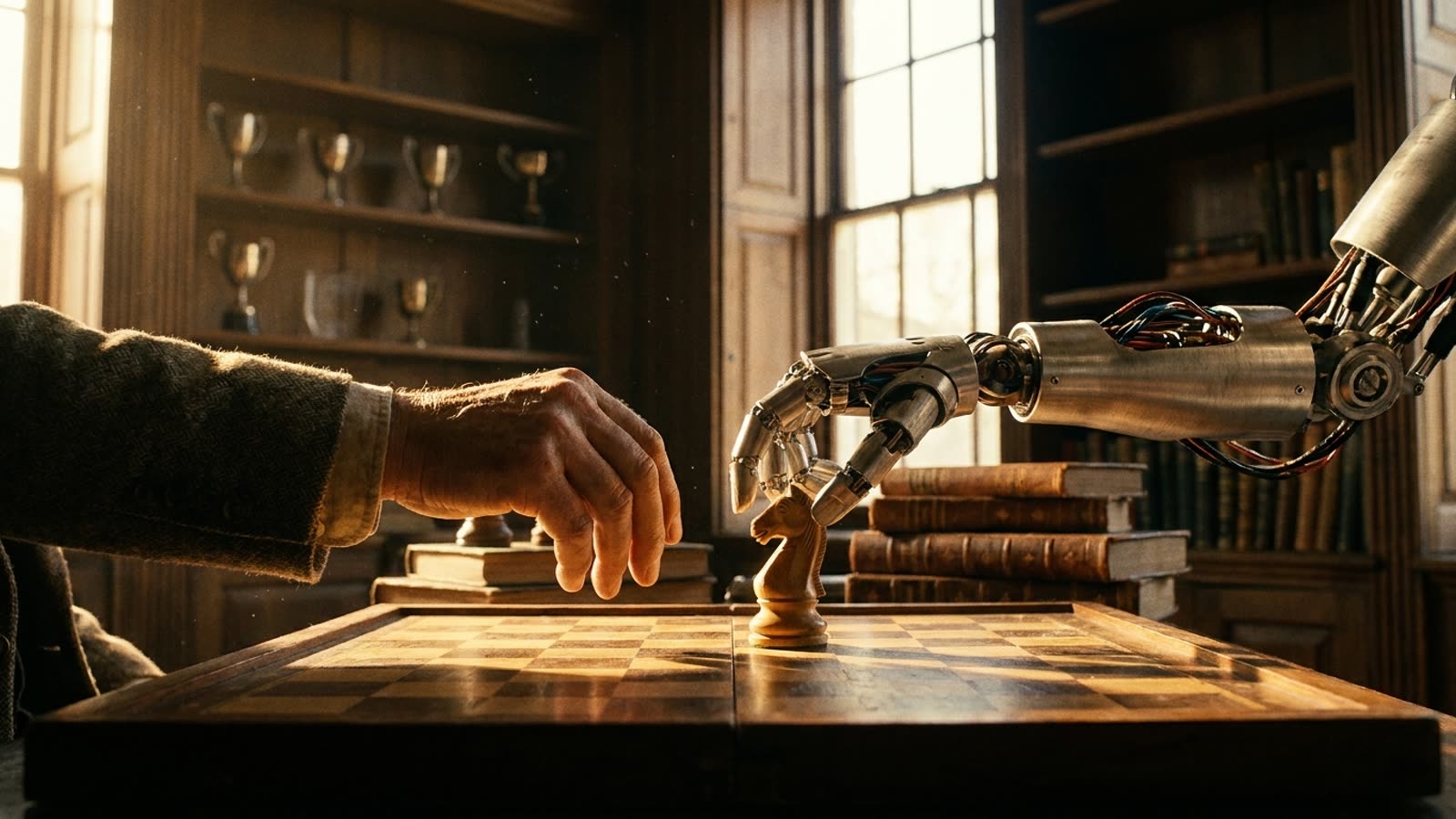
For a brief window after Deep Blue, a hybrid model flourished. "Freestyle" tournaments paired humans with engines, and the combination seemed to outperform either alone. Kasparov himself promoted the concept, calling these partnerships "centaurs." The theory was elegant: human intuition would guide the silicon brute force, pruning bad lines and injecting creativity.
It didn't last. As engines improved, the human contribution shrank to the point of noise. By the mid-2010s, even a club player with a top engine could crush any centaur team. The hybrid advantage depended on the machine being strong but not too strong — a narrow window that closed permanently.
What replaced it was subtler. The best humans stopped trying to collaborate with engines in real time and instead used them as tutors, drilling partners, and preparation laboratories. The machine became a mirror, revealing weaknesses the player couldn't see alone.
Preparation arms race
Modern elite chess is unrecognizable to anyone who learned the game before engines. A world-championship match now involves teams of seconds running neural-network engines around the clock, probing opening novelties dozens of moves deep. The players themselves spend more hours reviewing computer analysis than pushing pieces. Magnus Carlsen, the dominant figure of the past decade, once described his preparation as "trying to find the spots where the engine is slightly wrong, or where my opponent won't know the engine line."
This has produced a paradox. Games between top grandmasters are more theoretically correct than ever, yet also more decisive. The margin for error has collapsed; a single inaccuracy in a known position can be fatal, because the opponent has rehearsed the punishment. Draws by attrition are rarer. The spectacle, contrary to early fears, has improved.
What transferred, what didn't
Chess offers a controlled experiment because its rules are fixed and its outcomes measurable. Several patterns have emerged that generalise beyond the sixty-four squares.
First, the skill ceiling rose. Access to perfect feedback accelerated learning for everyone willing to do the work. The average rating of top juniors today would have been exceptional a generation ago.
Second, the nature of expertise shifted from memorisation to pattern recognition under pressure. Engines can store every line; humans cannot. The survivors are those who internalise principles deeply enough to navigate positions they have never seen.
Third, the economics bifurcated. A tiny elite commands larger audiences and purses, while the broad middle tier of professional players has hollowed out. Teaching and content creation absorbed some of them; others left the game.
Our take
Chess grandmasters did not become obsolete. They became something else — interpreters, entertainers, and students of an alien intelligence whose judgments they can verify but rarely fully explain. The same transformation is now underway in radiology, law, software engineering, and a dozen other fields. The lesson from chess is not that humans will always matter, nor that they won't. It is that the transition is survivable, but only for those who abandon the fantasy of competing with the machine on its own terms and find the adjacent game where human judgment still pays.