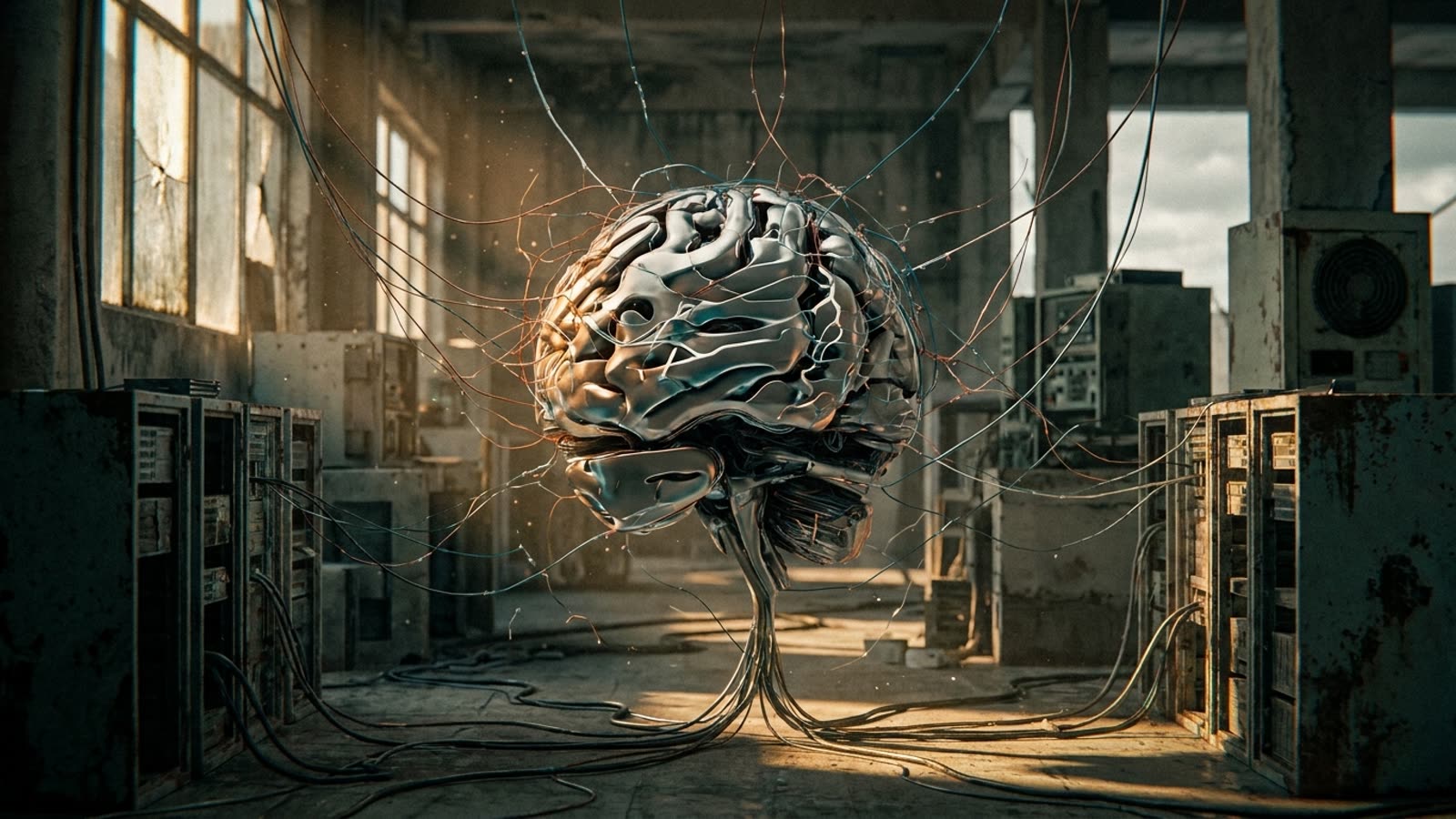
When you ask a large language model to forget something it learned during training, you are essentially asking it to perform surgery on itself without anesthesia, scalpel, or any clear idea where the offending memory resides. The request is not merely difficult—it may be architecturally impossible.
This is the forgetting problem, and it sits at the uncomfortable intersection of privacy law, technical limitation, and corporate incentive. Regulators in Europe and elsewhere have spent years establishing the "right to be forgotten," the principle that individuals can demand removal of their personal information from databases and search results. But the neural networks powering modern AI do not store information the way databases do. There is no row to delete, no file to erase. Knowledge in these systems is distributed across billions of numerical weights, entangled with everything else the model knows.
The architecture of remembering
A traditional database stores your name in a specific location. A language model stores something more like the statistical ghost of your name—patterns of association spread across the entire network. Teaching the model that "John Smith worked at Acme Corp" does not create a John Smith entry; it subtly adjusts millions of parameters that also encode information about other Johns, other Smiths, other corporations, and the grammatical structure of employment statements.
This is why researchers attempting to make models forget specific facts often find the information resurfaces through indirect prompting. The model may no longer complete "John Smith worked at..." but might still answer "Who was Acme Corp's most controversial employee?" The memory is not stored—it is dissolved.
The legal collision
Privacy regulators have not fully reckoned with this reality. The European Union's General Data Protection Regulation grants citizens the right to erasure, but applying this to AI training data creates a paradox. Complete compliance might require retraining entire models from scratch—a process costing tens of millions of dollars and months of compute time. Partial compliance through fine-tuning often fails to truly eliminate the targeted information.
Some AI companies have responded by arguing that training data is "transformed" sufficiently that the original information no longer exists in a legally meaningful sense. This argument has not been tested in major courts, and privacy advocates find it unconvincing. The model may not store your data verbatim, but it can still generate plausible statements about you based on what it absorbed.
The corporate calculation
There is also a quieter problem: AI companies have limited incentive to solve this. Forgetting degrades capability. Every successful erasure potentially removes useful context, makes the model slightly less knowledgeable, slightly less valuable. The business model of AI depends on models knowing more, not less.
This creates an uncomfortable dynamic where the technical difficulty of forgetting aligns conveniently with commercial interests in remembering. Research into "machine unlearning" exists but remains underfunded relative to capabilities research. The asymmetry is telling.
Our take
The forgetting problem reveals something important about the current AI moment: we have built systems whose internal workings we do not fully understand and cannot precisely control. This is not necessarily disqualifying—humans operate the same way—but it does mean that legal frameworks designed for filing cabinets and databases will need fundamental rethinking. The right to be forgotten may need to become something more nuanced: perhaps a right to be statistically diluted, or a right to have one's influence on model outputs minimized below some threshold. These are unsatisfying compromises, but they may be the only honest ones available.