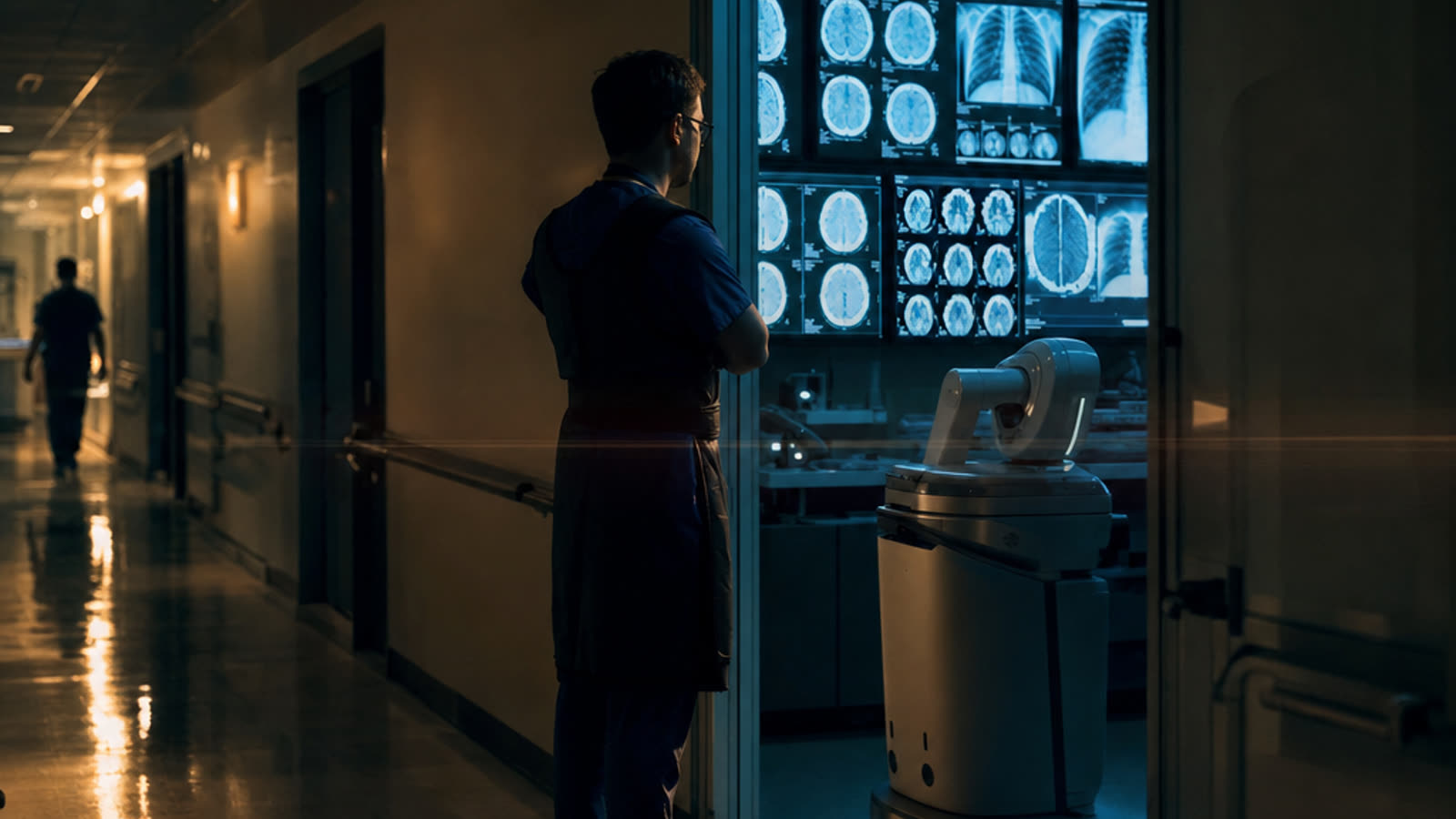
Somewhere in a hospital near you, a radiologist is reviewing a chest X-ray that has already been examined by an algorithm. The machine flagged a potential nodule in the upper left lobe. The radiologist squints, adjusts the contrast, and agrees. Or disagrees. Or, increasingly often, finds herself in that uncomfortable middle ground where she cannot quite articulate why the AI's confidence score of 87 percent feels wrong.
This is the daily reality of diagnostic radiology in the mid-2020s, and it represents something more profound than mere technological adoption. Radiology has become the test case for how AI integrates with — rather than replaces — human professional judgment. The results are instructive for every knowledge worker watching the machines approach their own domain.
The accidental pioneers
Radiology was not chosen for AI transformation; it volunteered itself by accident. Medical imaging produces standardized, digitized data in enormous quantities — the exact substrate on which deep learning thrives. A chest X-ray is a matrix of pixel values. A CT scan is a three-dimensional array. These are not messy interview transcripts or ambiguous legal precedents. They are clean, labeled, and abundant.
The major imaging AI platforms now screen for dozens of conditions simultaneously: pneumothorax, cardiomegaly, fractures, masses, effusions. They measure tumor volumes with sub-millimeter precision. They catch the subtle interval changes between scans taken months apart that even experienced eyes might miss at 3 a.m. after reviewing seventy cases.
But here is what the breathless press releases omit: these systems are pattern-matchers of extraordinary power operating with zero understanding. They have never seen a patient gasp for breath. They do not know that the 34-year-old woman whose scan they just flagged is a marathon runner with an unusually large heart. They cannot ask the referring physician whether the clinical picture actually suggests what the pixels imply.
The automation paradox
Radiologists report a curious phenomenon. When AI consistently catches what they catch, they begin to trust it. When they trust it, they begin to skim. When they skim, they occasionally miss what the AI also missed — the unusual presentation, the rare variant, the finding that falls outside the training distribution.
This is not laziness. It is the well-documented automation paradox: the better a system performs, the harder it becomes for humans to maintain the vigilance required to catch its failures. Airline pilots know this intimately. Now radiologists are learning it too.
The most sophisticated departments have responded by restructuring workflows entirely. Rather than using AI as a first-pass filter, some have implemented discordance protocols: the radiologist reads blind, the AI reads blind, and a third review triggers only when they disagree. This preserves human expertise while capturing the machine's different failure modes. It is also slower and more expensive, which means most institutions do not do it.
What the machines cannot see
Ask a radiologist what AI cannot do, and the answers cluster around a single theme: context. The algorithm does not know that the patient was in a car accident last week. It does not know that the referring oncologist specifically wants to know whether a lesion has changed character, not just size. It cannot read the terror in a parent's voice when they ask about their child's scan.
This is not a temporary limitation awaiting the next model release. It reflects something fundamental about the difference between pattern recognition and medical reasoning. A diagnosis is not merely a classification. It is a hypothesis that must be tested against everything else known about a particular human being.
The radiologists who have made peace with AI tend to describe their new role in curatorial terms. They are no longer primarily detectors; they are editors, integrators, explainers. The machine proposes; the human contextualizes. Whether this represents an elevation or a diminution of the profession depends entirely on how you value the work of synthesis versus the work of perception.
Our take
Radiology's AI experiment offers a preview that should unsettle and reassure in equal measure. The machines are genuinely good at what they do, which is exactly why their limitations matter so much. They will not replace radiologists because diagnosis is not detection — but they will hollow out the detection-heavy parts of the job, leaving behind work that is either more intellectually demanding or more emotionally fraught. The radiologists thriving in this environment are those who have stopped competing with algorithms on pattern recognition and started competing on everything algorithms cannot do: judgment, communication, the integration of image and story. That is probably the template for every profession watching AI approach. The question is not whether the machine can do your job. It is which parts of your job were ever really yours to begin with.