For most of the twentieth century, weather forecasting was an exercise in brute-force physics. Meteorologists divided the atmosphere into millions of grid cells, applied the equations of fluid dynamics, and ran the numbers on the fastest supercomputers available. The approach worked—five-day forecasts today are as accurate as one-day forecasts were in the 1980s—but it was computationally expensive, slow to improve, and dependent on an army of specialists who understood both atmospheric science and numerical methods.
Then the machine-learning models arrived, and the old guard discovered that pattern recognition could do in seconds what physics simulations took hours to compute.
The speed of the takeover
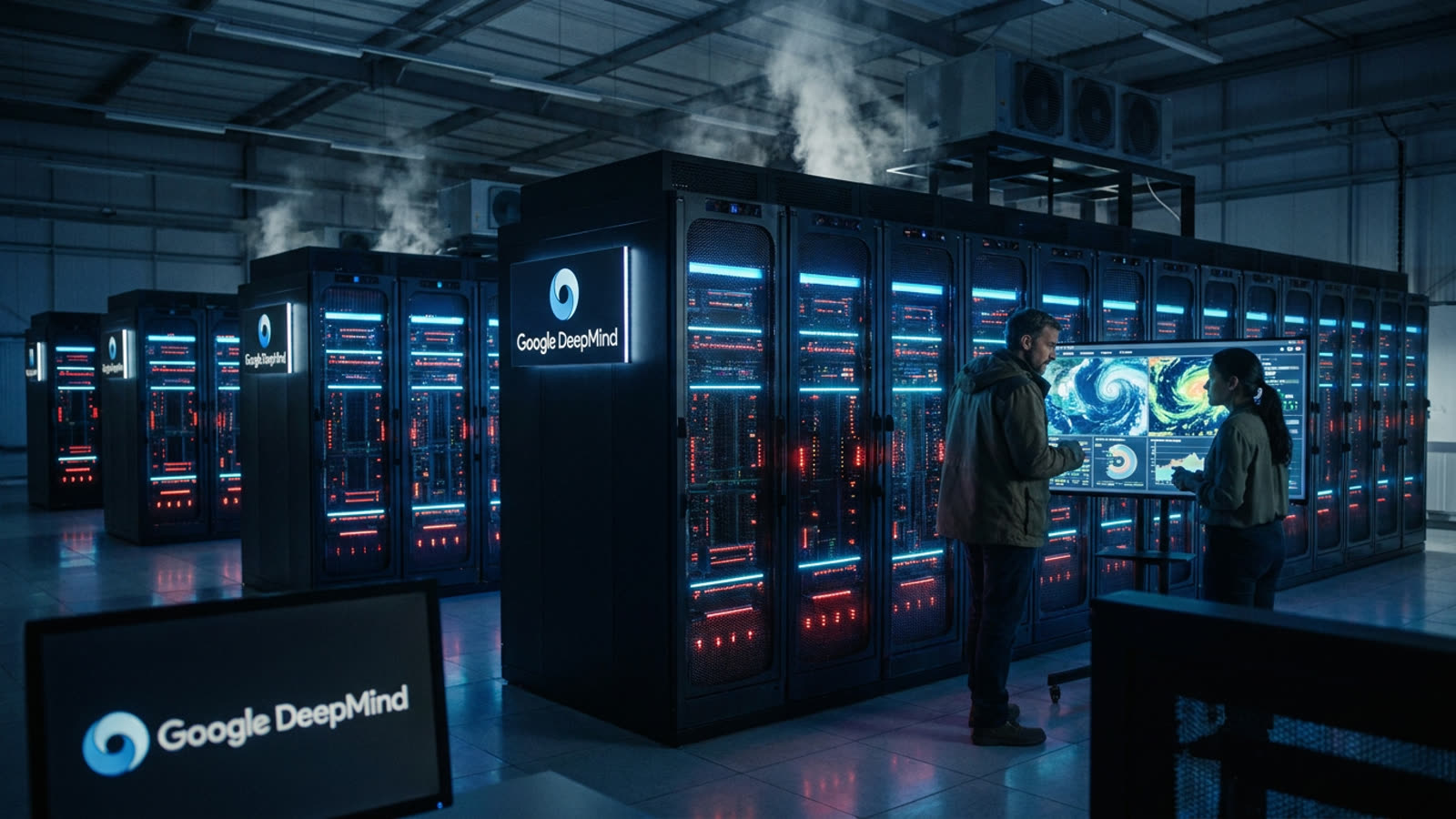
Google DeepMind's GraphCast, Huawei's Pangu-Weather, and Nvidia's FourCastNet emerged within months of each other, each demonstrating that neural networks trained on decades of historical weather data could match or exceed the European Centre for Medium-Range Weather Forecasts' gold-standard HRES model. The computational savings were staggering: what once required dedicated supercomputer time could run on a single graphics card. More troubling for traditionalists, the AI systems often nailed the track of hurricanes and the timing of cold fronts with fewer systematic errors than their physics-based predecessors.
The models don't understand why pressure gradients drive wind. They have never derived the Navier-Stokes equations. They simply learned, from petabytes of observations, that certain atmospheric configurations tend to evolve in certain ways. The philosophical implications are unsettling: prediction without comprehension.
What the humans still do
Meteorologists have not become obsolete, but their job description is shifting. The new workflow involves running multiple AI models alongside traditional numerical weather prediction, comparing outputs, and applying human judgment where the machines diverge. Forecasters spend less time interpreting raw model output and more time communicating uncertainty to the public—a skill that remains stubbornly difficult to automate.
Local knowledge still matters. AI models trained on global data can miss microclimates, lake-effect snow corridors, and the quirks of mountain valleys. The forecaster who knows that a particular ridge always accelerates afternoon thunderstorms retains an edge, at least for now. But the gap is narrowing as higher-resolution training data becomes available.
The limits of learned weather
AI forecasting has a ceiling that its proponents sometimes understate. The models are interpolating within the distribution of weather they have seen; they struggle with unprecedented events, the kind that climate change is making more frequent. A hurricane that intensifies faster than any in the historical record may confuse a neural network optimized on past patterns. Physics-based models, for all their computational expense, can at least simulate conditions outside the training distribution.
There is also the question of trust. When a physics model produces a surprising forecast, meteorologists can trace the logic back to first principles. When an AI model does the same, the explanation is a thicket of learned weights. For high-stakes decisions—evacuations, aviation reroutes, military operations—the opacity is a liability.
Our take
The weather profession is living through a preview of what many knowledge industries will experience: sudden, disorienting gains from AI that don't quite eliminate the need for human expertise but radically compress the value of certain skills. The meteorologists who thrive will be those who treat the models as powerful but fallible colleagues—useful for the first draft, dangerous if left unsupervised. The rest of us should watch closely. The atmosphere was one of the first complex systems to yield to machine learning. It will not be the last.