Ask a large language model to write a haiku about autumn leaves, and it will produce something lovely — perhaps even moving. Ask it to verify that the poem contains exactly seventeen syllables, and watch it fail. This is not a bug to be patched. It is a window into the profound strangeness of how these systems actually process language.
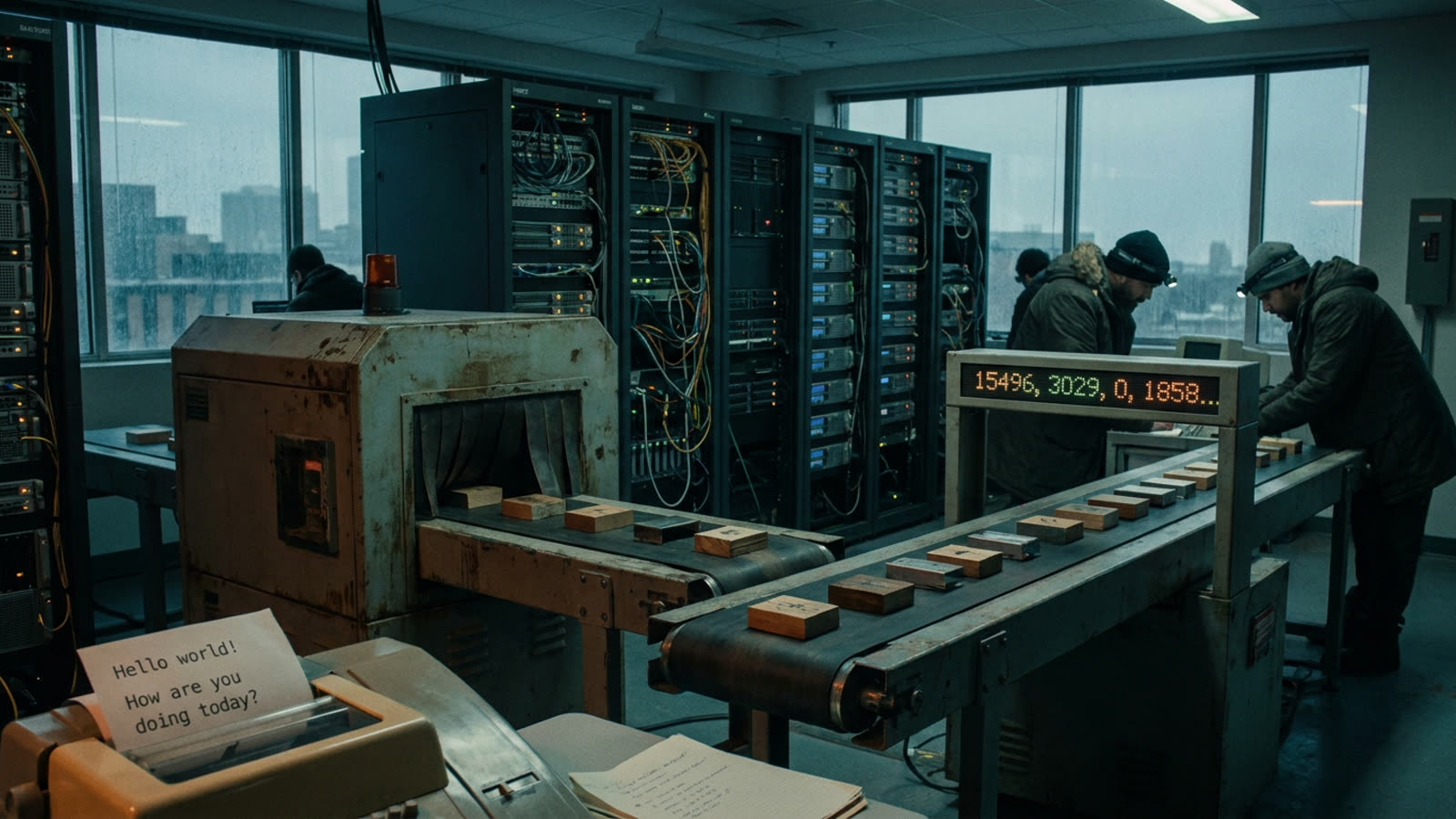
The disconnect illuminates something most users never consider: language models do not read words. They read tokens — arbitrary chunks of text that bear only a loose relationship to the linguistic units humans perceive. The word "syllable" itself gets split into "syll" and "able." The word "haiku" becomes a single token. "Refrigerator" might be two tokens or three, depending on the model's training vocabulary. When you ask an AI to count syllables, you are asking it to perform arithmetic on units it literally cannot see.
The tokenisation bargain
This architectural choice was not arbitrary. Tokenisation emerged as an elegant solution to a fundamental problem: how do you feed the infinite variety of human language into a system that requires fixed-size inputs? Early approaches tried character-by-character processing, but this proved computationally expensive and failed to capture meaningful patterns. Word-level tokenisation seemed natural but collapsed under the weight of rare words, misspellings, and the combinatorial explosion of compound terms.
The compromise — subword tokenisation — gave models a vocabulary of perhaps fifty thousand tokens that could represent virtually any text through combination. It worked brilliantly for the core task of predicting what comes next in a sequence. The trade-off was that the model's fundamental unit of perception became divorced from human linguistic intuition.
What the model actually learns
When a language model trains on billions of documents, it learns statistical relationships between tokens — which sequences tend to follow which others, across every context imaginable. It becomes extraordinarily good at this prediction task, good enough that the emergent behaviour resembles understanding. It can write in the style of Hemingway because Hemingway's token patterns are distinctive. It can explain quantum mechanics because explanations of quantum mechanics have recognisable statistical signatures.
But the model has no phonological layer. It has never heard language spoken. It does not know that "through" and "threw" sound identical while "read" can rhyme with either "reed" or "red" depending on tense. It cannot tap out a rhythm. The entire auditory dimension of language — the dimension that makes syllable-counting trivial for humans — simply does not exist in its representation of the world.
Why this matters beyond party tricks
The syllable problem is a toy example of a deeper limitation. Language models operate on form without access to the grounding that gives form meaning. They can discuss the taste of strawberries without having taste buds, describe the feeling of grief without having lost anyone, explain the rules of chess without being able to track a board state reliably. Their competence is genuine but strangely hollow — pattern matching so sophisticated it masquerades as comprehension.
This does not make these systems useless. Pattern matching at this scale turns out to be extraordinarily valuable. But it does mean that the failure modes are often invisible until you probe the edges. The model that writes your legal brief flawlessly may not notice when it invents a case citation. The model that drafts your code may not catch a logical error that any human programmer would spot immediately.
Our take
The syllable-counting failure is not a flaw to be fixed in the next version — it is a fundamental consequence of how these systems perceive language. Understanding this matters because it calibrates expectations. Large language models are not nascent general intelligences temporarily bad at counting. They are a genuinely new kind of tool: statistical engines of extraordinary power operating on representations that differ from human cognition in ways we are only beginning to map. The sooner we internalise this, the better we will use them.