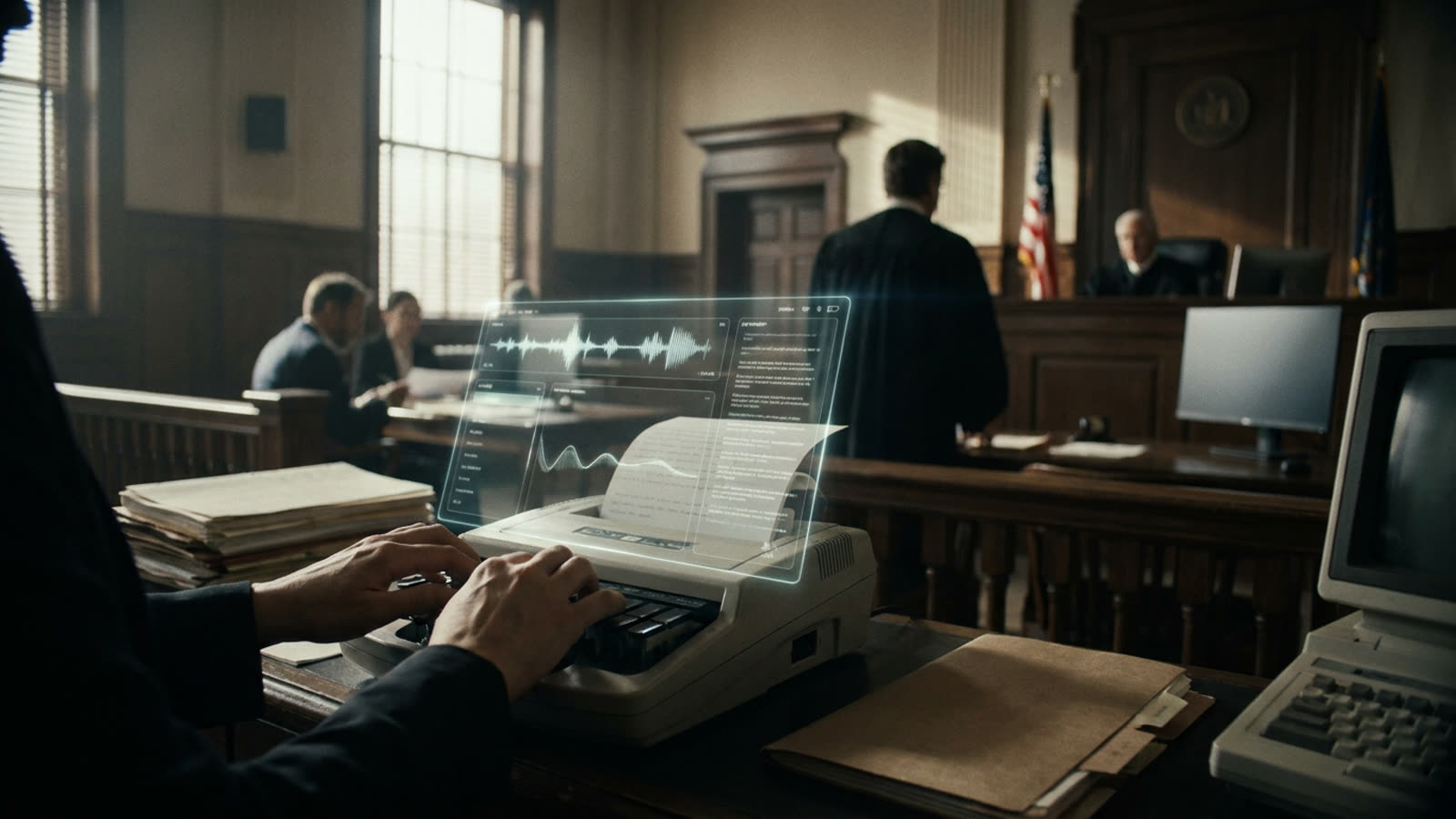
The stenotype machine has not changed much since its invention in the late nineteenth century. Twenty-two keys, a tripod, and a system of phonetic shorthand that allows trained fingers to capture speech at speeds exceeding 225 words per minute. For more than a century, this peculiar skill — part athletic, part linguistic — has been the backbone of legal transcription. Now artificial intelligence threatens to make it obsolete, or so the headlines suggest. The reality is considerably stranger.
Court reporters are not vanishing. They are mutating into something the profession's founders would not recognise: part stenographer, part AI supervisor, part quality-control specialist operating at the intersection of human expertise and algorithmic speed.
The automation that wasn't
Automatic speech recognition has improved dramatically. Modern systems can transcribe clear audio with impressive accuracy, and legal-technology companies have spent years promising that AI would soon handle depositions, hearings, and trials without human intervention. Yet courtrooms remain stubbornly resistant to full automation.
The reasons are both technical and institutional. Legal proceedings involve overlapping speakers, heavy accents, mumbled testimony, specialised terminology, and the occasional witness who whispers or weeps. Background noise, malfunctioning microphones, and attorneys who talk over each other compound the difficulty. AI systems trained on clean podcast audio struggle with the acoustic chaos of an actual courtroom.
More fundamentally, the legal system demands a particular kind of accountability. A certified court reporter is an officer of the court, personally responsible for the accuracy of the record. When an appeal hinges on whether a witness said "I did" or "I didn't," someone must bear professional and legal responsibility for that determination. Software cannot be cross-examined or held in contempt.
The hybrid model emerges
What has emerged instead is a workflow that would have seemed bizarre a decade ago. Many court reporters now work alongside AI, using speech-recognition software as a first-pass tool while their stenotype captures the authoritative record. The machine suggests; the human confirms. Some reporters have shifted primarily to "scopist" roles, editing AI-generated transcripts rather than producing original stenography. Others use voice-writing systems, speaking into masks that feed their narration to recognition software, then correcting the output in real time.
The economics have shifted accordingly. Routine depositions — the bread and butter of freelance court reporting — increasingly go to lower-cost transcription services that blend AI with offshore human editors. High-stakes trials, complex technical litigation, and proceedings requiring real-time captioning still demand certified reporters with traditional skills. The profession has stratified.
What the machines still cannot do
The persistent gap between AI transcription and court-reporting standards reveals something important about the limits of current language models. These systems excel at pattern recognition but struggle with the contextual judgement that experienced reporters exercise constantly. Knowing when to mark testimony as inaudible rather than guessing. Recognising that a witness's "uh-huh" means yes in one context and mere acknowledgment in another. Understanding that the attorney's "strike that" requires removing the previous statement from the record.
Court reporters also perform a subtle but essential function that no algorithm replicates: they serve as a human checkpoint on the proceedings themselves. A reporter who cannot hear a witness will interrupt. A reporter who notices a procedural irregularity may flag it. This watchdog role — passive but present — disappears when the recording is simply a microphone feeding software.
Our take
The court-reporting profession offers a useful case study for anyone trying to understand how AI actually reshapes work. The pattern is not replacement but reconfiguration. Skills that once defined the entire job become one component of a more complex workflow. New competencies — software management, AI error detection, hybrid system operation — become essential. The work does not disappear; it changes character. Those who adapt find their expertise more valuable, not less, precisely because they can do what the machines cannot. Those who insist the old ways will persist unchanged find themselves competing with algorithms on the algorithms' terms. The stenotype is not obsolete. But the hands that operate it now serve a different master.