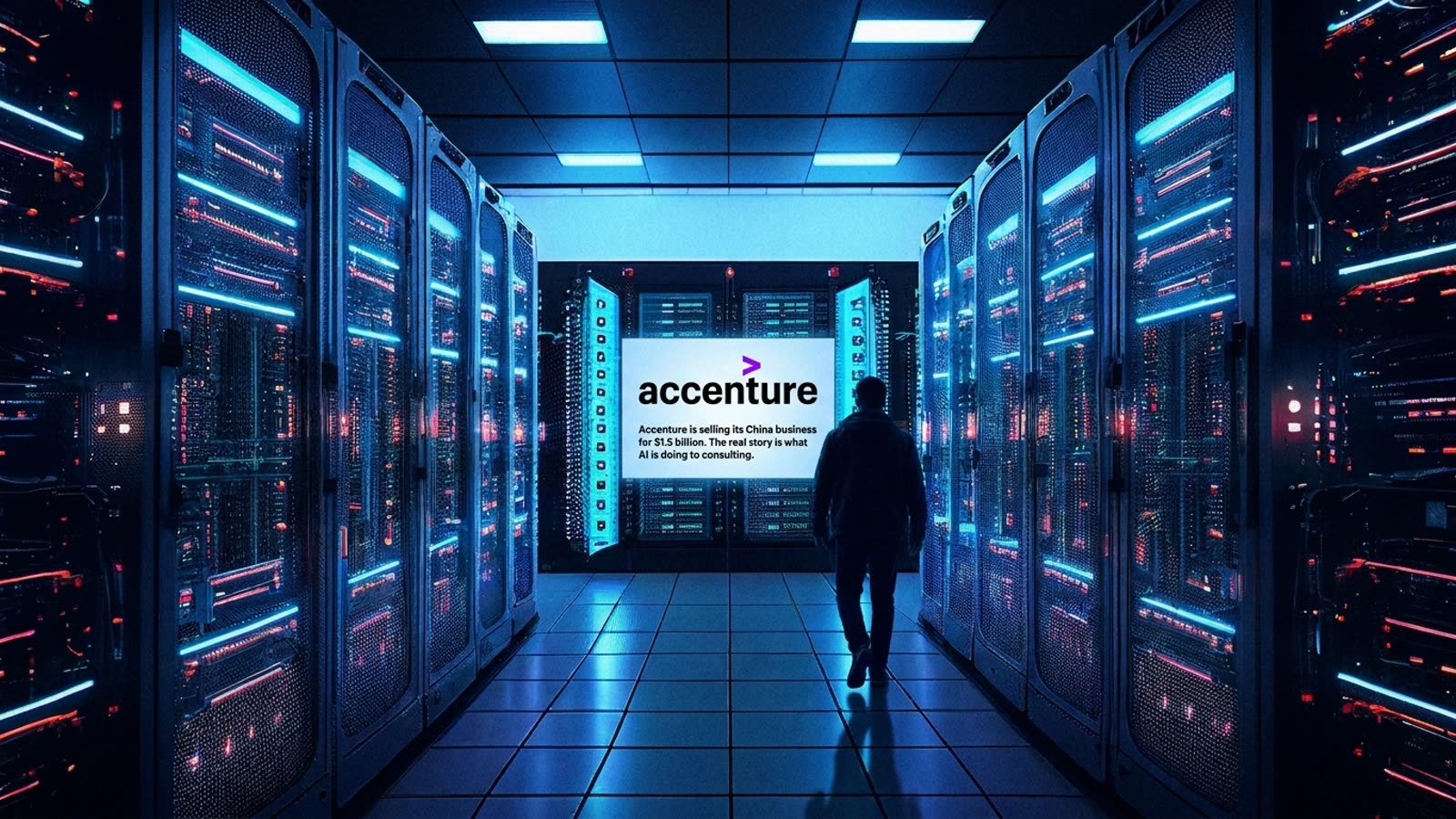
Accenture's reported plan to offload its Chinese operations for up to $1.5 billion looks, at first glance, like a geopolitical hedge — another Western firm de-risking its exposure to a market where regulatory friction and client caution have made life difficult. But the more interesting pressure is not coming from Beijing. It is coming from the very technology Accenture has spent years helping clients adopt.
The consultancy's shares have swung erratically in recent months, and the volatility tracks a single question that investors cannot answer with confidence: what happens to a firm that charges premium rates for human expertise when large language models can generate passable strategy decks, code reviews, and process documentation at a fraction of the cost?
The consulting paradox
For two decades, Accenture built a formidable business telling companies how to automate. It deployed armies of analysts to map workflows, identify inefficiencies, and recommend software that would reduce headcount elsewhere in the organization. The pitch was compelling because Accenture's own labor — expensive, credentialed, billable by the hour — was positioned as irreplaceable. Machines could handle the routine; humans would handle the judgment.
AI is now eroding that distinction. The tasks that once justified junior consultants — synthesizing research, drafting slide decks, writing boilerplate code — are increasingly within reach of off-the-shelf models. Accenture has responded by pivoting hard into AI services, promising to help clients implement the same tools that threaten its own margins. The strategy is not without logic: someone has to guide enterprises through the transition, and incumbents with deep client relationships have an advantage. But the economics are tricky. Selling AI implementation is a one-time engagement; selling human labor is a recurring revenue stream.
Why China, why now
The China exit fits this picture. Accenture's mainland operations were never its largest profit center, and the geopolitical headwinds — data localization rules, national security reviews, client reluctance to engage foreign consultants on sensitive projects — have been mounting for years. But the timing suggests something more than prudent risk management. A $1.5 billion divestiture generates cash that can be redeployed into AI acquisitions, internal tooling, or share buybacks to placate restless investors. It is a tacit admission that the old geographic-expansion playbook matters less than the technological-adaptation playbook.
Competitors are watching closely. Deloitte, PwC, and McKinsey face the same structural question, and none has offered a convincing answer. The industry's response so far has been to rebrand: what was once "digital transformation" is now "AI-enabled transformation," with higher day rates and vaguer deliverables. Whether clients will continue to pay premium prices for advice on technology they can increasingly query directly remains to be seen.
Our take
Accenture is not dying, but it is being forced to confront the uncomfortable truth that the automation revolution it championed is coming for its own workforce. The China sale is a symptom, not a strategy. The real test will be whether the firm can reinvent its value proposition before the models get good enough to make the reinvention moot. For an industry that has long counseled others on disruption, the disruption is finally personal.