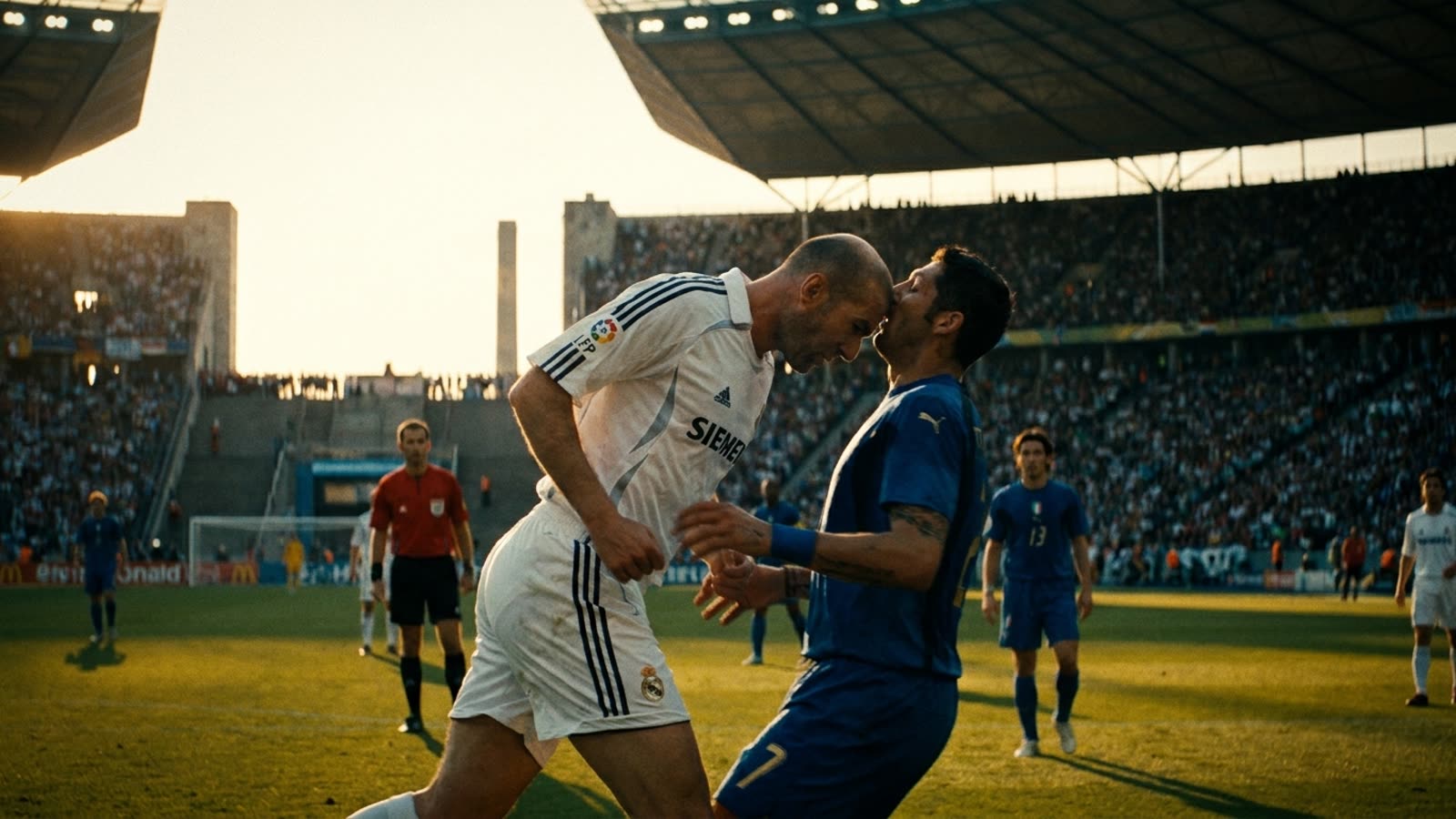
Zinedine Zidane had already scored. His panenka penalty in the seventh minute — a chip so audacious it grazed the crossbar on its way in — was the kind of moment careers are built around. At thirty-four, playing his final professional match, the Frenchman was authoring the ending every great athlete dreams of. Then Marco Materazzi said something, and Zidane drove his forehead into the Italian defender's chest.
The red card that followed sent Zidane past the World Cup trophy without touching it, past his teammates, past any chance at the storybook conclusion that had seemed inevitable. France lost on penalties. Zidane's career ended not with glory but with a walk of shame that has been replayed, memed, and analyzed more than perhaps any other moment in football history.
The anatomy of an implosion
What Materazzi actually said remains disputed. The Italian initially denied any provocation, then admitted to "an insult about his sister" while denying racial abuse. Zidane himself has never fully clarified, offering only that the words were "very personal" and concerned his mother and sister. The ambiguity has only deepened the moment's hold on collective memory. We know the effect without knowing the cause, which transforms the headbutt from mere incident into something closer to parable.
Zidane was not a player known for losing control. He was balletic, almost eerily composed, a midfielder who seemed to operate in slightly slower time than everyone around him. His technique was so refined that coaches used his clips as teaching material. Yet this was also the man who had stamped on a Saudi Arabian player in 1998 and headbutted a Hamburg defender in 2000. The violence was always there, coiled beneath the elegance.
Why the ending matters more than the career
Psychologists call it the peak-end rule: we judge experiences disproportionately by their most intense moment and how they conclude. Zidane's career contained two World Cup triumphs as a player and manager, three consecutive Champions League titles at Real Madrid from the dugout, and a Ballon d'Or. None of it registers as immediately as that headbutt. The image has become a kind of shorthand for the impossibility of controlling one's legacy.
This is what separates Zidane's exit from other infamous sporting meltdowns. He was not a villain unmasked but a virtuoso revealed as human in the cruelest possible frame. The headbutt did not contradict his greatness; it complicated it in ways that make him more interesting than a clean farewell ever could have.
Our take
We prefer our legends sanitized, their rough edges smoothed by retrospective hagiography. Zidane denied us that comfort. His final act was ugly, inexplicable, and utterly real — a reminder that the athletes we elevate are not characters in a script but people capable of destroying their own narratives in an instant. The headbutt endures because it is the rare moment when sport stopped being a story and became, briefly, just life.