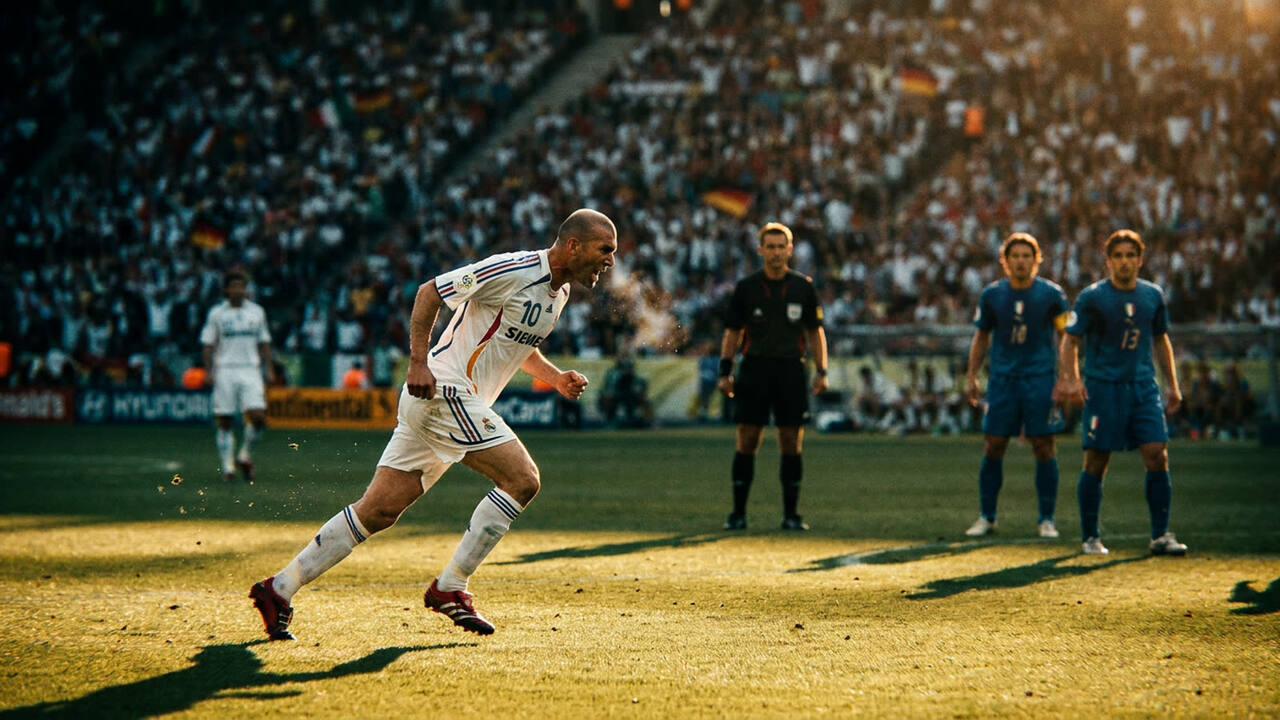
Sport loves a narrative arc. The aging champion's final triumph, the underdog's improbable rise, the redemption of the fallen star — these are the stories we tell ourselves because they make sense. Zinedine Zidane's headbutt on Marco Materazzi in the 2006 World Cup final makes no sense at all, which is precisely why it has outlasted every tidy fable football has produced since.
The facts are stark. France and Italy were locked at 1-1 in extra time in Berlin. Zidane, thirty-four years old and playing his final professional match, had already scored a nerveless Panenka penalty. He was the best player on the pitch, possibly the best player at the tournament, certainly the most experienced man available to drag France across the finish line. Then Materazzi said something. Zidane walked away, turned back, and drove his forehead into the Italian's chest. Red card. Exit. Italy won on penalties. The greatest midfielder of his generation ended his career walking past the World Cup trophy without looking at it.
The irreducible mystery
Materazzi later confirmed the insult involved Zidane's sister, though the exact phrasing remains disputed. Zidane himself has never fully explained his reaction, offering only that he would rather have taken a punch than hear those words. This is not an explanation; it is a restatement of the act. We know what happened and roughly why, yet the gap between provocation and response remains unbridgeable. Professional footballers hear vile things constantly. Zidane had heard them for two decades. He had ninety minutes of experience managing his temper in that very final. None of it mattered.
The headbutt resists the moralizing that sport invites. It was not a moment of competitive fire that went too far, like Roy Keane's assault on Alf-Inge Håland. It was not a calculated act of gamesmanship, like Diego Maradona's Hand of God. It was pure, irrational self-destruction at the worst possible moment, committed by a man celebrated for his preternatural calm. Zidane did not lose his head in the sense we usually mean. He seemed entirely present, deliberate, almost serene as he walked back toward Materazzi.
Why it still matters
The moment has become a cultural artifact beyond football. It inspired a song that topped the French charts, a twelve-metre bronze statue in Paris, and endless academic papers on masculinity, honor, and postcolonial identity. Zidane was the son of Algerian immigrants who became the symbol of multicultural France; Materazzi's insult, whatever it was, touched something deeper than professional rivalry. Yet even this reading feels incomplete. Plenty of players from marginalized backgrounds have absorbed worse abuse without responding with violence on the world's biggest stage.
What endures is the sheer human strangeness of it. Zidane was not a hothead. He was not naive about what was at stake. He chose annihilation anyway. The headbutt reminds us that greatness and self-control are not the same thing, that the mind that can produce transcendent beauty can also short-circuit catastrophically, and that the narratives we impose on sport are always partial.
Our take
The headbutt is football's Rorschach test. You can read it as tragedy, as farce, as a statement about honor, or as evidence that even geniuses are prisoners of their nervous systems. We prefer the simplest interpretation: sometimes people do inexplicable things, and the inexplicable is more honest than the stories we construct around it. Zidane's final act was not a lesson. It was just a man, a moment, and a mystery that will outlast everyone who witnessed it.