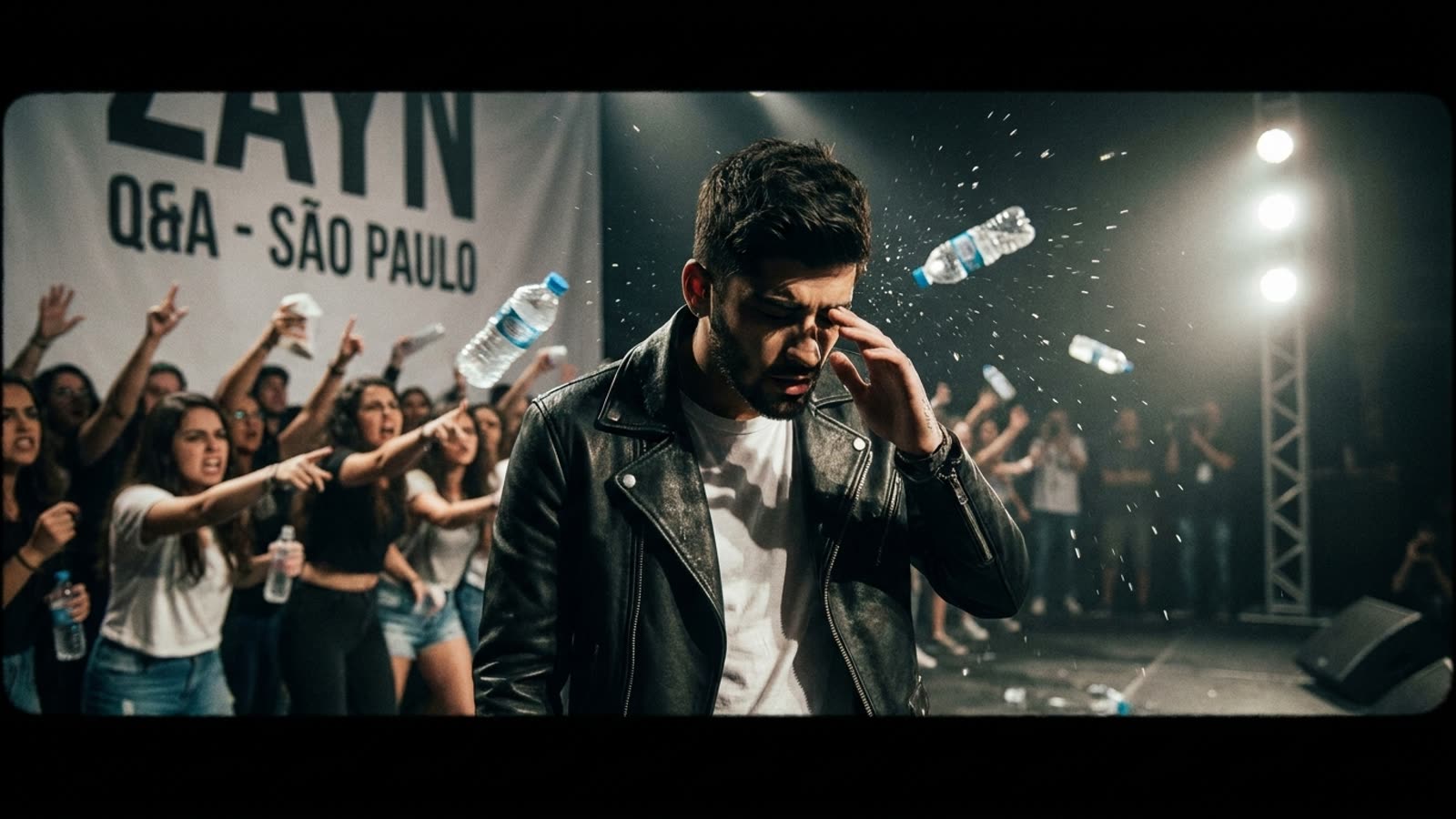
The footage is jarring in its casualness: Zayn Malik, seated on a stage in São Paulo for what was meant to be a gentle promotional Q&A, suddenly ducking as water bottles arc toward him from the crowd. Security scrambles. The event ends early. And somewhere, a publicist quietly updates their risk assessment for in-person fan engagements.
The incident, which occurred this week, joins a growing catalogue of fan-event chaos that has plagued the music industry in recent years. What was once a controlled transaction—artist appears, fans adore, everyone goes home happy—has curdled into something more volatile. The question is no longer whether these events are worth the promotional value, but whether they're worth the physical risk.
The parasocial economy breaks down
Malik has always occupied an unusual position in the pop ecosystem. His 2015 departure from One Direction made him simultaneously a traitor to the group's most fervent believers and a symbol of artistic autonomy. A decade later, that duality hasn't resolved—it's calcified. The fans who show up to his events carry a decade of accumulated grievance alongside their devotion, and the line between the two has become dangerously thin.
This isn't unique to Malik. Bebe Rexha required stitches after a fan threw a phone at her face in 2023. Ava Max was slapped onstage. Kelsea Ballerini took a bracelet to the eye. The common thread isn't the artists; it's the audience. Something in the parasocial contract has shifted. Fans who once understood the implicit rules of engagement—you watch, you cheer, you maybe get a wave—now seem to believe proximity entitles them to something more. Or perhaps something less: not connection, but confrontation.
The economics of accessibility
The cruel irony is that these events exist because the music industry has spent two decades telling fans they deserve unprecedented access. Meet-and-greets, VIP packages, intimate Q&As—all sold at premium prices, all predicated on the fiction that the barrier between star and superfan is merely transactional. Pay enough, and you're not an audience member; you're a participant.
But participation implies agency, and agency can curdle into entitlement. When you've spent significant money to be in the same room as someone whose life you've followed obsessively for years, the power dynamic feels less clear than it should. The bottle thrower in São Paulo likely didn't see themselves as committing assault. They saw themselves as finally being heard.
Our take
The water bottles aimed at Malik are a symptom of something the industry has been reluctant to name: the fan-access economy is unsustainable in its current form. You cannot simultaneously cultivate obsessive devotion and expect that devotion to remain polite. The artists who navigate the next decade successfully will be those who understand that scarcity, not accessibility, is the only reliable form of protection. The meet-and-greet era isn't ending because artists are aloof. It's ending because the alternative is body armor.