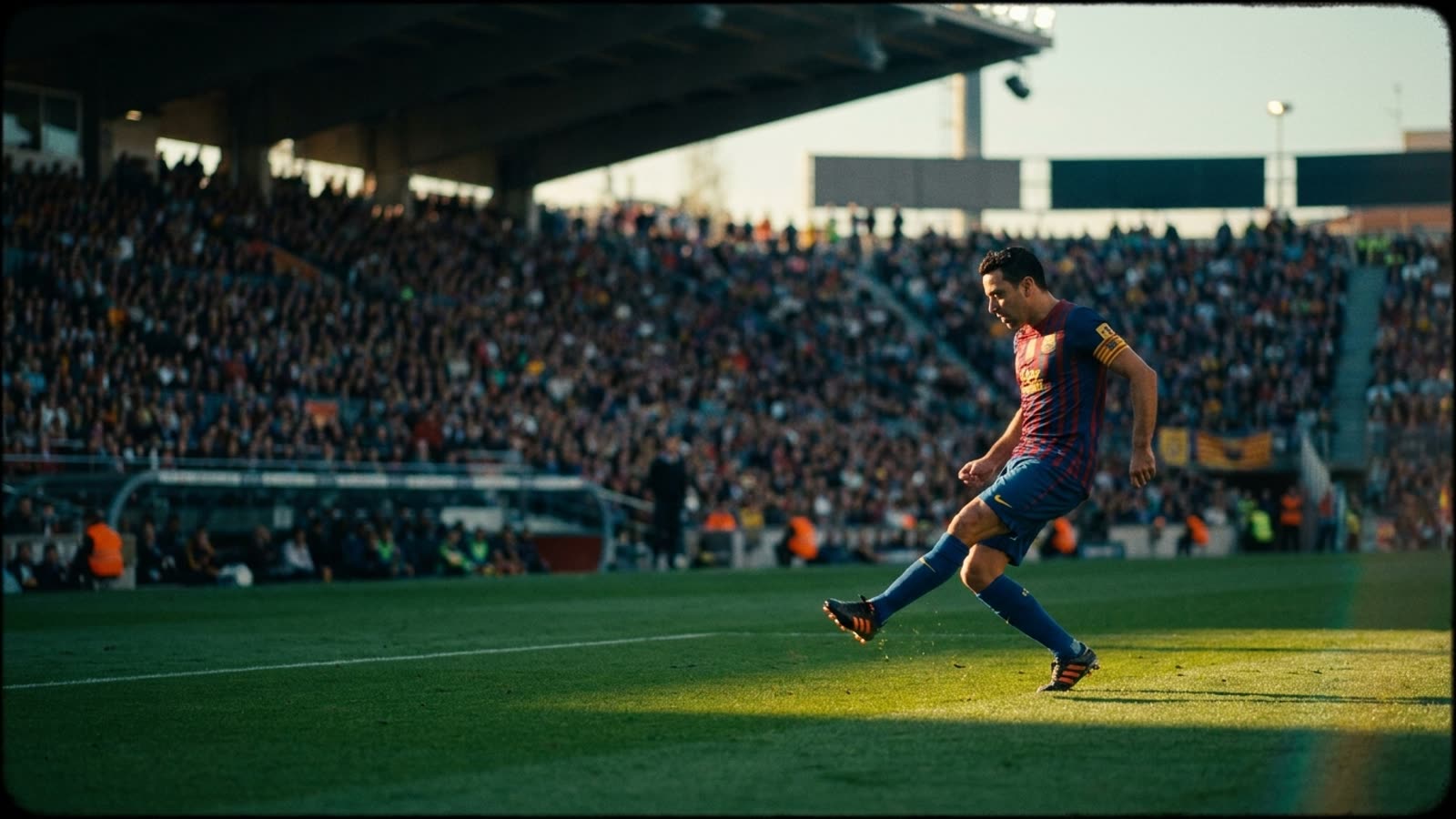
For a generation raised on the cult of the dribbler, Xavi Hernández offered a quiet heresy: what if the ball moved faster than any player ever could, and what if that was the whole point?
The Catalan midfielder, who anchored Barcelona's greatest era and Spain's unprecedented international dominance, retired with more trophies than almost any footballer in history. Yet his highlight reels remain curiously sparse. No bicycle kicks, no mazy runs through six defenders, no thunderbolts from thirty yards. Just pass after pass after pass, each one arriving exactly where a teammate was about to be, each one making the next move obvious and the one after that inevitable.
The geometry of inevitability
Xavi's genius was architectural. He saw football not as a series of duels but as a spatial problem to be solved collectively. His body would open toward three options simultaneously; his eyes would register which defender had shifted weight to the wrong foot; his pass would exploit the gap before it fully existed. Opponents described playing against him as chasing shadows. Teammates described playing with him as having the game explained in real time.
At his peak under Pep Guardiola, Xavi completed passes at rates that bordered on statistical absurdity—often exceeding ninety percent in matches where Barcelona held possession for two-thirds of the game. The raw numbers, though, missed the texture. It was not that he avoided risk; it was that he redefined what risk meant. A sideways pass that drew two pressers out of position was more dangerous than a Hollywood ball that went nowhere.
The Spanish transformation
Before Xavi and his midfield partners Andrés Iniesta and Sergio Busquets, Spain were perennial underachievers, a nation of technical players who wilted when tournaments demanded steel. The 2008 European Championship, the 2010 World Cup, and the 2012 Euros changed that calculus entirely. Spain did not merely win; they suffocated opponents with possession so relentless that the term "tiki-taka" entered the global lexicon.
Xavi was the metronome. He set the tempo, decided when to accelerate, and—crucially—knew when to pause. The 2010 World Cup final against the Netherlands was a brutal, foul-strewn affair, yet Xavi kept recycling possession as if the chaos around him was someone else's problem. When Iniesta finally scored the winner, the assist came from Cesc Fàbregas, but the architecture of the move was pure Xavi: patient, probing, then suddenly vertical.
Our take
Xavi Hernández proved that football's most valuable currency is not speed or strength but understanding. He was not the best athlete on any pitch he graced, yet he controlled more matches than players twice as fast and three times as powerful. In an era that increasingly fetishizes the spectacular, his legacy is a reminder that mastery often looks like simplicity—and that the most devastating thing you can do to an opponent is make them irrelevant to your plans.