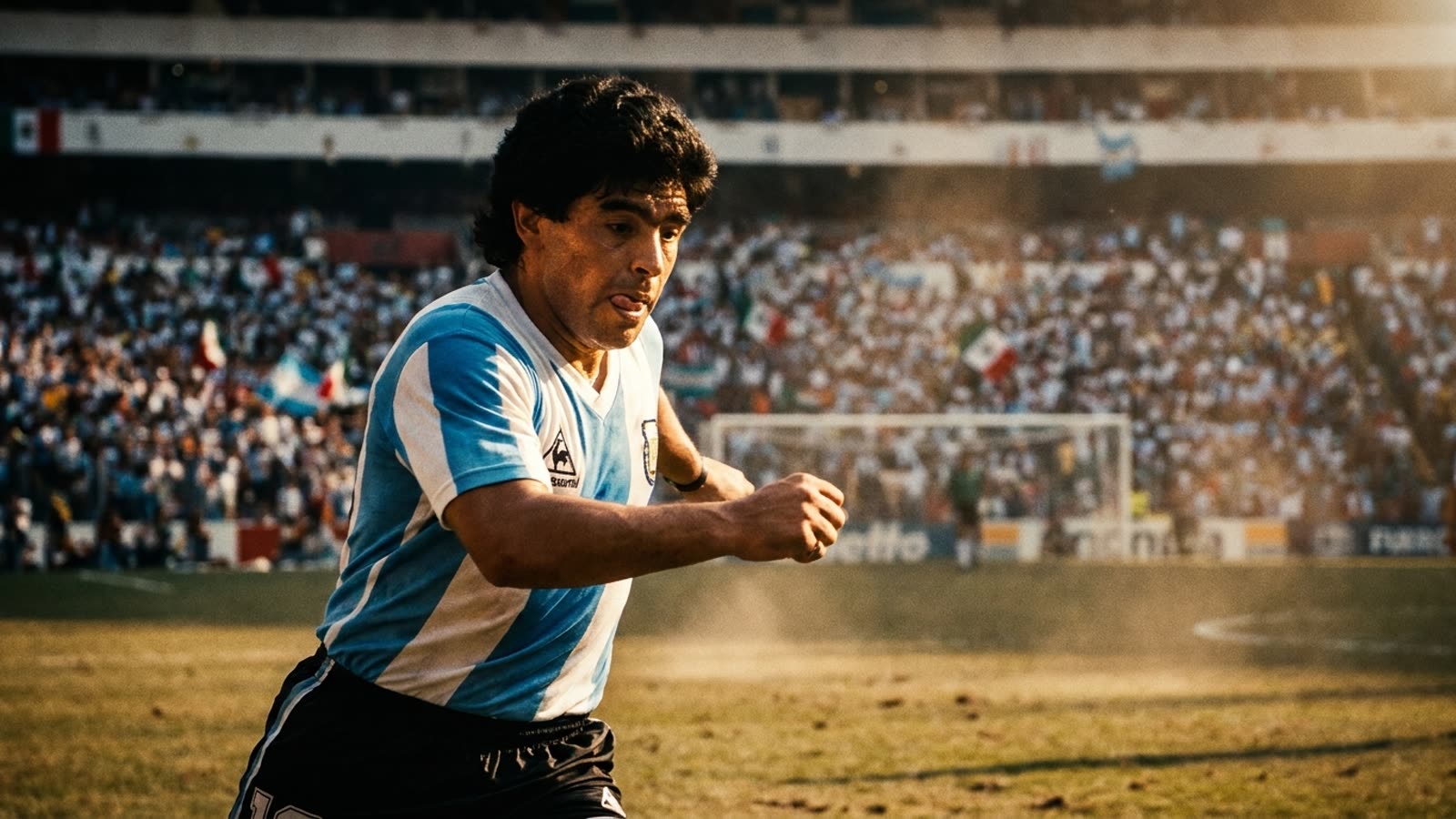
The greatest trick Diego Maradona ever pulled was convincing the world that punching a ball into the net was somehow beautiful. On a sweltering afternoon in Mexico City's Estadio Azteca, in the quarterfinals of the 1986 World Cup, the Argentine captain rose to meet a looping ball alongside England goalkeeper Peter Shilton and, with his left fist, guided it into the goal. The Tunisian referee saw nothing. The linesman saw nothing. Fifty thousand spectators saw everything and said nothing useful. Argentina led 1-0.
What happened next—the second goal, the one where Maradona collected the ball in his own half and slalomed past five English players before finishing with surgical calm—is routinely called the greatest goal ever scored. But that goal exists in football's collective memory as a kind of moral laundering, the virtuosity that made the villainy palatable. The Hand of God, as Maradona himself christened it with characteristic cheek, is the goal that actually matters.
The politics of a punch
To understand why Argentina celebrated a handball as divine intervention requires context that transcends sport. Four years earlier, Britain and Argentina had fought a brief, brutal war over the Falkland Islands—or the Malvinas, depending on your passport. Nearly nine hundred people died. The wounds were fresh, the humiliation on the Argentine side profound. When Maradona raised his fist to the ball, he was not merely cheating; he was, in the eyes of his countrymen, settling a score that football had no business settling but settled anyway.
Maradona understood this implicitly. In interviews afterward, he never apologized. He called the goal revenge for the Malvinas. He suggested that beating England by any means necessary was itself a form of justice. This was not sportsmanship. It was something more honest: the acknowledgment that international football, particularly at the World Cup, has never been merely a game.
Why the goal endures
The Hand of God persists in cultural memory not because it was clever but because it was clarifying. It exposed the fragility of football's honor system, the absurdity of trusting human officials to adjudicate events that unfold in fractions of seconds. It revealed that the World Cup's mythology depends as much on controversy as on brilliance. And it demonstrated that history is written by winners—Argentina lifted the trophy that summer, and Maradona became a god in a country that needed one.
The goal also endures because Maradona himself was incapable of shame. Lesser players might have deflected credit, mumbled about unfortunate angles. Maradona leaned in. "A little with the head of Maradona and a little with the hand of God," he said, and the quote became immortal precisely because it refused to choose between confession and defiance.
Our take
Football has spent the decades since 1986 trying to eliminate the Hand of God through technology—goal-line cameras, VAR, frame-by-frame review. The effort misses the point. Maradona's handball was not a failure of officiating to be corrected; it was a revelation about what the World Cup actually is. The tournament sells itself as a celebration of fair play and global unity. In reality, it is a stage for national grievance, individual audacity, and the uncomfortable truth that winning forgives everything. The Hand of God was cheating, yes. It was also the most honest moment in World Cup history.