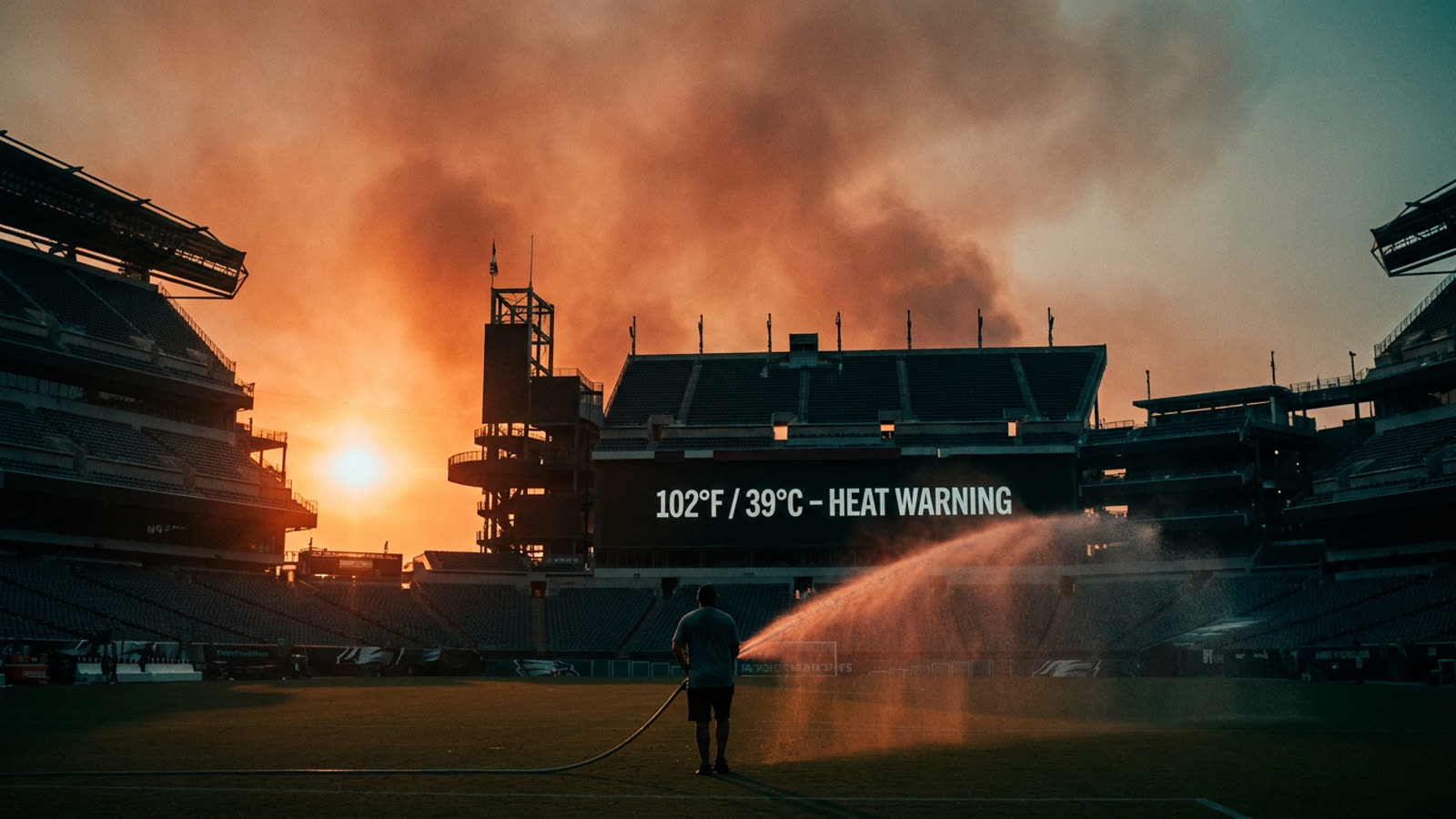
The most consequential variable in the 2026 World Cup may not be Mbappé's hamstring or Argentina's midfield depth. It may be the thermometer.
As the tournament kicks off tomorrow across the United States, Mexico, and Canada, organizers face a problem they cannot coach around: summer heat that increasingly refuses to cooperate with the beautiful game. Forecasts for opening-week venues paint an uncomfortable picture — triple-digit temperatures in Dallas, oppressive humidity in Miami, and the kind of volatile weather patterns that turn tactical preparation into guesswork. FIFA's decision to award the tournament to North America always carried this asterisk; climate change has now bolded and underlined it.
The physics of exhaustion
Soccer is an endurance sport masquerading as a skill competition. Elite players cover roughly 10 to 13 kilometers per match, much of it at high intensity. Heat doesn't merely inconvenience them — it fundamentally alters what's possible. Core body temperatures rise, cognitive function degrades, and the pressing systems that define modern football become physiologically untenable. The teams that thrive in Qatar 2022's air-conditioned stadiums won't have that luxury in open-air American venues.
FIFA has implemented cooling breaks and reserves the right to adjust kickoff times, but these are band-aids on a structural wound. The tournament's footprint — spanning from Guadalajara to Toronto — means some host cities will be playing in conditions that would trigger workplace safety concerns in other industries. Players' unions have raised alarms quietly; publicly, everyone maintains the fiction that elite athletes can simply adapt.
Winners and losers in the heat lottery
Not all squads suffer equally. European powers accustomed to temperate conditions face a steeper adjustment curve than African and South American teams with players seasoned in tropical leagues. Germany's high-tempo system looks different when the air feels like soup. England's depth becomes more valuable when rotation isn't a choice but a survival strategy.
The draw matters less than the venue assignment. A Group F match in Atlanta's humidity presents a different challenge than the same fixture in Seattle's comparatively mild summer. Smart federations have been heat-training for months; others are about to learn expensive lessons about preparation.
Our take
This tournament will be remembered as the moment international soccer stopped pretending summer heat was a manageable inconvenience. The sport's governing bodies have spent decades chasing television money and geopolitical favor, scheduling marquee events with little regard for the athletes who must perform in them. The 2026 World Cup won't be ruined by weather — the games will happen, the goals will be scored, someone will lift the trophy. But the margins will be thinner, the collapses more frequent, and the post-tournament reckoning about player welfare louder than ever. FIFA wanted a North American summer spectacular. They're getting a stress test.