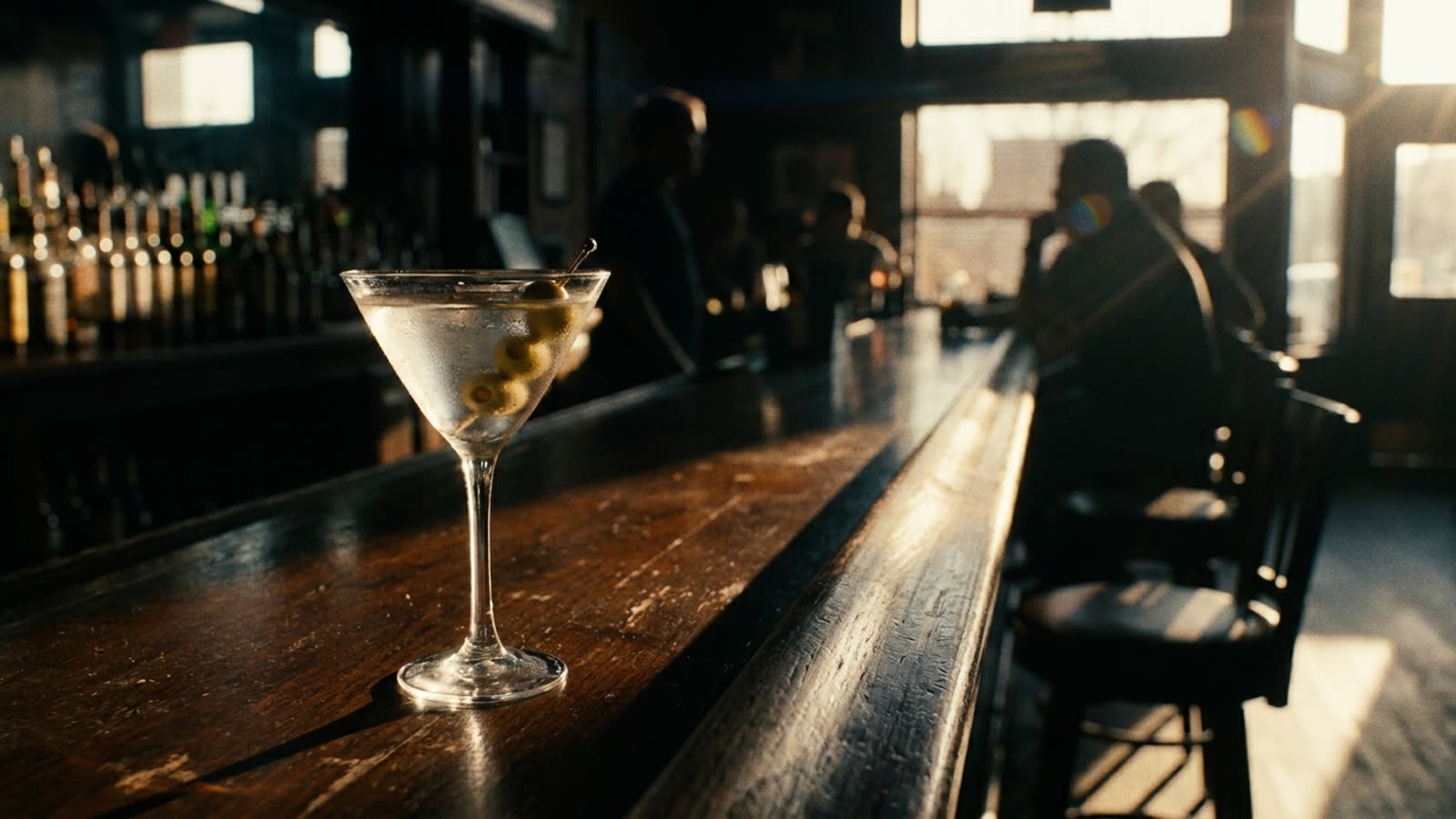
The martini is not a complicated drink. It is gin (or vodka, if you must) and vermouth, stirred or shaken, served cold in a stemmed glass. There is no muddling, no egg white, no house-made shrub. A competent bartender can produce one in under a minute. And yet no cocktail has generated more opinions, more rituals, or more staying power than this deceptively simple combination of two ingredients.
The drink's longevity is paradoxical. In an era when cocktail menus read like chemistry dissertations—clarified this, fat-washed that—the martini sits apart, almost aggressively minimal. It has no story to tell about Peruvian pisco or Japanese whisky. It cannot be Instagrammed to advantage. It tastes, frankly, like cold alcohol. And still, decade after decade, it persists at the top of every bar's order sheet, ordered by people who could choose anything.
The architecture of restraint
What makes the martini work is what it lacks. Most cocktails are exercises in addition: another modifier, another garnish, another technique to justify the price. The martini is an exercise in subtraction. The original recipes from the late nineteenth century called for equal parts gin and vermouth, sometimes with orange bitters or maraschino. Over the following decades, the vermouth retreated—first to a splash, then to a rinse, then, in the famous Churchill formulation, to merely glancing at the bottle from across the room.
This drift toward dryness was not about taste alone. It was about performance. Ordering a martini "very dry" or "with a whisper of vermouth" became a way of signaling sophistication, of demonstrating that you knew the rules well enough to break them. The drink became a vehicle for connoisseurship theater, and the theater became inseparable from the drink itself.
A canvas for personality
The martini's emptiness is its genius. Because it offers so little flavor complexity, it offers enormous room for personal preference. Gin or vodka. Shaken or stirred. Olive or twist. Dirty or clean. Up or on the rocks. Each choice becomes a small declaration of identity, a way of saying something about yourself without saying anything at all.
This is why the martini has attached itself so durably to certain archetypes: the executive unwinding, the spy between missions, the socialite at the hotel bar. The drink does not compete with the person holding it. It recedes, allowing the drinker to project whatever image they prefer. A negroni has opinions. A martini has discretion.
The economics of simplicity
There is also a commercial logic to the martini's persistence. For bars, it is among the most profitable drinks on the menu—high-margin spirits, minimal labor, no perishable ingredients. For drinkers, it offers reliable quality: a martini at a mediocre bar is still drinkable, while a mediocre bar's attempt at a Paper Plane or a Last Word is often a disaster. The martini's floor is higher than almost any other cocktail's ceiling.
This reliability has made it recession-proof and trend-proof. Tiki had its moment. Speakeasy revivalism had its moment. Natural wine had its moment. Through all of it, the martini remained on every menu, ordered by people who never stopped ordering it, joined periodically by new converts who discovered that sometimes the old ways persist because they work.
Our take
The martini endures because it solved a problem most cocktails never acknowledge: how to drink seriously without taking your drink too seriously. It is cold, strong, and almost flavorless—which means it gets out of the way. In a culture that treats every consumer choice as an expression of identity, the martini offers something rare: a blank space where you can simply be a person at a bar, holding a drink, thinking your own thoughts. That is worth more than any barrel-aged, sous-vide, micro-seasonal concoction a mixologist could devise.