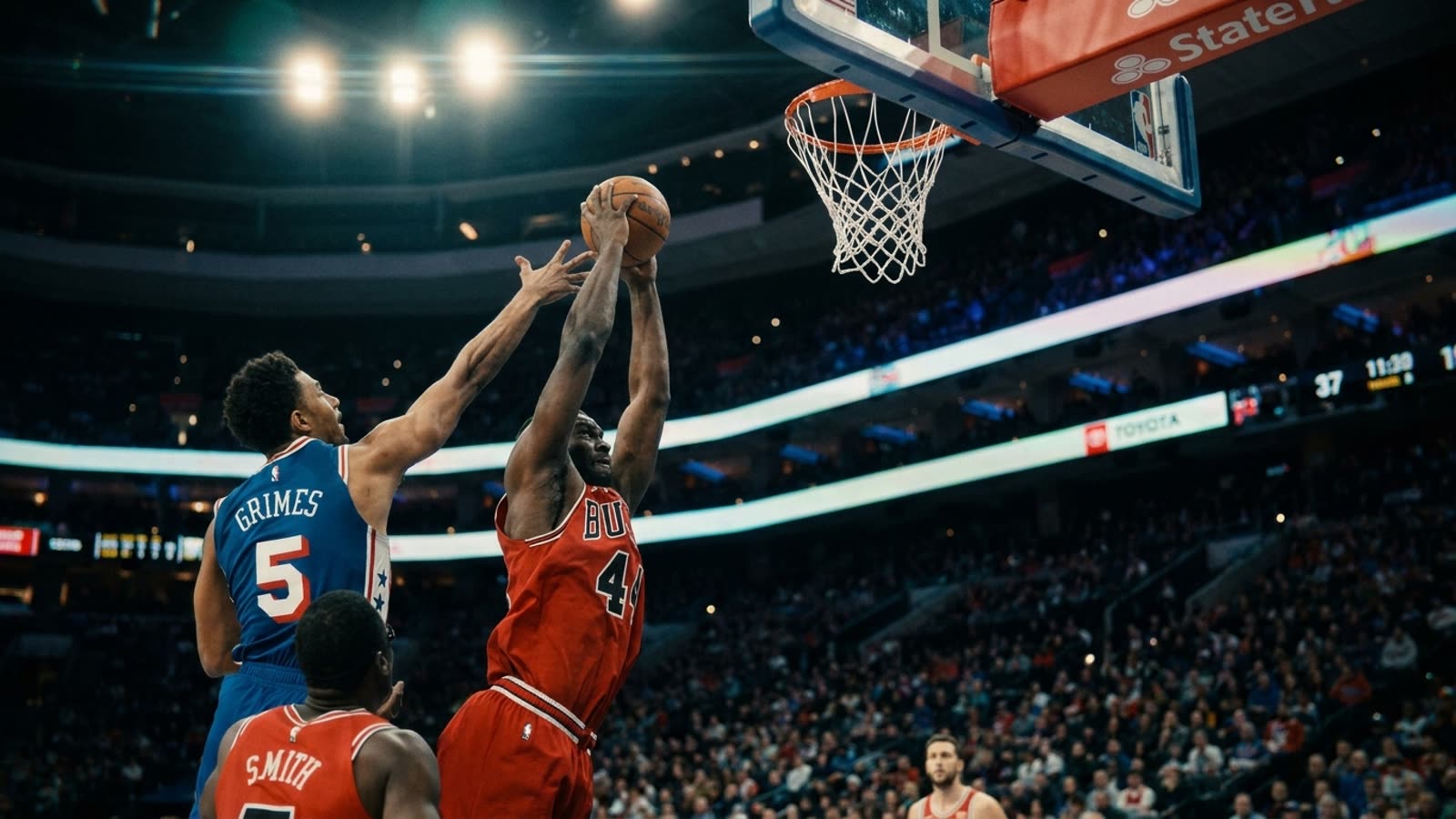
The midrange jumper—that elegant pull-up from fifteen feet, the fadeaway from the elbow, the catch-and-shoot from the free-throw line extended—has become basketball's endangered species. Not because players can no longer execute it, but because front offices have decided it represents a failure of optimization. The sport's governing philosophy now holds that the best shot is rarely the most beautiful one.
This shift did not happen gradually. It arrived with the force of doctrine, backed by spreadsheets that proved what coaches once considered heresy: a 35% three-pointer is mathematically superior to a 50% two-pointer. Expected value became the sport's new scripture, and the midrange jumper—worth only two points despite requiring considerable skill—became its original sin.
The geometry of efficiency
The numbers are difficult to argue with. A league-average three-point shooter converting at 36% generates 1.08 points per attempt. A midrange specialist hitting 45% of their shots—an excellent rate—produces only 0.90 points per attempt. Over a season, over a career, over a franchise's competitive window, those decimal points compound into championships or lottery picks.
Teams responded rationally. In the early 2010s, NBA offenses took roughly 20% of their shots from midrange. By the mid-2020s, that figure has collapsed to single digits for many franchises. The Houston Rockets, under Daryl Morey's analytical regime, famously attempted to eliminate the midrange entirely, treating it as a market inefficiency to be exploited by opponents foolish enough to take such shots.
What the spreadsheets miss
Yet something has been lost that cannot be captured in expected-value calculations. The midrange game was basketball's jazz—improvisational, personal, requiring a vocabulary of fakes and footwork that three-point shooting, by comparison, renders binary. Michael Jordan's fadeaway, Kobe Bryant's turnaround, Dirk Nowitzki's one-legged stepback—these were signatures, as distinctive as handwriting.
The modern game has traded this artistry for spacing. Five shooters orbit the three-point line, creating driving lanes and kick-out opportunities. It is effective basketball. It is also, increasingly, homogeneous basketball. Teams that once had distinct offensive identities now run variations of the same motion concepts, seeking the same high-value shots.
Defenses have adapted accordingly. The midrange is now deliberately conceded—a soft spot in the floor that teams bait opponents into occupying. The irony is that this concession has made the midrange more valuable for those still willing to take it. DeMar DeRozan and Chris Paul have built late-career renaissances partly on opponents' refusal to guard shots that analytics deemed inefficient.
Our take
The three-point revolution was inevitable and, on its own terms, correct. But basketball's analytical awakening has produced a curious blindness: the assumption that what cannot be quantified does not matter. The midrange jumper created rhythm, demanded craft, and produced moments of individual brilliance that no corner three can replicate. The sport is more efficient now, and perhaps that is enough. But efficiency is not the same as beauty, and the game's aesthetic impoverishment is real even if no spreadsheet can measure it.