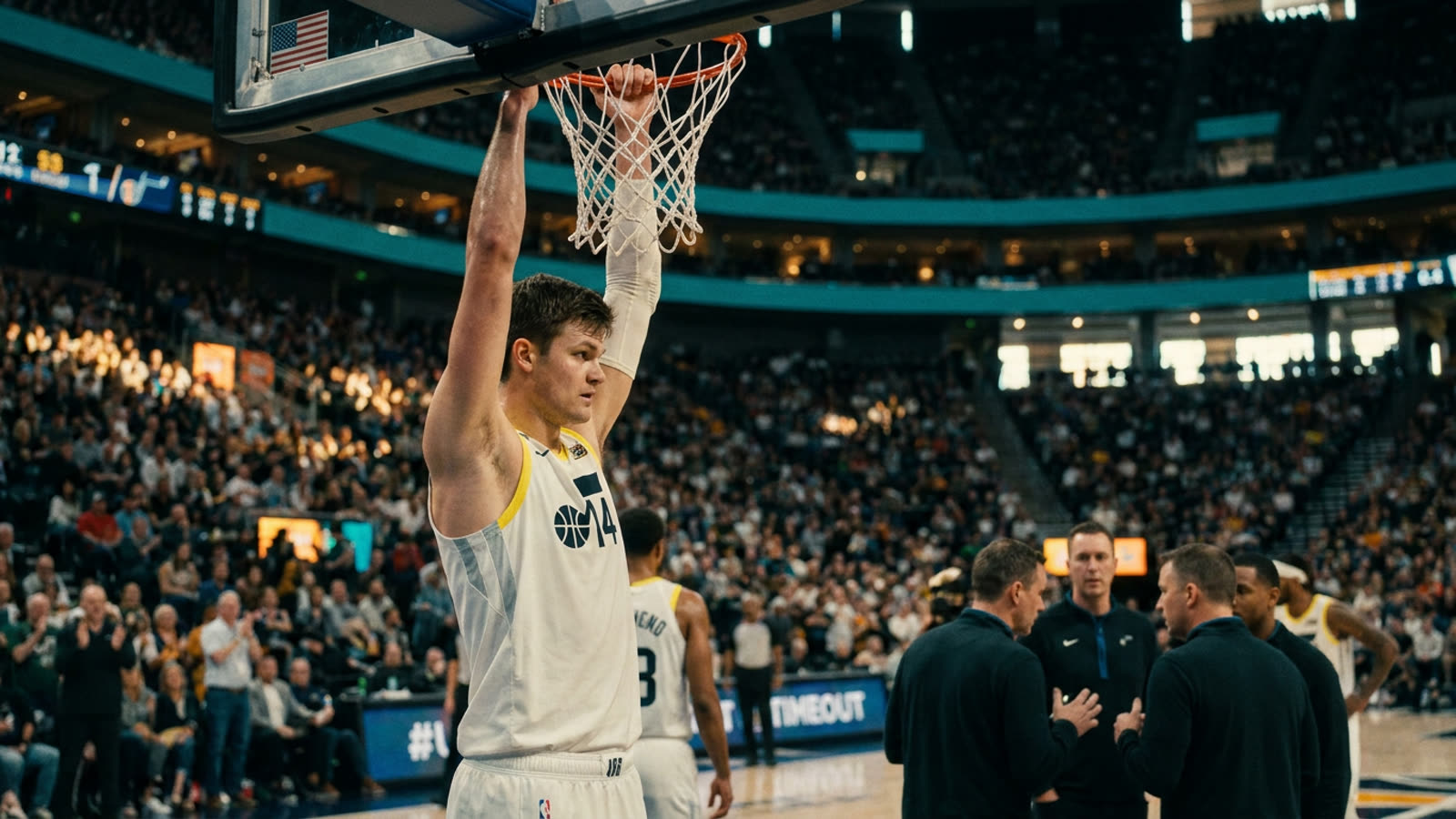
The Utah Jazz have reportedly offered Walker Kessler approximately $140 million, and the 24-year-old center's camp has responded with something between hesitation and a polite no. On its face, this is puzzling: Kessler is a restricted free agent with limited leverage, and $140 million is not a figure most humans encounter outside lottery fantasies. But the stalemate reveals something more interesting than a contract dispute—it exposes the NBA's ongoing identity crisis about what to pay the men who stand closest to the basket.
Kessler, the 22nd pick in 2022, has developed into one of the league's premier shot-blockers. His 2.4 blocks per game last season ranked among the top five, and his defensive impact metrics suggest a player who genuinely changes how opponents attack. The problem is that "defensive anchor who can't space the floor" is a job description the modern NBA has spent a decade trying to eliminate.
The center paradox
The league's highest-paid centers—Joel Embiid, Nikola Jokić, Anthony Davis—are offensive engines who happen to be tall. They create, they shoot, they run systems. Kessler is none of those things. He is, instead, a throwback: a lob threat, a rebounder, a rim eraser. Valuable, certainly. But valuable enough to command a max extension?
Utah's offer reportedly falls in the four-year, $140 million range—roughly $35 million annually. Kessler's representatives apparently believe he deserves more, likely eyeing the contracts signed by players like Jarrett Allen ($100 million over five years in 2021, now looking like a bargain) and projecting forward with the rising salary cap. The Jazz, meanwhile, are mid-rebuild and reluctant to anchor their cap sheet to a player who may not be a first or second option on a championship team.
What the market says
The broader center market has been sending mixed signals for years. Traditional rim protectors like Rudy Gobert command massive salaries, then watch their teams struggle in the playoffs when opponents go small. Meanwhile, stretch fives and versatile bigs get paid as if they're solving a different problem entirely. Kessler sits uncomfortably between categories: too impactful to let walk, too limited to build around.
The Jazz's hesitation is also philosophical. They have Lauri Markkanen as their franchise cornerstone, a forward-thinking front office, and no particular reason to rush into a marriage with a player whose skill set might age poorly. Restricted free agency gives them matching rights, but it also creates awkwardness—and awkwardness between a team and a young player rarely resolves cleanly.
Our take
Kessler is probably worth something close to what Utah is offering, and his camp is probably right that the number will look small in three years when the cap explodes again. Both sides are negotiating rationally, which is precisely why this is taking so long. The real lesson here is that the NBA still hasn't figured out how to value defense, particularly the old-fashioned kind that doesn't translate to highlight reels or playoff closeout games. Kessler will get paid handsomely. Whether he'll ever be paid what he thinks he deserves is a different question—one the league keeps asking about centers and never quite answering.