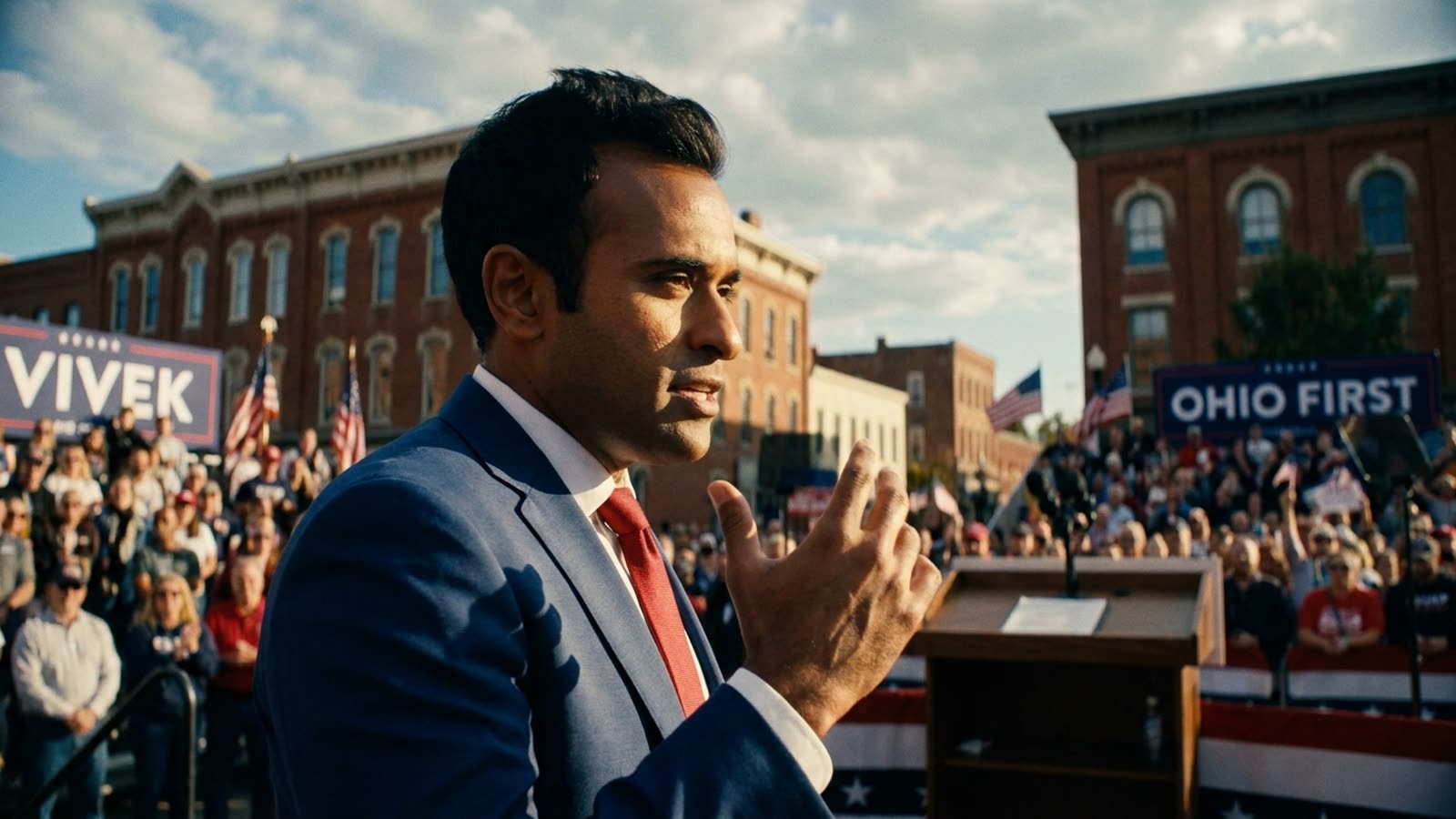
Barack Obama returned to the campaign trail this weekend with a mission: remind wavering Democrats that Trumpism is not confined to Donald Trump. But in Ohio, he did something unusual—he made Vivek Ramaswamy, the biotech entrepreneur turned MAGA standard-bearer, the co-star of his attack.
At a rally in Columbus on Saturday, the 44th president excoriated Trump's "cruelty and corruption" in terms that have become familiar Democratic boilerplate. What was not familiar was the sustained attention he devoted to Ramaswamy, the Republican nominee for governor, whom Obama called a "dangerous experiment" and a vessel for "the worst instincts of this movement." The critique was detailed, personal, and—by the standards of Obama's normally calibrated rhetoric—almost contemptuous.
The Ramaswamy Problem
For Democrats, the 41-year-old Ramaswamy presents a strategic headache. He is young, fluent in the language of grievance, and capable of translating Trumpist themes into the syntax of a McKinsey deck. His gubernatorial campaign has leaned into culture-war provocation while maintaining plausible deniability through corporate-speak about "stakeholder capitalism" and "institutional capture." Ohio's Democratic candidate, state Senator Morgan Harper, has struggled to make the race competitive; polls show Ramaswamy leading by mid-single digits in a state Trump carried twice.
Obama's intervention suggests national Democrats have concluded that Ramaswamy is not merely an Ohio problem. A Governor Ramaswamy would instantly become a 2028 presidential contender, a younger, more media-savvy vehicle for the movement Trump built. Better to define him now, the thinking goes, than to let him accumulate power unchallenged.
The Gift of Enemies
Yet there is a risk in the strategy that the Ramaswamy campaign grasped immediately. Within hours of Obama's remarks, the Republican's fundraising operation blasted out clips of the attack, framing the former president as an out-of-touch elite desperate to stop a "son of immigrants who actually built something." For a candidate whose brand depends on positioning himself as an outsider persecuted by the establishment, an Obama denunciation is not a wound—it is a credential.
The dynamic mirrors Trump's own ascent: the more legacy institutions attacked him, the more his base consolidated. Ramaswamy, who modeled much of his 2024 presidential primary campaign on Trump's combative style, understands this arithmetic intimately. He has spent years courting exactly the kind of elite disapproval that Obama delivered on Saturday.
The Midterm Stakes
Ohio's gubernatorial race is one of several contests that will determine whether Republicans can extend their dominance in state capitals ahead of the 2030 redistricting cycle. A Ramaswamy victory would give the party unified control of a state that was once a genuine battleground, further entrenching its structural advantages in the Midwest.
For Democrats, the race is also a test of whether anti-Trump energy can be transferred to anti-Trumpism more broadly—whether voters who recoil from the president will extend that revulsion to his imitators. Obama's gamble is that the answer is yes, that Ramaswamy's polish cannot disguise the underlying ideology.
Our take
Obama is probably right that Ramaswamy is dangerous in ways that transcend Ohio. But the former president's instinct to elevate him may prove counterproductive. Ramaswamy's entire political identity is built on the premise that elites fear him; Obama just confirmed it on national television. The smarter play would have been to let Harper make the case while Obama focused on Trump. Instead, Democrats have given a gubernatorial candidate the one thing his considerable fortune could not purchase: a nemesis worthy of his ambitions.