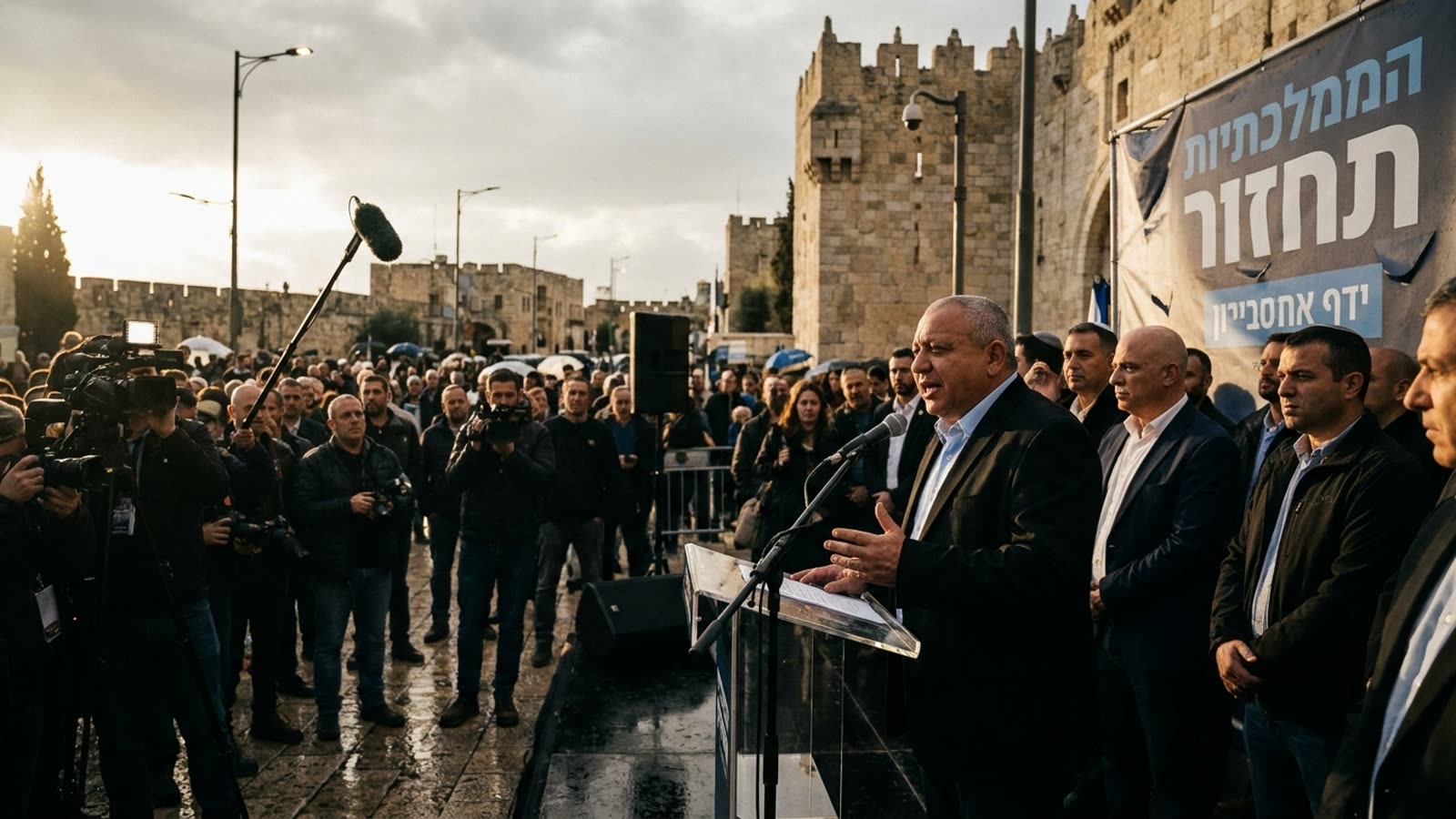
Gadi Eisenkot does not raise his voice. He does not pound lecterns. He has called Benjamin Netanyahu an "anti-leader," which in Israeli political discourse is roughly the equivalent of whispering an insult at a heavy-metal concert. And yet, with Tuesday's general election approaching, the 64-year-old former Israel Defense Forces chief of staff holds a narrow but persistent lead in most public surveys—a statistical rebuke to the theatrical style that has dominated the country's politics for three decades.
The contrast is almost too neat. Netanyahu, 77, has spent the final stretch of the campaign promising a "decisive" West Bank offensive after Palestinian gunmen killed two soldiers on Friday, leaning into the hawkish reinvention he has pursued since the October 7, 2023 attacks shattered his long-cultivated image as Mr. Security. Eisenkot, meanwhile, has been holding town halls in community centers, speaking in the measured cadence of a man accustomed to briefing cabinets rather than rallying crowds. His supporters are nervous. His opponents are bemused. The polls remain stubbornly in his favor.
The anti-leader's theory of the case
Eisenkot's campaign rests on a single, counterintuitive premise: that Israelis are tired. Tired of permanent crisis governance, tired of coalition dramas, tired of a prime minister who has reshaped the judiciary, the military brass, and the public broadcaster to suit his survival. The former general is not offering transformation; he is offering temperament. In a country where politics is blood sport, he is running as the designated driver.
This is not without risk. Israeli elections reward mobilization, and mobilization rewards emotion. Netanyahu's Likud has spent weeks warning that Eisenkot is too passive to handle Iran, too conciliatory to manage the West Bank, too boring to inspire turnout among the right-wing base that has kept Netanyahu in or near power since 1996. The Friday attack—and Netanyahu's immediate vow of a major offensive—handed the incumbent a closing argument written in the grammar he knows best: security, strength, and the suggestion that his challenger would flinch.
The institutional question
Beyond personality, the election is a referendum on what Netanyahu has done to Israeli governance. His allies have installed loyalists at the state prosecutor's office, weakened the Supreme Court's override powers, and turned public broadcasting into a softer echo of the prime minister's messaging. Eisenkot has promised to reverse much of this, but he has been vague on mechanisms, preferring to speak of "restoring norms" rather than detailing legislative rollbacks. Critics say this is evasion; supporters call it prudence in a country where coalition math is merciless and campaign promises rarely survive contact with junior partners.
What is clear is that the election's outcome will determine whether Netanyahu's institutional remodeling becomes permanent. A fourth consecutive term would cement the changes; a loss would test whether they can be unwound without triggering the constitutional crisis his opponents have long warned about.
Our take
Eisenkot is gambling that exhaustion is a stronger political force than fear. It is a bet against three decades of evidence, against the reflexive rally-around-the-flag instinct that Friday's attack will almost certainly trigger, and against his own temperament in a media environment that rewards volume. If he wins, it will be the most improbable victory in modern Israeli politics—a whisper that outlasted a roar. If he loses, it will confirm what Netanyahu has always believed: that in a dangerous neighborhood, the man who shouts loudest is the one who gets to keep the keys.