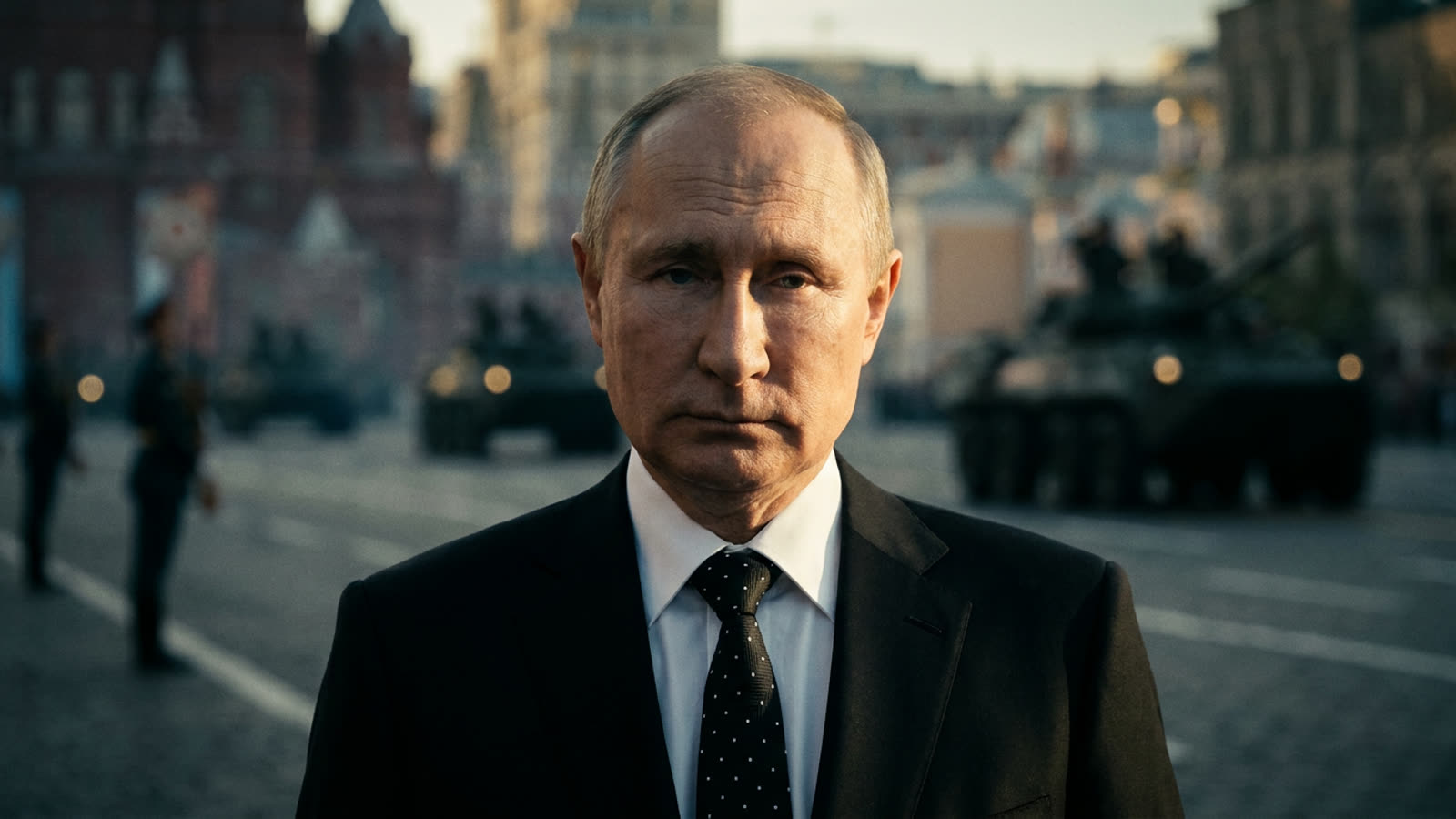
The three-day ceasefire that Russian President Vladimir Putin declared in honor of the 9 May Victory Day commemorations collapsed, as most analysts predicted it would, within hours of taking effect. By Friday morning, Russia and Ukraine were publicly accusing each other of hundreds of drone attacks and artillery exchanges across the 700-mile front, each side releasing air-defense radar stills to prove the other had broken the truce first.
Victory Day, which marks the Soviet Union's 1945 defeat of Nazi Germany, is the most politically loaded date on the Russian calendar. Moscow will host its traditional Red Square parade on Saturday, with Chinese President Xi Jinping among the foreign guests. Putin's ceasefire announcement last week was designed, Kremlin watchers said at the time, less as a genuine diplomatic gesture than as insurance against a Ukrainian long-range drone strike on the parade itself — a scenario the Russian air-defense command has reportedly war-gamed every year since 2023.
The numbers from the first night
Ukraine's general staff said Russia launched 108 Shahed-type drones and four cruise missiles across Ukrainian airspace in the first twelve hours of the supposed truce, striking targets in Kharkiv, Sumy, and Zaporizhzhia oblasts. Ukraine's air force claimed to have shot down 78 of them. Russia's defence ministry, in its own Friday-morning briefing, said it had intercepted 192 Ukrainian drones overnight, including 27 over Moscow oblast and one that was neutralized within 40 kilometres of the Kremlin.
Neither claim is independently verifiable. Both are roughly consistent with the nightly tempo of the war for the last six months, which is itself the point: the "ceasefire" is, in operational terms, statistically indistinguishable from a normal night.
Why Putin called it anyway
The Kremlin's logic is narrative, not military. If Ukraine strikes Moscow during the Victory Day parade, Russian state television now has a ready-made talking point: we offered peace, they chose war, in front of our grandfathers' graves. If Ukraine does not strike, Putin gets to stand on the reviewing stand in an uncontested sky. Either way, Moscow writes the news chyron.
Kyiv, for its part, never agreed to the truce. President Volodymyr Zelensky called the proposal "a theatre ceasefire, built for one camera angle." Ukrainian officials have been explicit that they will continue deep-strike operations on Russian military and energy infrastructure throughout the anniversary weekend, and that the only ceasefire they will consider is the 30-day unconditional proposal tabled by the Trump administration in March — which Russia has still not accepted.
The Trump administration's silence
The White House did not issue a formal statement on the collapse of the Victory Day truce, which is itself a statement. Trump has been conspicuously less vocal about the Russia-Ukraine file since the Iran war began, and U.S. officials privately acknowledge that the administration's diplomatic bandwidth is effectively spent. Special envoy Keith Kellogg told reporters Thursday only that "we continue to encourage both sides to lower the temperature," which in Washington is the phrase you use when you no longer have a plan.
Our take
The Victory Day ceasefire was never going to hold because neither side had anything to gain from it holding. It was a press release dressed as a peace plan, and it bought Moscow exactly what it was designed to buy: a clean news cycle for Saturday's parade. The real test is whether the 30-day proposal still on the table in Washington survives the week. So far, nobody is betting on it.