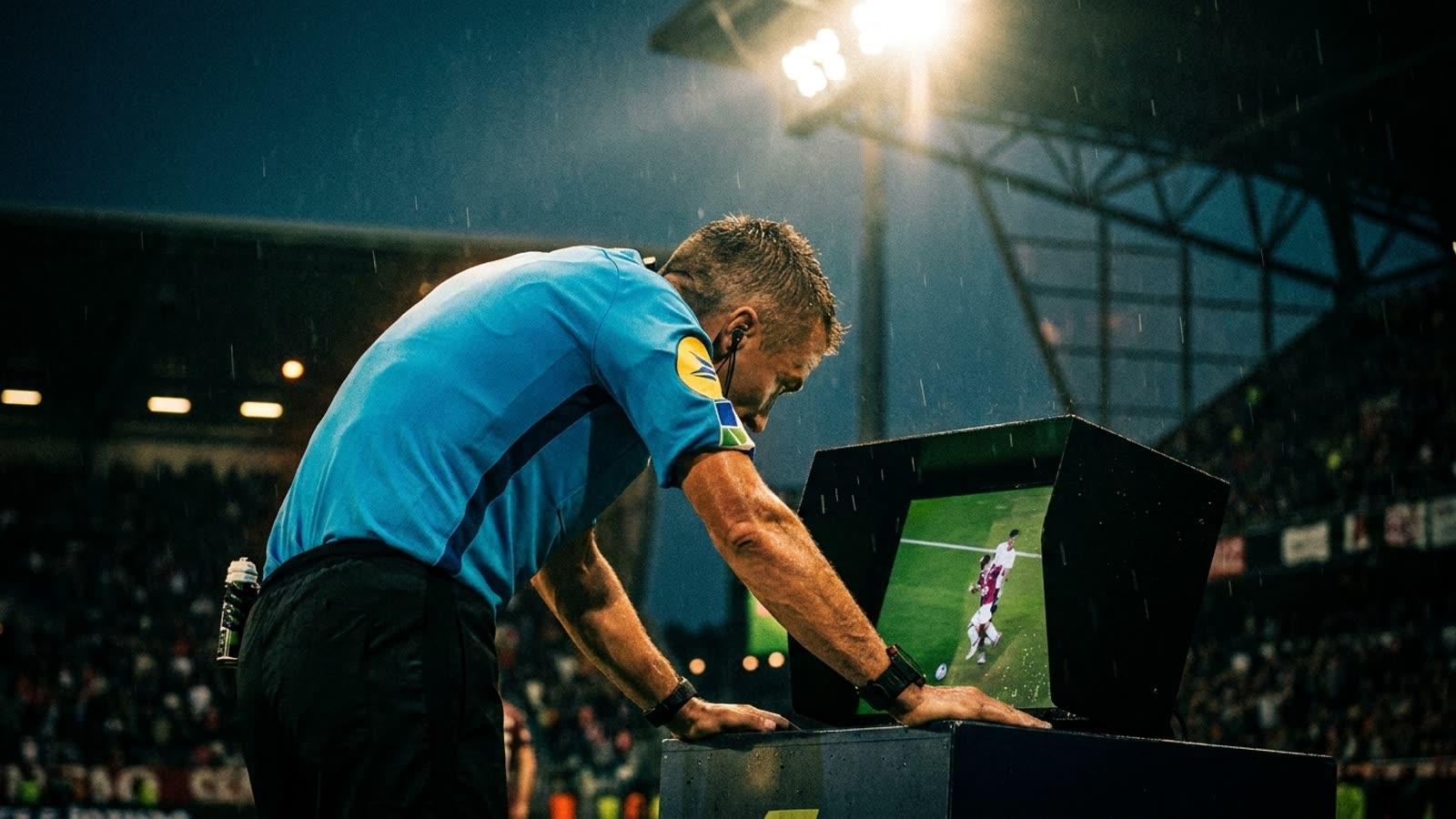
The 4-3 thriller that ended Mexico's World Cup campaign will be remembered for Harry Kane's nerveless penalty and the sheer volume of goals, but the match's lasting contribution to football discourse may be its two-act demonstration of VAR's fundamental contradiction: the technology is brilliant at seeing what happened and mediocre at deciding what it means.
Jarell Quansah's 67th-minute red card and Kane's converted spot-kick in the 82nd arrived via the same process—referee consultation with the video booth—yet they represent opposite poles of officiating confidence. One was a clear correction of a missed foul; the other was a judgment call that VAR can surface but never truly resolve.
The Quansah decision: VAR doing what it does best
The Liverpool defender's challenge on Hirving Lozano was initially shown yellow. Replays made the contact look worse: studs up, above the ankle, late. The on-field referee, after a monitor review, upgraded to red. This is the system working as designed—catching clear and obvious errors in factual assessment. Did the studs make contact? Yes. Was it dangerous? The slow-motion evidence was damning.
Critics who wanted Quansah spared argue context: England were already trailing, the game was stretched, Lozano sold the contact. But VAR's mandate is not to weigh competitive stakes. It exists to ensure the referee sees what the cameras saw. By that standard, the red was correct. The original yellow was the error.
The penalty: where video evidence ends and philosophy begins
Kane's spot-kick originated from a tangle in the box involving Edson Álvarez and Bukayo Saka. Contact occurred—it always does in a crowded penalty area. The question was whether Álvarez's arm impeded Saka's run or whether Saka initiated the collision. VAR showed the referee multiple angles. The referee pointed to the spot.
This is where the technology's limitations become structural rather than technical. More cameras and higher frame rates cannot answer the question "was that enough contact to warrant a penalty?" because that question is irreducibly interpretive. VAR can confirm contact existed; it cannot legislate how much contact is too much. Different referees, reviewing identical footage, will reach different conclusions—and both can be defensible.
FIFA's protocol instructs officials to overturn only "clear and obvious" errors, but the phrase does no work in situations where reasonable people disagree. The penalty call was not obviously wrong. It was not obviously right either. It was a coin flip dressed in procedural legitimacy.
The permanence of the problem
Seven years after VAR's World Cup debut, the pattern is consistent: the system excels at offsides, handballs with geometric clarity, and missed red-card fouls. It struggles with the soft penalties, the theatrical dives, the "was there enough contact" debates that constitute football's gray zone. This is not a bug awaiting a patch. It is the inherent boundary between observation and judgment.
England benefited on both counts against Mexico—the red card swung momentum, the penalty sealed the win. Whether justice was served depends entirely on which angles you trust and which interpretive framework you bring. VAR provided the footage. The argument continues without it.
Our take
VAR will never satisfy because football wants technology to deliver certainty in a sport built on ambiguity. The Quansah red was correct and still felt harsh; the Kane penalty was plausible and still felt soft. Both outcomes were defensible, which is another way of saying neither was inevitable. The system has made refereeing more accurate at the margins and more contested at the core. That trade-off is permanent. Anyone waiting for VAR to eliminate controversy is waiting for football to become a different game.