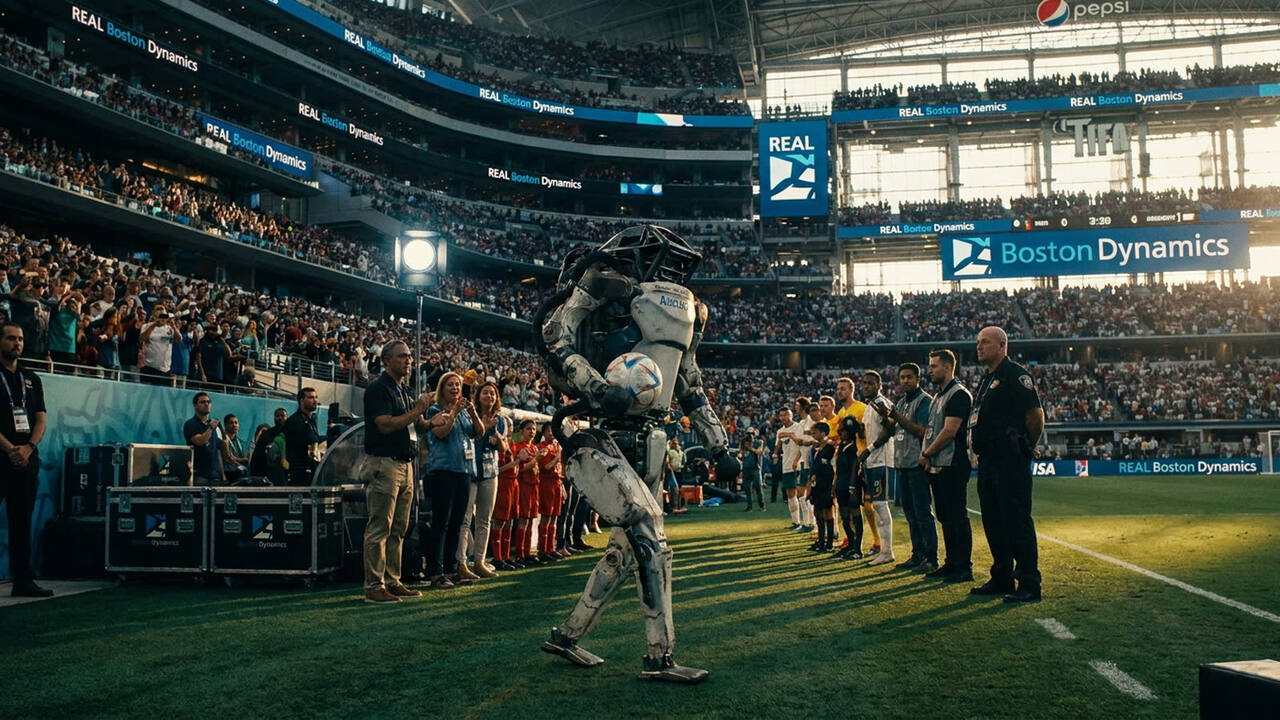
The 2026 World Cup will be remembered for Norway's fairytale run, for Haaland's thunderbolts, for the Trump-Balogun controversy. But the image that may define this tournament's place in cultural history is a bipedal machine striding across the turf in Arlington, Texas, cradling a football like a waiter presenting a bottle of wine.
Boston Dynamics' Atlas—the humanoid robot that spent years tumbling through viral videos of parkour and warehouse work—made its global sporting debut this week, delivering the official match ball before a round-of-sixteen fixture. The crowd at AT&T Stadium offered a mix of cheers and nervous laughter. FIFA offered no apology. The future, it seems, has learned to walk.
The choreography of spectacle
FIFA has long understood that the World Cup sells more than football; it sells moments. The opening ceremonies, the celebrity ambassadors, the carefully curated nostalgia of retired legends carrying trophies—all of it is theater designed to justify the billions in broadcast rights. Atlas fits neatly into this tradition, except that it also happens to represent a $150 billion robotics industry racing toward commercial viability.
Boston Dynamics, now owned by Hyundai, has spent years searching for a use case that matches Atlas's viral fame. Warehouse logistics proved less cinematic than backflips. But a global audience of billions, watching a machine perform a simple human task with eerie grace? That is marketing no Super Bowl ad could buy.
Why this feels different
Robots have appeared at sporting events before—drones at Olympic ceremonies, mechanical mascots at Japanese baseball games. But Atlas occupies uncanny territory. It walks like a person. It balances like a person. It hands over an object with something approaching deliberation. The cognitive dissonance is the point: we know it is a machine, yet our brains insist on reading intention into its movements.
This is the threshold that roboticists and AI researchers have been warning about and promising in equal measure. Not artificial general intelligence, not the singularity—just a machine competent enough at human motion that we instinctively anthropomorphize it. The World Cup, with its universal audience and emotional stakes, was the perfect stage to normalize that dissonance.
Our take
Atlas delivered a ball. It did not score a goal, coach a team, or replace a referee. But the symbolism was unmistakable: humanoid robots have graduated from research labs to prime-time spectacle, and the sports-industrial complex is eager to accelerate the introduction. Whether this is thrilling or unsettling depends on your disposition toward technological change. What it is not is ignorable. FIFA just showed two billion people what the next decade looks like, and it walks on two legs.